Student-built satellite to prepare NASA instrument
Oct 26, 2011
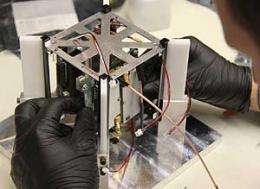
The M-Cubed CubeSat mini-satellite, built by Michigan students, will be used to test high resolution camera hardware for a future NASA Earth science mission. Credit: The Michigan Exploration Lab.

(PhysOrg.com) -- When the M-Cubed satellite, built by University of Michigan students, goes into orbit, it will become the first CubeSat to test a NASA instrument for major space missions. It is scheduled to be launched on Oct. 28.

A is cubic mini-satellite, about four inches per side, with a mass of no more than 3 pounds. CubeSats take little time to design, are inexpensive to build and can be launched as secondary payloads in standardized pods that attach easily to the launch vehicles. These characteristics make CubeSats an inexpensive, efficient way to test space-flight components and software for subsequent major .

James Cutler, an assistant professor in the U-M departments of and Atmospheric, Oceanic and Space Sciences, said that CubeSat technology is "raising the readiness level so that future missions can have confidence in their ability to perform in orbit."

NASA selected M-Cubed to evaluate and certify the Virtex-5 Field-Programmable Gate Array, a new instrument designed to process images taken by a multi-directional, multi-wavelength camera that has been under development at NASA's Jet Propulsion Laboratory. One of the missions the camera will be used on is the Aerosol-Cloud-Ecosystem (ACE) mission, which will take high-resolution images of the Earth. The mission is slated to launch between 2013 and 2016.

M-Cubed will be accompanied by a second University of Michigan student-built satellite, RAX-2, which will study irregularities in the density of plasma in the ionosphere.

Students in the U-M Student Space Systems Fabrication Lab (S3FL) used hardware purchased in local retail stores to build much of M-Cubed.

The students were equally frugal in the development of RAX-2, using spare parts from its forerunner, RAX-1, to build major components. The RAX device is a stack of three CubeSat units, making it about a foot high and about four inches square at the base. Using one-unit CubeSats to build larger satellites, such as the three-unit RAX, has accelerated production dramatically.

The upcoming mission is part of the third NASA Educational Launch of Nanosatellites (ELaNa) project. M-Cubed is the first CubeSat funded through the Advanced Technology Initiative in NASA's Earth Science Technology Office. The RAX project has been and continues to be a joint venture between the University of Michigan and SRI International, and is the first CubeSat program sponsored by the National Science Foundation. SRI is an independent nonprofit research and development organization.

If the Delta II launch vehicle performs as it should, the mission will mark the first successful launch of CubeSats by a NASA vehicle.

The Student Space Systems Fabrication Lab (S3FL) is a U-M student organization that expands the classroom experience by giving students hands-on experience with the design, analysis, fabrication, integration and operation of functional flight vehicles and space payloads. Each year, more than a hundred undergraduate and graduate students participate in S3FL activities that cross a range of activities, such as microgravity experiments and nanosatellite design-build-test projects that enable students to develop quickly in ways that would otherwise take years of post-graduate work.

Explore further: NASA head views progress on asteroid lasso mission

More information: www.umcubed.org/ , exploration.engin.umich.edu/

add to favorites email to friend print save as pdf

Related Stories

Student-built satellite scheduled for launch

Sep 08, 2010

(PhysOrg.com) -- A 6.5-pound satellite is scheduled to become the first stand-alone spacecraft built by Michigan students to go into orbit and perform a science mission.

Student-built satellite selected for flight by NASA

Jan 27, 2010

A tiny communications satellite designed and built by University of Colorado at Boulder undergraduates has been selected as one of three university research satellites to be launched into orbit in November ...

NASA ejects nanosatellite from microsatellite in space

Dec 07, 2010

(PhysOrg.com) -- On Dec. 6 at 1:31 a.m. EST, NASA for the first time successfully ejected a nanosatellite from a free-flying microsatellite. NanoSail-D ejected from the Fast, Affordable, Science and Technology ...

Recommended for you

NASA head views progress on asteroid lasso mission

10 hours ago

Surrounded by engineers, NASA chief Charles Bolden inspected a prototype spacecraft engine that could power an audacious mission to lasso an asteroid and tow it closer to Earth for astronauts to explore.

Ecuador satellite collides with Russian space junk

10 hours ago

A small Ecuadoran satellite collided in orbit with the remains of a Russian rocket, but it is too soon to know how much damage it might have sustained, Quito's space agency said Thursday.

Forecast for Titan: Wild weather could be ahead

May 22, 2013

(Phys.org) —Saturn's moon Titan might be in for some wild weather as it heads into its spring and summer, if two new models are correct. Scientists think that as the seasons change in Titan's northern hemisphere, ...

SDO observes mid-level solar flare

May 22, 2013

UPDATE 16:30 p.m. EDT: The M7-class flare was also associated with a coronal mass ejection or CME, another solar phenomenon that can send billions of tons of particles into space. While this CME was not Ea ...

User comments : 0

More news stories

A hidden population of exotic neutron stars

(Phys.org) —Magnetars – the dense remains of dead stars that erupt sporadically with bursts of high-energy radiation - are some of the most extreme objects known in the Universe. A major campaign using ...

Hubble reveals the ring nebula's true shape

(Phys.org) —The Ring Nebula's distinctive shape makes it a popular illustration for astronomy books. But new observations by NASA's Hubble Space Telescope of the glowing gas shroud around an old, dying, ...

NASA head views progress on asteroid lasso mission

Surrounded by engineers, NASA chief Charles Bolden inspected a prototype spacecraft engine that could power an audacious mission to lasso an asteroid and tow it closer to Earth for astronauts to explore.

Controlling mood through the motions of mitochondria

(Medical Xpress)—Regulating the distribution of power in neurons is done by a system that makes the national electric grid look simple by comparison. Each neuron has several thousand mitochondria confined ...

A quantum simulator for magnetic materials

Physicists understand perfectly well why a fridge magnet sticks to certain metallic surfaces. But there are more exotic forms of magnetism whose properties remain unclear, despite decades of intense research. ...