SLAC software developer discusses physics simulation tool to make cancer therapy safer
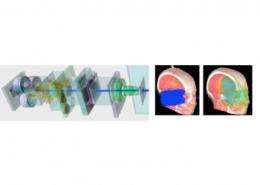
Geant4 simulates for medical physicists how particles travel through a proton delivery device (at left) and into the patient. The rightmost panel represents a computer model of the location and levels of radiation delivery. Image by Jan Schuemann/TOPAS Collaboration
Tiny particles are making a big difference in the world of cancer therapy. And SLAC physicistsexperts in particle transportare using computer simulations to make those therapies safer.
At the Oct. 10 SLAC Colloquium, the lab's own Joseph Perl described how he and his colleagues are turning the simulation toolkit Geant4 into a powerful application for medical physicists. Originally designed to track subatomic particles in high-energy physics experiments, Geant4 can also map proton paths through patients' bodies during radiation treatment.
In radiation treatment, subatomic particles inflict DNA damage on dividing cellsboth healthy and cancerouscausing them to commit suicide. The technique works because rapidly growing cancer cells are more likely to be dividing at any given time, and thus are more likely to be killed; but a smaller proportion of healthy cells are also susceptible to damage.
Minimizing collateral damage is a tough problem for medical physicists who design radiation treatments.
To perfect this stuff, what we have to understand really is where are the particles going? Perl said. We have to understand particle transport when we're designing the medical linacs, the accelerators that deliver the particles to patients. We have to understand particle transport when we're talking about how the beams actually penetrate the body.
Computer simulation tools such as EGS4, developed at SLAC in the 1970s, have helped medical physicists predict the behavior of X-rays and gamma rays. Now, Geant4 offers the ability to model proton beams, too. Perl is one of five people at SLAC developing tools for this up-and-coming cancer therapy; they constitute the second-largest team in the international Geant4 collaboration.
In contrast to the X-ray beams used in traditional therapies, which go all the way through the body, proton beams dump their energy at a specific depth. Medical physicists can target a tumor at one depth and avoid deeper and shallower tissues by tweaking the energy levels of one or more beams. Proton beam therapy may be particularly useful in children, for whom stray radiation can stunt growth and cause secondary cancers in adulthood.
Geant 4 relies on a technique called Monte-Carlo simulation, which models each proton moving through the body in a series of random steps. At each step, the program essentially casts a die to guess where the particle will move next. Over many steps, the program shows where protons are most likely to end up.
Unlike many other tools, Geant4 can also simulate the effect of tissues, such as the rib bones, that may move in and out of the proton beam as a patient breathes. Such obstructions can block some radiation from the intended target, while simultaneously allowing some tissue to soak up unnecessary radiation. Geant4 can potentially help medical physicists program beams to track a moving target and deliver a constant dosage to the tumor.
Geant4 is freely available to anyone who wants to use it, but in its current form may be challenging to some novices. Its a really fancy techno-Lego kit, said Perl, but the box does not come with any ready-made toys.
To address this problem, SLACs Geant4 team has joined Massachusetts General Hospital and the University of California-San Francisco, in a four-year collaboration funded by the National Institutes of Health. The project, headed by Perl, will help medical physicists customize their simulations without disrupting the programs innermost workings.
If we can make it easier for people to use, Perl said, the more likely they are to use things right.
Provided by
SLAC National Accelerator Laboratory
-
From lemons to lemonade: Reaction uses carbon dioxide to make carbon-based semiconductor,
32 comments
-
Thioridazine kills cancer stem cells in human while avoiding toxic side-effects of conventional cancer treatments,
3 comments
-
SpaceX private rocket blasts off for space station (Update),
42 comments
-
Climate scientists say they have solved riddle of rising sea,
31 comments
-
SpaceX capsule has 'new car' smell, astronauts say (Update),
3 comments
-
Water flow question
3 hours ago
-
[Drift velocity] Factors affecting velocity
6 hours ago
-
does cold gasoline have less energy
7 hours ago
-
distribution of molecules throughout the atmosphere
9 hours ago
-
The Global Positioning System !
10 hours ago
-
A Question relating Power
11 hours ago
- More from Physics Forums - General Physics
More news stories
Is a classical electrodynamics law incompatible with special relativity?
(Phys.org) -- The laws of classical electromagnetism that were developed in the 19th century are the same laws that scientists use today. They include Maxwell’s four equations along with the Lorentz la ...
Landmark calculation clears the way to answering how matter is formed
(Phys.org) -- An international collaboration of scientists, including Thomas Blum, associate professor of physics, is reporting in landmark detail the decay process of a subatomic particle called a kaon ...
May 25, 2012 |
4.3 / 5 (22) |
51
|
Lying in wait for WIMPs: Researchers seek to dramatically increase sensitivity of Large Underground Xenon detector
Although it's invisible, dark matter accounts for at least 80 percent of the matter in the universe. No one knows what it is, but most scientists would bet on weakly interacting massive particles, or WIMPs.
May 23, 2012 |
4 / 5 (7) |
15
|
Hawaii lab turns laser-powered bubbles into microrobots
(Phys.org) -- A team of scientists from the University of Hawaii are working on microrobots created from bubbles of air in a saline solution. The bubbles take on their title of robots as a laser ...
Sound increases the efficiency of boiling
Scientists at the Georgia Institute of Technology achieved a 17-percent increase in boiling efficiency by using an acoustic field to enhance heat transfer. The acoustic field does this by efficiently removing vapor bubbles ...
May 24, 2012 |
5 / 5 (2) |
2
'Unzipped' carbon nanotubes could help energize fuel cells, batteries
Multi-walled carbon nanotubes riddled with defects and impurities on the outside could replace some of the expensive platinum catalysts used in fuel cells and metal-air batteries, according to scientists at ...
T cells 'hunt' parasites like animal predators seek prey, study shows
By pairing an intimate knowledge of immune-system function with a deep understanding of statistical physics, a cross-disciplinary team at the University of Pennsylvania has arrived at a surprising finding: T cells use a movement ...
Computer model used to pinpoint prime materials for efficient carbon capture
When power plants begin capturing their carbon emissions to reduce greenhouse gases and to most in the electric power industry, it's a question of when, not if it will be an expensive undertaking.
Change in developmental timing was crucial in the evolutionary shift from dinosaurs to birds: study
At first glance, it's hard to see how a common house sparrow and a Tyrannosaurus Rex might have anything in common. After all, one is a bird that weighs less than an ounce, and the other is a dinosaur that ...
Yale study concludes public apathy over climate change unrelated to science literacy
Are members of the public divided about climate change because they don't understand the science behind it? If Americans knew more basic science and were more proficient in technical reasoning, would public consensus match ...
Same gene that stunts infants' growth also makes them grow too big: research
UCLA geneticists have identified the mutation responsible for IMAGe* syndrome, a rare disorder that stunts infants' growth. The twist? The mutation occurs on the same gene that causes Beckwith-Wiedemann syndrome, which makes ...