Computer scientist cracks mysterious 'Copiale Cipher'
October 25, 2011

Computer scientist cracks mysterious 'Copiale Cipher'

Enlarge

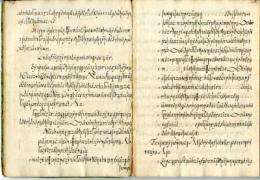
These are pages from the "Copiale Cipher," a mysterious cryptogram, bound in gold and green brocade paper, that was finally cracked by an international team of cryptographers. Credit: Courtesy University of Southern California and Uppsala University

The manuscript seems straight out of fiction: a strange handwritten message in abstract symbols and Roman letters meticulously covering 105 yellowing pages, hidden in the depths of an academic archive.

Now, more than three centuries after it was devised, the 75,000-character "Copiale Cipher" has finally been broken.

The mysterious cryptogram, bound in gold and green brocade paper, reveals the rituals and political leanings of a 18th-century secret society in Germany. The rituals detailed in the document indicate the secret society had a fascination with eye surgery and , though it seems members of the secret society were not themselves eye doctors.

"This opens up a window for people who study the history of ideas and the history of secret societies," said computer scientist Kevin Knight of the USC Viterbi School of Engineering, part of the international team that finally cracked the Copiale Cipher. " believe that secret societies have had a role in revolutions, but all that is yet to be worked out, and a big part of the reason is because so many documents are enciphered."

To break the Copiale Cipher, Knight and colleagues Beáta Megyesi and Christiane Schaefer of Uppsala University in Sweden tracked down the original manuscript, which was found in the East Berlin Academy after the Cold War and is now in a private collection. They then transcribed a machine-readable version of the text, using a computer program created by Knight to help quantify the co-occurrences of certain symbols and other patterns.

"When you get a new code and look at it, the possibilities are nearly infinite," Knight said. "Once you come up with a hypothesis based on your intuition as a human, you can turn over a lot of grunt work to the computer."

With the Copiale Cipher, the codebreaking team began not even knowing the language of the encrypted document. But they had a hunch about the Roman and Greek characters distributed throughout the manuscript, so they isolated these from the abstract symbols and attacked it as the true code.

"It took quite a long time and resulted in complete failure," Knight says.

After trying 80 languages, the cryptography team realized the Roman characters were "nulls," intended to mislead to reader. It was the abstract symbols that held the message.

The team then tested the hypothesis that abstract symbols with similar shapes represented the same letter, or groups of letters. Eventually, the first meaningful words of German emerged: "Ceremonies of Initiation," followed by "Secret Section."

For more information about the method of decipherment, visit http://stp.lingfil.uu.se/%7Ebea/copiale/

Knight is now targeting other coded messages, including ciphers sent by the Zodiac Killer, a serial murderer who sent taunting messages to the press and has never been caught. Knight is also applying his computer-assisted codebreaking software to other famous unsolved codes such as the last section of "Kryptos," an encrypted message carved into a granite sculpture on the grounds of CIA headquarters, and the Voynich Manuscript, a medieval document that has baffled professional cryptographers for decades.

But for Knight, the trickiest language puzzle of all is still everyday speech. A senior research scientist in the Intelligent Systems Division of the USC Information Sciences Institute, Knight is one of the world's leading experts on machine translation -- teaching computers to turn Chinese into English or Arabic into Korean. "Translation remains a tough challenge for artificial intelligence," said Knight, whose translation software has been adopted by companies such as Apple and Intel.

With researcher Sujith Ravi, who received a PhD in computer science from USC in 2011, Knight has been approaching translation as a cryptographic problem, which could not only improve human language translation but could also be useful in translating languages that are not currently spoken by humans, including ancient languages and animal communication.

More information: The Copiale Cipher work was presented as part of an invited presentation at the 2011 Association for Computational Linguistics meeting.

Provided by University of Southern California search and more info website

4.8 /5 (26 votes)  

Filter


Move the slider to adjust rank threshold, so that you can hide some of the comments.


Display comments: newest first

dschlink
Oct 25, 2011

Rank: 3.7 / 5 (9)
I expect that most fruitful approach will be to build a rigidly defined artificial language and use it as an intermediary between natural languages. This has worked in computer science and modeling.
ABSOLUTEKNOWLEDGE
Oct 25, 2011

Rank: 2.6 / 5 (7)
oh i tghought secret societies are invetion of cospiracy theorist and that they would manipulate revolutions

wow

puff
icecycle66
Oct 25, 2011

Rank: 1 / 5 (4)
Another code for you puzzle junkes.

http://truelibert...age.html
Pirouette
Oct 25, 2011

Rank: 4.2 / 5 (5)
what a fascinating challenge for Knight. Wondering if he can translate the actual language of the ancient Sumerians as to their giant gods and lore that caused Zechariah Sitchin to believe that a planet he called Nibiru was where those gods came from.
210
Oct 25, 2011

Rank: 3 / 5 (3)
The Copiale Cipher, it is visually VERY attractive. But the people who wrote it...appear...to have been like us! They were posting, expressing their desire to share knowledge or opinion on ideas about which they wanted to know more...but...they had to ...hide?? It would appear that the 'miracle' of our age/day is the free flow of knowledge and its ready availability to the masses. WE encode/encrypt/Cipher to protect our identities/and Privileged data from the ever-increasing number of bad people who are always most abundant and well funded...hummm...could they have feared prosecution for pursuing their quest..?
word-to-ya-muthas (This means good bye, when decrypted :-)
GDM
Oct 25, 2011

Rank: 3 / 5 (1)
dschlink: You may be interested in "loglan" which was an artificial language invented in the 50's to try to understand whether languages could inhibit, or vice versa, expand human thinking. It also made a good language for human-computer interaction, although natural language programming has taken the center stage of late. I studied logan for several months and was somewhat astounded by the ways it changed the way I thought about things. Made me a bit pickier about logic and precision in using the english language.
GDM
Oct 25, 2011

Rank: 4 / 5 (2)
...also, it's successor language "lojban"
Jeddy_Mctedder
Oct 25, 2011

Rank: 3.8 / 5 (4)
its a cookbook!!!
Grizzled
Oct 25, 2011

Rank: 3.3 / 5 (4)
I expect that most fruitful approach will be to build a rigidly defined artificial language and use it as an intermediary between natural languages. This has worked in computer science and modeling.

This is an old idea but it runs into an obvious problem: ars you sure there is such a language? Or can be constructed even in principle, nevermind in practice?

Note that even projects in computing that you mention have consistently run into this problem - lack of one-to-ons correspondence between the different language paradigms. And that's in more or less formal, artificial computing languages.

Now throw in the [in]famous Chomsky's hypothesis and you are realt looking for trouble trying to devise such a universal intermediate language.
Au-Pu
Oct 25, 2011

Rank: 3 / 5 (6)
pirouette's posting is the best.
GDM's is interesting.
210 is so far off the mark that it isn't even funny.
There are more secretive groups around now than ever before and sadly most of them are created by paranoid delusionals within our governments. People who, like terrorists, are control freaks and want to make everyone conform to their ideas.
Secrecy is always the tool of those who mean ill to others.
So let us hear it for the decryptors.
omatranter
Oct 26, 2011

Rank: 3.7 / 5 (6)
When they finally decypher the Voynich Manuscript they will realise the effort I have had to undertake to hide my theory of Repulsive Neutron from the dread Illuminati, it is not gibberish that I speak but a very carefully constructed code that makes what ever I say seem the ravings of an compleat Moron. My future self has assured me of my eventual construction of a time travelling vehicle using Repellent Neutronium as it power source, with this conveyance I will seed histories with my "Chron-Retarded" brilliance so that future generations from both our future and past will have the chance to Bathe in my Majestic imbecility.

The power of Neutrons Repels you
210
Oct 26, 2011

Rank: 5 / 5 (2)
A German state in the 1700's would not have been any more 'secure' than Germany in the 1800s, In fact "A striking fact of the German state created in 1871 was its lack of religious unity, which was partly an outcome of the failed national centralization since the Thirty Years War. Whereas rulers in France, Russia, and England had strived toward, and nearly reached, religious homogeneity by siding with one church and persecuting other religions (often with great brutality), the Bismarckian empire contained about one third Catholics and two thirds mostly Lutheran Protestants.
To be sure, religion mattered less in 1871 than in previous centuries, but it still outlined deep cultural differences." Germany has struggled to be a united state until the Berlin Wall fell. European politics was ruled by major powers and the church and those states made the laws legal. In the 19th century, Europeans and Americans were still 'burning witches' and science was heresy! Only the guilds and masons....
210
Oct 26, 2011

Rank: 5 / 5 (2)
Provided SOME shelter for advancing what would stop being Alchemy and sorcery and become real science. No, I suspect these early adherents of science may have feared persecution and dwelled underground. Much as the early Christians in Rome literally lived underground and developed their own signs and insignia. The Christian faith was revolutionary, the admission of science was/is revolutionary and both were persecuted right into Greatness! Secrecy is sometimes necessary: Stalin, Hitler, Saddam, Khaddafi, all tried to destroy both secrecy and privacy by using, a SECRET security element and a PRIVATE police force, duh! Today, in China, the Falung Dong are persecuted and forced underground, their cause is swelling and growing. Those who penned the Copiale Cipher, would be proud of what they see today. Eye glasses, contacts, laser eye surgery, retina and optic nerve implants, soon - eyes repaired by stem cell regeneration. Question science and religion, but, do NOT hate!
word-to-ya-muthas
tadchem
Oct 26, 2011

Rank: 5 / 5 (1)
Kudos to the cryptographers!
The challenge in computerized translation (as is apparent to users of Babelfish) is that 'meaning' requires more than just equivocating words and phrases between two languages. Grammatical structures (as is well known to any student of Latin) can massively complicate meanings, adding layers of subtlety that are best interpreted through a lifelong familiarity with the language.
Even 'translating' spoken English into written English (or vice versa) has its pitfalls. The text cannot carry nuances of verbal inflection, and speech without punctuation often has trouble with complex sentence structures.
Grizzled
Oct 26, 2011

Rank: 5 / 5 (1)
As someone who fluently speaks 3 languages, plus 2 more on the so-so or "passable" level, I will only believe in AI machine translator if and when we can talk and discuss the niceties of the said translation issues without any undue regard to the fact that one of us is a machine.
Jotaf
Oct 29, 2011

Rank: not rated yet
"Computer scientist cracks mysterious 'Copiale Cipher'"

"Viterbi School of Engineering"

I see what you did there...
hush1
Oct 31, 2011

Rank: 5 / 5 (1)
"Translation remains a tough challenge for artificial intelligence," - Knight


You are in need of a psychologist. Not you. Your team. Or any team wishing to write translation software. A psycholinguistic analyst.

The key to any language, encrypted or not, is to know the origin of ALL human languages.

The key to the meaning of ANY word in ANY language comes from the way the human brain and mind handles sound. Yes. Sound.

Sound is the origin of ALL human language. And the way the spoken language, the spoken sound acquires and adheres to associations associated with the human endeavor to represent sounds visually is critical to all translations and deciphering.

You may be an expert. Your paths will always be the longest paths to solutions, (brute force, for example), when you ignore the in concrete unwritten rules governing all human languages.

Congratulations for putting yourselves through the paces that in the future will proved to have not been necessary.
hush1
Oct 31, 2011

Rank: not rated yet
Grizzly
You say "fluent". Who has 'tested' you? Fluent is when literally no one can tell your are more than monolingual - when you speak to the monolinguals of the languages you claim to be "fluent" in.

I refute your claims.
hush1
Oct 31, 2011

Rank: not rated yet
dschlink/Grizzly

The most successful of translations are without an intermediary.
This will take place with a one-to-one correspondence - analogous to methods of Cantor used to compare sets that contain infinite elements.
The human languages, all of them, have sets of finite elements defining them. Simplifying the challenge of perfect translation.
Manhar
Oct 31, 2011

Rank: not rated yet
I heard that tablets they found at the excaveted site of MOHAN JO DERO in northern India are still not decipherd as yet. As Sujith Ravi is part of the team, he may help to locate tablets.
hush1
Oct 31, 2011

Rank: not rated yet
Good. You have easy deciphering. The researchers in the article above will take the longest road to decipher. They will take themselves through the same paces that led to their first success. Using the motto: If it works, why change the method of approach? Sad. The approach justifies the existence of their professions. Which is not in the interest of science.

The 'forensics' at the site of discovery is half of the deciphering story.

Find it within yourselves to forgive the harsh words I have for the research team in the article. They did it their way.
That will be harsh enough on them. There are better, and faster methods and ways of deciphering.
Rank 4.8 /5 (26 votes)
Relevant PhysicsForums posts
  • Ideas to mitigate risk of 911 calls being misdirected
    createdMay 24, 2012
  • Live scribe pen?
    createdMay 10, 2012
  • Shallow water flow simulation
    createdMay 07, 2012
  • Tablet for taking notes?
    createdMay 05, 2012
  • Best fit tablet for me?
    createdMay 05, 2012
  • Measure of Informaton
    createdMay 04, 2012
  • More from Physics Forums - Computing & Technology

More news stories

Browser wars flare in mobile space

The browser wars are heating up again, but this time the fight is for dominance of the mobile Internet.

Technology / Software

created 10 hours ago | popularity 5 / 5 (1) | comments 3

Probability of contamination from severe nuclear reactor accidents is higher than expected: study

Catastrophic nuclear accidents such as the core meltdowns in Chernobyl and Fukushima are more likely to happen than previously assumed. Based on the operating hours of all civil nuclear reactors and the number ...

Technology / Energy & Green Tech

created May 22, 2012 | popularity 3.6 / 5 (22) | comments 56 | with audio podcast

SpotterRF debuts Radar Backpack Kit (w/ Video)

(Phys.org) -- SpotterRF has announced a special radar backpack kit designed to enhance situational awareness for soldiers on the ground. The company says its special radar is designed for warfighters as part ...

Technology / Hi Tech & Innovation

created May 26, 2012 | popularity 5 / 5 (5) | comments 13 | with audio podcast report

HyperSolar shows dirty water no barrier to power world

(Phys.org) -- The Santa Barbara, California, company, HyperSolar, is set to transparently share the ups and downs of its research experiences toward the company’s ultimate vision, successfully producing ...

Technology / Energy & Green Tech

created May 24, 2012 | popularity 4.8 / 5 (16) | comments 17 | with audio podcast report

Tesla to launch electric sedan in US on June 22

Tesla Motors said Tuesday it would begin deliveries of "the world's first premium electric sedan" on June 22, slightly ahead of schedule.

Technology / Energy & Green Tech

created May 22, 2012 | popularity 4.5 / 5 (12) | comments 18


Land and sea species differ in climate change response: study

(Phys.org) -- Marine and terrestrial species will likely differ in their responses to climate warming, new research by Simon Fraser University and Australia’s University of Tasmania has found.

Almost half of new vets seek disability

(AP) -- America's newest veterans are filing for disability benefits at a historic rate, claiming to be the most medically and mentally troubled generation of former troops the nation has ever seen.

'Unzipped' carbon nanotubes could help energize fuel cells, batteries

Multi-walled carbon nanotubes riddled with defects and impurities on the outside could replace some of the expensive platinum catalysts used in fuel cells and metal-air batteries, according to scientists at ...

T cells 'hunt' parasites like animal predators seek prey, study shows

By pairing an intimate knowledge of immune-system function with a deep understanding of statistical physics, a cross-disciplinary team at the University of Pennsylvania has arrived at a surprising finding: T cells use a movement ...

Computer model used to pinpoint prime materials for efficient carbon capture

When power plants begin capturing their carbon emissions to reduce greenhouse gases – and to most in the electric power industry, it's a question of when, not if – it will be an expensive undertaking.

Change in developmental timing was crucial in the evolutionary shift from dinosaurs to birds: study

At first glance, it's hard to see how a common house sparrow and a Tyrannosaurus Rex might have anything in common. After all, one is a bird that weighs less than an ounce, and the other is a dinosaur that ...