Saint Lawrence seaway eels slipping into oblivion

October 21, 2011 by Guillaume Lavallee

The eels of this region reproduce in the Sargasso Sea in the middle of the North Atlantic Ocean

Enlarge

Eels, pictured on October 3, 2011, can be seen in a cage after being caught by fisherman on the shores of the Saint Lawrence River in Kamouraska, Quebec. Researchers and fishers noted a decline in the eel population starting in the 1980s.

Standing in tall rubber boots in mud smeared with gooey algae, Bruno Ouellet tugs on massive nets strewn across the shores of the Saint Lawrence River, hoping to snag just a few eels.

"The fishing isn't good," the 47-year-old says. "In the early 1980s, you could catch 1,000 eels in a cage, but today I've only got three and I have to work just as hard."

For centuries, aboriginals and later French colonists fished eels from the shores of the mighty waterway at Kamouraska, Quebec about 400 kilometers (250 miles) northeast of Montreal.

Then suddenly, the eel population collapsed and only a handful of fishermen are still tending their nets here, from September to October each year.

The eels of this region reproduce in the Sargasso Sea in the middle of the .

The migrate towards Canadian shores where they are fished, or they go on to inland lakes and rivers where they grow into adult eels that eventually return to the waters near Bermuda to start over the cycle.

Researchers and fishers noted a decline in the population starting in the 1980s. "It's a freefall," said Guy Verreault, a biologist with the Quebec ministry of natural resources.

Pollution in the Great Lakes is partly to blame.

"The fishing isn't good," Ouellet says
Enlarge

Bruno Ouellet, 47, is now one of the remaining 14 eel fisherman at the Saint Lawrence River in Kamouraska, Canada. Twenty years ago, fishermen caught up to 400 tonnes of eels per year, but now their annual catch is less than an estimated 40 tonnes.

Also, 12,000 dams and other obstacles were erected along the eels' on the Saint Lawrence River towards the Great Lakes over the years, hindering their reproduction.

"Of the eels that do manage to overcome these obstacles (on their way to freshwater basins inland), 40 percent later die in the hydroelectric turbines on their way back to the ," Verreault said.

Twenty years ago, fishermen caught up to 400 tonnes of eels per year, but now their annual catch is less than 40 tonnes, he estimated.

The odorous, fatty white meat was smoked and exported to Germany and Japan. But nowadays, the lean harvest is mostly sold to Chinatowns in North America.

The government of Quebec in 2009 bought back most of the eel fishing permits issued over past decades, in an effort to prevent a total collapse of the fishery.
Pollution in the Great Lakes is partly to blame for the decline in eel population
Enlarge

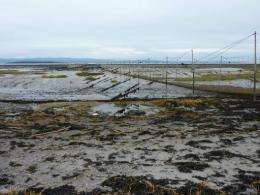
An eel net can be seen at low tide on the Saint-Lawrence River banks. According to Canadian government statistics, the number of young eels entering inland lakes and rivers through the Saint Lawrence has dropped to less than three percent of the numbers recorded in the 1980s.

Today, there are just 14 licensed eel fishers in these parts, including Gertrude Madore, a 75-year-old redhead who was the first and maybe the last woman to be licensed by the province.

In the past, fishermen would cross the muddy beach on horseback to bring the eels back to their village. "There were spots where the horses got stuck so we had to haul the eels out in sacks on our backs; they would wiggle and we'd fall face first into the sludge," Madore recalled.

"Today we have tractors, but there are no more eels," she said.

According to Canadian government statistics, the number of young eels entering inland lakes and rivers through the Saint Lawrence has dropped to less than three percent of the numbers recorded in the 1980s.

During the same period, the population has remained stable in other North American coastal waters.

Biologist Louis Bernatchez of Laval University in Quebec City believes the divergence in the population numbers inland and in coastal waters in North America may be due to genetic changes.

"It takes an eel with specific genetic qualities to make it to the upper Saint Lawrence river," he explained. "Generations of eels were crushed in electric turbines, and so these (robust) qualities are less present among this population."

"If it continues, the eel will disappear from these parts," he said.

Biologists say if it can be done it will take 25 to 30 years for the eel population to bounce back in these waters.

On the shores of the Saint Lawrence River, the last eel fishers tend their nets, breathing in the salt air blowing from the ocean and listening to geese squawking above as they begin their annual migration south for the winter.

"My children and my grandchildren will continue to fish. One day, things will change back to the way they were," Madore said hopefully.

(c) 2011 AFP


Rank not rated yet
Relevant PhysicsForums posts

More news stories

Manufacturing genes to attack flu virus

An international research team has manufactured a new protein that can combat deadly flu epidemics.

Biology / Biotechnology

created 2 hours ago | popularity not rated yet | comments 0 | with audio podcast

Scientist: Evolution debate will soon be history

(AP) -- Richard Leakey predicts skepticism over evolution will soon be history. Not that the avowed atheist has any doubts himself.

Biology / Evolution

created 21 hours ago | popularity 3.5 / 5 (20) | comments 81

More plant species responding to global warming than previously thought

(Phys.org) -- Far more wild plant species may be responding to global warming than previous large-scale estimates have suggested.

Biology / Ecology

created May 22, 2012 | popularity 4.6 / 5 (14) | comments 18 | with audio podcast

Thousands of shellfish found dead in Peru

Thousands of crustaceans were found dead off the coast of Lima following the mystery mass death of dolphins and pelicans, the Peruvian Navy said Friday.

Biology / Ecology

created May 26, 2012 | popularity 4.8 / 5 (5) | comments 7

For monogamous sparrows, it doesn't pay to stray (but they do it anyway)

It's quite common for a female song sparrow to stray from her breeding partner and mate with the male next door, but a new study shows that sleeping around can be costly.

Biology / Plants & Animals

created May 22, 2012 | popularity 5 / 5 (2) | comments 8 | with audio podcast


Land and sea species differ in climate change response: study

(Phys.org) -- Marine and terrestrial species will likely differ in their responses to climate warming, new research by Simon Fraser University and Australia’s University of Tasmania has found.

Almost half of new vets seek disability

(AP) -- America's newest veterans are filing for disability benefits at a historic rate, claiming to be the most medically and mentally troubled generation of former troops the nation has ever seen.

'Unzipped' carbon nanotubes could help energize fuel cells, batteries

Multi-walled carbon nanotubes riddled with defects and impurities on the outside could replace some of the expensive platinum catalysts used in fuel cells and metal-air batteries, according to scientists at ...

T cells 'hunt' parasites like animal predators seek prey, study shows

By pairing an intimate knowledge of immune-system function with a deep understanding of statistical physics, a cross-disciplinary team at the University of Pennsylvania has arrived at a surprising finding: T cells use a movement ...

Computer model used to pinpoint prime materials for efficient carbon capture

When power plants begin capturing their carbon emissions to reduce greenhouse gases – and to most in the electric power industry, it's a question of when, not if – it will be an expensive undertaking.

Change in developmental timing was crucial in the evolutionary shift from dinosaurs to birds: study

At first glance, it's hard to see how a common house sparrow and a Tyrannosaurus Rex might have anything in common. After all, one is a bird that weighs less than an ounce, and the other is a dinosaur that ...