T. rex was bigger than thought: study
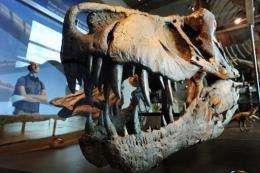
The iconic T. rex dinosaur grew bigger and faster than previously estimated, according to new methods based on actual skeletons instead of scale models, British and US scientists said Wednesday.
In a new study just published in the journal PLoS One, a team of scientists led by Professor John R. Hutchinson of The Royal Veterinary College, London, and Peter Makovicky, PhD, curator of dinosaurs at The Field Museum of Natural History in Chicago applied cutting edge technology and computer modeling to "weigh" five Tyrannosaurus rex specimens, including The Field Museum's iconic SUE skeleton. Their results reveal that T. rex grew more quickly and reached significantly greater masses than previously estimated.
In a departure from earlier methods, the new study uses mounted skeletons to generate body mass estimates. Makovicky notes, "Previous methods for calculating mass relied on scale models, which can magnify even minor errors, or on extrapolations from living animals with very different body plans from dinosaurs. We overcame such problems by using the actual skeletons as a starting point for our study."
The team used 3D laser scans of mounted skeletons as a template for generating fleshed-out digital models whose masses could then be computed. The laser scans are accurate to less than half an inch for skeletons that are up to 40 feet long. Digital body cross-sections were reconstructed along the length of each skeleton using the relationships of the soft tissues to skeletons in birds and crocodiles as a guide. A digital skin was then overlaid to generate a body volume, whose mass was calculated after empty spaces such as lungs and the mouth cavity were modeled and subtracted.
In order to appreciate the uncertainty involved in estimating how much flesh would wrap the skeleton of an extinct animal, body sections (e.g. head, neck, torso, legs, tail) were modeled individually at three levels of "fleshiness." The three versions of each body segment were combined in different ways to generate a range of whole body models with varying masses.
"These models range from the severely undernourished through the overly obese, but they are purposely chosen extremes that bound biologically realistic values" says study co-author Dr. Vivian Allen of the Royal Veterinary College. "The real advantage to our method is that the models can be adjusted to accommodate the variation that is inherent in nature, so we don't have to pick an arbitrary result, but rather deal with more meaningful ranges of results," adds co-author Dr. Karl T. Bates of the University of Liverpool.
Calculating the masses of the resulting virtual T. rex herd yielded some exciting surprises. For instance, T. rex appears to have been significantly heavier than previously believed. The Field Museum's SUE skeleton, which is the largest and most complete T. rex skeleton known, weighed in at over nine tons. "We knew she was big but the 30 percent increase in her weight was unexpected." says Makovicky.
The fleshier models for SUE range even higher in body mass, though this is likely an effect of how the skeleton was reconstructed. "SUE's vertebrae were compressed by 65 million years of fossilization, which forced a more barrel-chested reconstruction" says Makovicky. But he thinks that the new weight estimates will not be affected much by correcting for this. "Nine tons is the minimum estimate we arrived at using a very skinny body form, so even if we made the chest smaller, adding a more realistic amount of flesh would make up for the weight," he explains.
SUE was also larger than the other specimens when individual body segments were compared, but Makovicky is not surprised by that result. "We often hear about new T. rex discoveries that rival SUE in some select measurement, but body size is a three-dimensional parameter and SUE is much more robust than other known skeletons," he says.
The new mass estimates also alter understanding of T. rex biology. The higher mass estimates for the larger specimens and a lower one for the smallest individual indicate even faster growth than was proposed in a landmark study just five years ago.
According to lead author Hutchinson, "We estimate they grew as fast as 3,950 pounds per year (1790 kg) during the teenage period of growth, which is more than twice the previous estimate."
Although a staggering number, it is in keeping with growth rate calculations for other dinosaurs. "Our new growth rate value actually erases a deficit between the previous growth rate estimate and what is expected for a dinosaur of this size," adds Makovicky.
The rapid growth to gargantuan size came at the cost of speed and agility, according to the study, which concluded that the locomotion of this giant biped slowed as the animal grew. This is because its torso became longer and heavier while its limbs grew relatively shorter and lighter, shifting its center of balance forward.
Hutchinson adds, "The total limb musculature of an adult T. rex probably was relatively larger than that of a living elephant, rhinoceros, or giraffe, partly because of its giant tail and hip muscles. Yet the muscles of the lower leg were not as proportionately large as those of living birds, and those muscles seem to limit the speed at which living animals can run. Our study supports the relative consensus among scientists that peak speeds around 10-25 miles per hour (17-40 kph) were possible for big tyrannosaurs."
These locomotory insights come from detailed modelling of some of the major hindlimb muscles and estimates of total muscle mass in the legs calculated by subtracting the volume of bones from the modelled leg volumes.
"Such analytical details underscore the value of working with complete specimens," says Makovicky. "T. rex represents a biological extreme because it's one of the largest bipeds that ever lived. Putting numbers on that requires access to the dimensions of whole skeletons and their individual parts. For completeness and abundance, no other large predatory dinosaur can match T. rex."
Acquiring data for these specimens was a challenging task, and in the case of SUE, required four instruments that use light or X-ray technology, and the generosity and collaboration of some unlikely partners. The forensics unit of the Chicago Police Department provided laser surface scans of SUE, which were supplemented with scans of individual bones generated at the Loyola University Medical Center outpatient CT facility at Maywood, Illinois. Parts that were too large to fit in a medical scanner were scanned by Ford Motor Co. in Livonia, Michigan, and Cubic-Vision in Deerfield, Illinois. Scan coordination and data processing was handled by Ralph Chapman and Linda Deck at New Mexico Virtualization, LLC, Los Alamos and Art Andersen, president of Virtual Surfaces Inc, based in Glenview, Illinois.
Makovicky was thrilled to see how Chicago-area institutions came together around the project. "SUE has become an icon of our city and it was fantastic to work with so many organizations and people as part of this process. The enthusiasm and generosity of everyone involved was incredible," he says.
Provided by Field Museum


