Rendezvous with a near Earth object
Oct 25, 2011
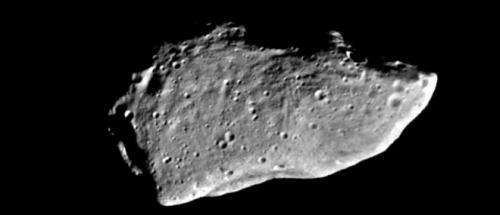
An image of the asteroid Gaspra, which is about 16 kilometers in its longest dimension. A new paper discusses the importance of finding most of the near earth asteroids, of which today only an estimated 10% are known. Credit: NASA GSFC

(PhysOrg.com) -- One of the most accessible goals for human spaceflight is a rendezvous with a Near Earth Object (NEO). NEOs are asteroids or comets whose orbits take them close to the earth's orbit. An NEO might someday collide with the earth -- and there are almost 6000 larger in diameter than about 100 meters known, with predictions that over ten times as many could exist. The impact of even a one-kilometer-sized NEO would probably destroy an average state, and this is certainly one reason to study them. From the perspective of pure science, NEOs are important nearby representatives of the early Solar System.

A manned mission to an NEO is now under study at NASA. considerations provide an additional reason to study them. In futuristic scenarios, when they are close by their resources can be mined for spacecraft use (propellant, life support, construction materials) or commercial use. Of course such a mission would want to aim for an NEO that is (at the time of the rendezvous) fairly close to the Earth, and to minimize the fuel needed, one that is not moving too fast with respect to the Earth. This accessible class of NEOs, however, is very difficult to detect. Because their orbits are very Earth-like, their motions are very similar to the Earth's. Hence, most of the time they are in the daytime sky, not in the Earth's night shadow, and therefore they are hard to spot. Only about sixty-five are now known, leaving NASA with only a modest-sized sample from which to select characteristics of interest, like composition.

CfA astronomers Martin Elvis, and Jonathan McDowell, together with two colleagues, review the case for visiting an accessible NEO, and summarize the statistics. They estimate from NEO research that there are probably ten times as many of these accessible NEOs still to be discovered, and argue that a dedicated survey looking for them should be a NASA priority. Not only would it help identify the site of a potential future astronaut visit, such a study would also increase our understanding of NEO characteristics in general, as we use them as tracers of the conditions in the .

Explore further: Nine-year-old Mars rover passes 40-year-old record

add to favorites email to friend print save as pdf

Related Stories

Visiting an asteroid

Dec 17, 2010

Asteroids (or comets) whose orbits bring them close to the earth's orbit are called Near Earth Objects (NEOs). Some asteroids are old, dating from the origins of the solar system about four and one-half billion ...

Sizes for potentially dangerous asteroids

Aug 27, 2010

Near Earth Objects (NEOs) are asteroids or comets whose orbits sometimes take them close to the earth's orbit. An NEO could therefore someday collide with the earth -- and there are almost 7000 of them known, ...

NASA's NEOWISE completes scan for asteroids and comets

Feb 01, 2011

(PhysOrg.com) -- NASA's NEOWISE mission has completed its survey of small bodies, asteroids and comets, in our solar system. The mission's discoveries of previously unknown objects include 20 comets, more ...

Recommended for you

Mars rover Opportunity examines clay clues in rock

1 hour ago

(Phys.org) —NASA's senior Mars rover, Opportunity, is driving to a new study area after a dramatic finish to 20 months on "Cape York" with examination of a rock intensely altered by water.

NASA's STEREO detects a CME from the sun

15 hours ago

On 5:24 a.m. EDT on May 17, 2013, the sun erupted with an Earth-directed coronal mass ejection or CME, a solar phenomenon that can send billions of tons of solar particles into space that can reach Earth ...

Nine-year-old Mars rover passes 40-year-old record

23 hours ago

While Apollo 17 astronauts Eugene Cernan and Harrison Schmitt visited Earth's moon for three days in December 1972, they drove their mission's Lunar Roving Vehicle 19.3 nautical miles (22.210 statute miles ...

Bright explosion on the Moon

May 17, 2013

For the past 8 years, NASA astronomers have been monitoring the Moon for signs of explosions caused by meteoroids hitting the lunar surface. "Lunar meteor showers" have turned out to be more common than anyone ...

User comments : 1

Adjust slider to filter visible comments by rank

Display comments: newest first

dirk_bruere
not rated yet Oct 25, 2011
It should be obvious to everyone by now that NASA is going nowhere.

More news stories

Alaska volcano shoots ash 15,000 feet into the air

(AP)—One of Alaska's most restless volcanoes has shot an ash cloud 15,000 feet into the air in an ongoing eruption that has drawn attention from a nearby community but isn't expected to threaten air traffic.

Chinese, Indian airlines face EU pollution fines

Eight Chinese and two Indian airlines face fines of up to several million euros for not paying for their greenhouse gas emissions during flights within the bloc, the European Commission said on Friday.

Bright explosion on the Moon

For the past 8 years, NASA astronomers have been monitoring the Moon for signs of explosions caused by meteoroids hitting the lunar surface. "Lunar meteor showers" have turned out to be more common than anyone ...

US seizes Bitcoin operator accounts

US authorities seized the accounts of a Bitcoin digital currency exchange operator, claiming it was functioning as an "unlicensed money service business," court documents showed Friday.