NASA says comet Elenin gone and should be forgotten
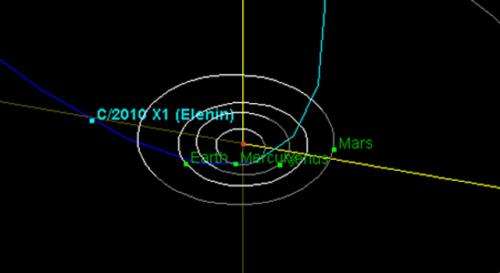
Trajectory of comet Elenin. Image credit: NASA/JPL-Caltech
(PhysOrg.com) -- Comet Elenin is no more.
Latest indications are this relatively small comet has broken into even smaller, even less significant, chunks of dust and ice. This trail of piffling particles will remain on the same path as the original comet, completing its unexceptional swing through the inner solar system this fall.
"Elenin did as new comets passing close by the sun do about two percent of the time: It broke apart," said Don Yeomans of NASA's Near-Earth Object Program Office at NASA's Jet Propulsion Laboratory in Pasadena, Calif. "Elenin's remnants will also act as other broken-up comets act. They will trail along in a debris cloud that will follow a well-understood path out of the inner solar system. After that, we won't see the scraps of comet Elenin around these parts for almost 12 millennia."
Twelve millennia may be a long time to Earthlings, but for those frozen inhabitants of the outer solar system who make this commute, a dozen millennia give or take is a walk in the celestial park. Comet Elenin came as close as 45 million miles (72 million kilometers) to the sun, but it arrived from the outer solar system's Oort Cloud, which is so far away its outer edge is about a third of the way to the nearest star other than our sun.
For those broken up over the breakup of what was formerly about 1.2 miles (2 kilometers) of uninspiring dust and ice, remember what Yeomans said about comets coming close to the sun - they fall apart about two percent of the time.
"Comets are made up of ice, rock, dust and organic compounds and can be several miles in diameter, but they are fragile and loosely held together like dust balls," said Yeomans. "So it doesn't take much to get a comet to disintegrate, and with comets, once they break up, there is no hope of reconciliation."
Comet Elenin first came to light last December, when sunlight reflecting off the small comet was detected by Russian astronomer Leonid Elenin of Lyubertsy, Russia. Also known by its astronomical name, C/2010 X1, Elenin somehow quickly became something of a "cause célèbre" for a few Internet bloggers, who proclaimed this minor comet could/would/should be responsible for causing any number of disasters to befall our planet.
Internet posts began appearing, many with nebulous, hearsay observations and speculations about earthquakes and other disasters being due to Elenin's gravitational effects upon Earth. NASA's response to such wild speculations was then in turn speculated to be an attempt to hide the truth.
"I cannot begin to guess why this little comet became such a big Internet sensation," said Yeomans. "The scientific reality is this modest-sized icy dirtball's influence upon our planet is so incredibly miniscule that my subcompact automobile exerts a greater gravitational influence on Earth than the comet ever would. That includes the date it came closest to Earth (Oct. 16), when the comet's remnants got no closer than about 22 million miles (35.4 million kilometers)."
Yeomans knows that while Elenin may be gone, there will always be Internet rumors that will attempt to conjure up some form of interplanetary bogeyman out of Elenin, or some equally obscure and scientifically uninteresting near-Earth object. Thinking of ways to make himself any more clear about the insignificance of this matter is somewhat challenging for a scientist who has dedicated his life to observing asteroids and comets and discovering their true nature and effects on our solar system.
"Perhaps a little homage to a classic Monty Python dead parrot sketch is in order," said Yeomans. "Comet Elenin has rung down the curtain and joined the choir invisible. This is an ex-comet."
NASA detects, tracks and characterizes asteroids and comets passing relatively close to Earth using both ground- and space-based telescopes. The Near-Earth Object Observations Program, commonly called "Spaceguard," discovers these objects, characterizes the physical nature of a subset of them, and predicts their paths to determine if any could be potentially hazardous to our planet. There are no known credible threats to date.
Provided by
JPL/NASA
-
From lemons to lemonade: Reaction uses carbon dioxide to make carbon-based semiconductor,
32 comments
-
Thioridazine kills cancer stem cells in human while avoiding toxic side-effects of conventional cancer treatments,
3 comments
-
SpaceX private rocket blasts off for space station (Update),
42 comments
-
Climate scientists say they have solved riddle of rising sea,
31 comments
-
SpaceX capsule has 'new car' smell, astronauts say (Update),
3 comments
-
Distance of planets from stars and revolution
1 hour ago
-
revamping general concept and cosmological principle
May 25, 2012
-
Transiting Exoplanet Light Curve
May 25, 2012
-
Math behind Theoretical Physics
May 24, 2012
-
Do we know whats at the center of galaxies yet?
May 23, 2012
-
Structure of the Milky Way?
May 20, 2012
- More from Physics Forums - General Astronomy
More news stories
Yale study concludes public apathy over climate change unrelated to science literacy
Are members of the public divided about climate change because they don't understand the science behind it? If Americans knew more basic science and were more proficient in technical reasoning, would public consensus match ...
1 hour ago |
not rated yet |
8
|
10 million years needed to recover from mass extinction
It took some 10 million years for Earth to recover from the greatest mass extinction of all time, latest research has revealed.
Space & Earth / Earth Sciences
1 hour ago |
not rated yet |
1
|
Sophisticated simulations predict future warming
The chances of our planet being hit by a global warming of 3 degrees Celsius by 2050 is as likely as it being hit by an increase of 1.4 degrees, new research shows. Presented in the journal Nature Geoscience, the British study ...
Space & Earth / Earth Sciences
May 22, 2012 |
4.4 / 5 (9) |
51
Aliens don't want to eat us, says former SETI director
Alien life probably isnt interested in having us for dinner, enslaving us or laying eggs in our bellies, according to a recent statement by former SETI director Jill Tarter.
Space & Earth / Space Exploration
May 25, 2012 |
4.4 / 5 (14) |
39
Kyoto Protocol architect 'frustrated' by climate dialogue
UN climate talks are going nowhere, as politicians dither or bicker while the pace of warming dangerously speeds up, one of the architects of the Kyoto Protocol told AFP.
May 23, 2012 |
3.7 / 5 (7) |
39
'Unzipped' carbon nanotubes could help energize fuel cells, batteries
Multi-walled carbon nanotubes riddled with defects and impurities on the outside could replace some of the expensive platinum catalysts used in fuel cells and metal-air batteries, according to scientists at ...
T cells 'hunt' parasites like animal predators seek prey, study shows
By pairing an intimate knowledge of immune-system function with a deep understanding of statistical physics, a cross-disciplinary team at the University of Pennsylvania has arrived at a surprising finding: T cells use a movement ...
Computer model used to pinpoint prime materials for efficient carbon capture
When power plants begin capturing their carbon emissions to reduce greenhouse gases and to most in the electric power industry, it's a question of when, not if it will be an expensive undertaking.
Change in developmental timing was crucial in the evolutionary shift from dinosaurs to birds: study
At first glance, it's hard to see how a common house sparrow and a Tyrannosaurus Rex might have anything in common. After all, one is a bird that weighs less than an ounce, and the other is a dinosaur that ...
Same gene that stunts infants' growth also makes them grow too big: research
UCLA geneticists have identified the mutation responsible for IMAGe* syndrome, a rare disorder that stunts infants' growth. The twist? The mutation occurs on the same gene that causes Beckwith-Wiedemann syndrome, which makes ...
Scientists develop ultra-sensitive test that detects diseases in their earliest stages
Scientists have developed an ultra-sensitive test that should enable them to detect signs of a disease in its earliest stages, in research published today in the journal Nature Materials.
Oct 26, 2011
Rank: not rated yet
Waaaah, waaah, waaaah, waaaaah <--trumpet of sadness
Maybe the gamma ray laser of death from the Crab Nebula ?
Oct 26, 2011
Rank: 1 / 5 (1)
Oct 28, 2011
Rank: not rated yet