And the microbes shall inherit the Earth
October 13, 2011 By Robert Perkins
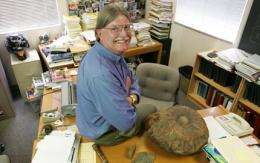
USC Dornsife's David Bottjer is searching for clues to the future by examining the past. Photo by Philip Channing.
(PhysOrg.com) -- Global warming is not a novel phenomenon, and by studying what happened to the planet during a period of global warming about 250 million years ago, one USC Dornsife scientist hopes to discover what could happen to us this time around.
Of course, given that up to 90 percent of ocean species on Earth went extinct during that period, its not surprising that the news isnt good.
Science shows that the earth is changing, said David Bottjer, professor of earth sciences and biological sciences.
Global temperatures are up almost three-quarters of a degree Celsius over the past 100 years, with documented increases in the amount of atmospheric carbon dioxide and other greenhouse gases.
Regardless of the cause, scientists must grapple with the question Is this something to worry about or not? Bottjer said.
To answer that question, Bottjer turned to the past, examining fossil evidence of the planets oceans from hundreds of millions of years ago. He presented his findings on Oct. 11 at this years annual meeting of The Geological Society of America in Minneapolis.
Historically, rapid increases in carbon dioxide in the past that were due to natural causes have led to mass extinctions.
The most severe of these extinctions occurred about 250 million years ago at the end of the Permian Period. Though the exact cause remains the source of debate, one theory is that the breakup of the supercontinent Pangaea drove increasing volcanic activity activity that included magma erupting through coal deposits which in turn dumped massive amounts of greenhouse gases such as carbon dioxide into the atmosphere.
As the planet warmed by as much as 5 degrees Celsius or more, animals and plants on land and up to 90 percent of ocean life on Earth died.
As it gets hotter, there are predicted consequences, Bottjer said. Putting it mildly, he added, Life on land and in the sea is stressed.
Bottjer made three main predictions based on observations of what is occurring today and what occurred in the past:
More CO2 will be absorbed by the ocean, making it more acidic. Among other things, we can expect to see the die-off of coral reefs, which also occurred at the end of the Permian.
Microbes will increase in abundance as other forms of life decline. The animals are all dying off, and maybe the microbes get to take over, he said. Though the coral will be gone, microbes will start building their own reefs in the ocean.
A hotter atmosphere will slow ocean circulation. A slower ocean means less mixing, which in turn means that less oxygen is dissolved into the ocean. So called dead zones, where the ocean is anoxic and unable to support fish and other oxygen-dependant life, will appear. Were starting to see increasing oxygen minimum zones in the Pacific, he said. Expanding dead zones are developing off of Oregon and the Gulf Coast.
Bottjer said he is not the only scientist turning his eye to the past for a glimpse at the future.
Other scientists perform similar studies using the Paleocene-Eocene Thermal Maximum, which occurred about 55 million years ago. The warming event resulted in a global temperature increase of several degrees Celsius, Bottjer said.
Although it will not be a perfect analogue, the end-Permian mass extinction ocean has much to teach us about the future global-warming ocean, he said.
Provided by USC College
-
From lemons to lemonade: Reaction uses carbon dioxide to make carbon-based semiconductor,
32 comments
-
Thioridazine kills cancer stem cells in human while avoiding toxic side-effects of conventional cancer treatments,
3 comments
-
SpaceX private rocket blasts off for space station (Update),
42 comments
-
Climate scientists say they have solved riddle of rising sea,
31 comments
-
SpaceX capsule has 'new car' smell, astronauts say (Update),
3 comments
-
Hypothetical desert earth
16 hours ago
-
More human population = greater mass?
May 25, 2012
-
Conversion from aircraft bearing to normal degrees
May 23, 2012
-
Interpretation/Analysis of the Lab results(HEPA filter)
May 22, 2012
-
Has anyone here attended the The Urbino Summer School in Paleoclimatology?
May 22, 2012
-
Earthquakes: Mag 6 N. Italy and Mag 5.6 W. Bulgaria
May 21, 2012
- More from Physics Forums - Earth
More news stories
Yale study concludes public apathy over climate change unrelated to science literacy
Are members of the public divided about climate change because they don't understand the science behind it? If Americans knew more basic science and were more proficient in technical reasoning, would public consensus match ...
1 hour ago |
not rated yet |
8
|
10 million years needed to recover from mass extinction
It took some 10 million years for Earth to recover from the greatest mass extinction of all time, latest research has revealed.
Space & Earth / Earth Sciences
1 hour ago |
not rated yet |
1
|
Sophisticated simulations predict future warming
The chances of our planet being hit by a global warming of 3 degrees Celsius by 2050 is as likely as it being hit by an increase of 1.4 degrees, new research shows. Presented in the journal Nature Geoscience, the British study ...
Space & Earth / Earth Sciences
May 22, 2012 |
4.4 / 5 (9) |
51
Aliens don't want to eat us, says former SETI director
Alien life probably isnt interested in having us for dinner, enslaving us or laying eggs in our bellies, according to a recent statement by former SETI director Jill Tarter.
Space & Earth / Space Exploration
May 25, 2012 |
4.4 / 5 (14) |
39
Kyoto Protocol architect 'frustrated' by climate dialogue
UN climate talks are going nowhere, as politicians dither or bicker while the pace of warming dangerously speeds up, one of the architects of the Kyoto Protocol told AFP.
May 23, 2012 |
3.7 / 5 (7) |
39
'Unzipped' carbon nanotubes could help energize fuel cells, batteries
Multi-walled carbon nanotubes riddled with defects and impurities on the outside could replace some of the expensive platinum catalysts used in fuel cells and metal-air batteries, according to scientists at ...
T cells 'hunt' parasites like animal predators seek prey, study shows
By pairing an intimate knowledge of immune-system function with a deep understanding of statistical physics, a cross-disciplinary team at the University of Pennsylvania has arrived at a surprising finding: T cells use a movement ...
Computer model used to pinpoint prime materials for efficient carbon capture
When power plants begin capturing their carbon emissions to reduce greenhouse gases and to most in the electric power industry, it's a question of when, not if it will be an expensive undertaking.
Change in developmental timing was crucial in the evolutionary shift from dinosaurs to birds: study
At first glance, it's hard to see how a common house sparrow and a Tyrannosaurus Rex might have anything in common. After all, one is a bird that weighs less than an ounce, and the other is a dinosaur that ...
Same gene that stunts infants' growth also makes them grow too big: research
UCLA geneticists have identified the mutation responsible for IMAGe* syndrome, a rare disorder that stunts infants' growth. The twist? The mutation occurs on the same gene that causes Beckwith-Wiedemann syndrome, which makes ...
Scientists develop ultra-sensitive test that detects diseases in their earliest stages
Scientists have developed an ultra-sensitive test that should enable them to detect signs of a disease in its earliest stages, in research published today in the journal Nature Materials.
Oct 13, 2011
Rank: not rated yet
Oct 13, 2011
Rank: 5 / 5 (5)
Anticipating future comments: -Yes, this is relevant for today's warming -it shows us what to expect in a warming world.
-No, the temporary regional warming in Greenland a millennium ago (induced by altered ocean currents and jet streams) is not analogous to today's warming -we have a GLOBAL warming today.
-No, the *present* warming is well understood. The past Permian-Triassic warming happened a quarter of a billion years ago, which means the records are spotty, hence the cause is not as well understood. The *effects* of that event are however well documented.
-Yes, we have a global warming trend, documented across all continents. No conspiracy can be everywhere at once, except in the imagination. Yes, there is a "hockey stick" temperature graph.
Oct 13, 2011
Rank: 1 / 5 (8)
Oct 13, 2011
Rank: 1 / 5 (10)
Thanks for the story and for introducing some reality into the global warming story!
Observations suggest changes in Earth's climate are controlled mostly by the Sun's compact, impulsive pulsar core [1-6].
1. "Suns motion and sunspots, Astron. J. 70, 193-200 (1965).
2. Prolonged minima and the 179-yr cycle of the solar inertial motion, Solar Physics 110, 191-220 (1987).
3. Cosmic rays and Earths climate, Space Science Reviews, pp.1555-1666 (2000)
4. "Super-fluidity in the solar interior: Implications for solar eruptions and climate", J Fusion Energy 21, 193-198 (2002)
http://arxiv.org/.../0501441
5. "Earth's Heat Source - The Sun", E & E 20, 131-144 (2009)
http://arxiv.org/pdf/0905.0704
6. "Neutron Repulsion", The APEIRON Journal, in press (2011)
http://arxiv.org/...2.1499v1
With kind regards,
Oliver K. Manuel
http://myprofile....anuelo09
http://dl.dropbox...reer.pdf
Oct 13, 2011
Rank: 2 / 5 (4)
I figure that due to conservation laws, whenever you launch a deep space probe to the outer solar system, you change the Earth's velocity by a tiny, tiny amount.
In launching just one of the Voyager space craft, the Earth's velocity in space should have been changed by at least 5.4 meters per year.
this is a very tiny amount, but after more than 30 years, that adds up to about 158 meters.
Not a big number at all on a per probe basis.
But if you are constantly pushing things out to the outer solar system, then by conservation laws, the Earth must be pushed inward towards the Sun.
Now if the Earth is pushed inward then it falls deeper into the Sun's gravity well.
Might it be that our mad quest for exploration has pushed the Earth closer to the Sun, causing the modern warming trend?
Ironically, most of the warming has happened in just about the past 40 years, neatly coinciding with... OSS probes.
Oct 13, 2011
Rank: 1 / 5 (2)
However using a giant catapult or cannon to launch the rocket would.
Oct 13, 2011
Rank: 1 / 5 (1)
Conservation of momentum says you are wrong.
The propellant coming out of the rocket hits back on the surface (and/or the atmosphere) of the earth.
After it leaves the nozzle, the propellant mixes with the air, and some of it hits the ground at the launch pad, transferring an equal and opposite momentum to the combination of ground and atmosphere of the planet.
You want proof?
Go stand under your shower head, or better yet, if you have your own well and a pressurized water tank and pump, then your shower and hose work EXACTLY like a water rocket. The "propellant" being the water comes out with a force, which hits you, but it also pushes the hose in your hand.
Now, if you have a rocket that is already in space and you do a burn, you are partly right, at least for whatever portion of the propellant doesn't get later captured by the earth.
Oct 14, 2011
Rank: 5 / 5 (1)
Glade the earth doesn't have volcanoes. Unimaginable are the consequences to earth's orbit.