Mexican astronomers suggest Bonilla sighting might have been a very close comet breaking up

October 19, 2011 by Bob Yirka report

Mexican astronomers suggest Bonilla sighting might have been a very close comet breaking up
Enlarge

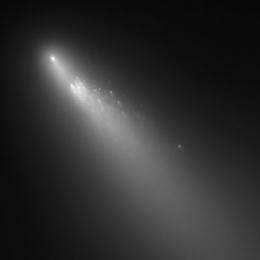
Schwassmann-Wachmann3 Comet: Fragment B photographed during its passing in 2006. We can observe up to 73 fragments. This photo is from APOD (Astronomy Picture of the Day) (Internet 3). Credit: NASA, ESA, H. Weaver (JHU/APL), M. Mutchler and Z. Levay (STScl)

(PhysOrg.com) -- Mexican astronomers Hector Javier Durand Manterola, Maria de la Paz Ramos Lara, and Guadalupe Cordero working out of National Autonomous University of Mexico in Mexico City, have uploaded a paper onto the prepress server arXiv, suggesting that objects Mexican astronomer José Bonilla recorded in 1883 passing in front of the sun and surrounded by a hazy mist, were in fact fragments of a comet as it came apart very near the earth.

Binilla wrote down his observations at the time and took some photographs of what he saw, but never really tried to explain what the objects were. Three years later the French astronomy journal L'Astronomie published the photos but deemed them likely high flying birds or bugs on the camera lens.

Now Manterola and his colleagues suggest that there is sufficient evidence to at least consider the possibility that the objects Bonilla saw were comet fragments. First of all they say, Bonilla wrote down everything about the sighting; where in the sky the objects appeared, how many fragments he counted (447) over the two days that he could see them, the type of camera he used and the photography techniques, etc. And perhaps most importantly, the time it took for a single fragment to cross the sun, because it’s that number that allowed the modern researchers to calculate their distance from Earth, which they suggest would have been somewhere near just 8000 kilometers. Also, because of Bonilla’s precision in recording the events, it seems doubtful that he would have overlooked bugs on his lens, or the possibility of the objects being birds, etc.

The unfortunate thing in all this is that no one else reported seeing the objects that Bonilla saw, and there was no associated meteor shower as would be expected if a comet fell apart so close to Earth. Manterola and his team say that this could be because of the parallax effect, which happens when an object is so close, only those closest to it can see it. They also note that because of the apparent position of the objects, they would have been observable only from areas in roughly the same latitude, which would have included parts of Africa and Northern India and south-east Asia; places where no one was looking at the sun through a telescope.

Others clearly are skeptical, for obvious reasons. But that may or may not matter because if the objects were in fact fragments, it appears we came pretty close to being wiped out. The researchers suggest that many of the fragments would have been on the order of the size of the one that struck Siberia back in 1908, destroying everything for miles around. If we’d been hit with hundreds or thousands of such fragments at the same time, it might have knocked the life out of our planet, literally.

More information: Interpretation of the observations made in 1883 in Zacatecas (Mexico): A fragmented Comet that nearly hits the Earth, arXiv:1110.2798v1 [astro-ph.EP] http://arxiv.org/abs/1110.2798

Abstract
In 1883, on the 12th and 13th of August, Mexican astronomer Jose A. y Bonilla observed several objects passing in front of the solar disk. In 1886 in the L'Astronomie magazine, he reported his observations without providing a hypothesis explaining the registered phenomena. Our objective in this work is to interpret, with current knowledge, what he observed in Zacatecas. Our working hypothesis is that what Bonilla observed in 1883 was a highly fragmented comet, in an approach almost flush to the Earth's surface. The fragmentation of the comet's nucleus is a phenomenon known since the XIX century. Using the results reported by Bonilla, we can estimate the distance at which the objects approach to the Earth's surface, their size, their mass and total mass of the comet before fragmentation. According to our calculations, the distance at which the objects passed over the Earth's surface, was between 538 km and 8,062 km, the width of the objects was between 46 m and 795 m and its length between 68 m and 1,022 m, the object's mass was between 5.58e8 kg and 2.5e12 kg. Finally, the mass of the original comet, before fragmentation, was between 1.83e12 and 8.19e15 kg, i.e., between 2e-3 and 8.19 times the mass of Halley Comet.

via TechnologyReview, Discover

© 2011 PhysOrg.com

4.9 /5 (10 votes)  

Filter


Move the slider to adjust rank threshold, so that you can hide some of the comments.


Display comments: newest first

horve
Oct 19, 2011

Rank: 5 / 5 (4)
I wonder how many other near misses we are unaware off?
Also its sobering to think that we may be hit by multiple objects in the future not just one big object.
Callippo
Oct 19, 2011

Rank: 5 / 5 (4)
I consider this interpretation plausible, but some astronomers are contradicting it already and their arguments aren't illogical:

http://blogs.disc...eptical/

We'll never know -- this seems to be a waste of time
We could say the very same about every research of historical events. But without studying the history we couldn't predict the future. Historia, magistra vitae.

In particular, the path of potentially dangerous asteroids and comets is established just with studying of their former path. This comet will return to Earth in 2024 and it would be quite good to know, whether the same event cannot repeat again.
Grizzled
Oct 19, 2011

Rank: not rated yet
If a comet came that close to Earth before disintegrating, surely some of its fragments should have been captured by the Earth gravity? The article itself points out there were no meteor showers observed at the time which makes this explanation a bit suspect. And it couldn't be simply travelling too fast for that since it wouldn't be in a comet-type orbit then (i.e. not a comet again).
SemiNerd
Oct 19, 2011

Rank: 4.3 / 5 (3)
If a comet came that close to Earth before disintegrating, surely some of its fragments should have been captured by the Earth gravity? The article itself points out there were no meteor showers observed at the time which makes this explanation a bit suspect. And it couldn't be simply travelling too fast for that since it wouldn't be in a comet-type orbit then (i.e. not a comet again).

Comets can travel at over 21km/sec if they have highly elliptical orbits. I didn't see any estimates on its actual orbit. Just because it came close, doesn't mean any fragments would be captured or even have any likelihood of being captured. Again, it depends on the orbit.
antialias_physorg
Oct 20, 2011

Rank: 5 / 5 (1)
I wonder how many other near misses we are unaware off?

- Anything with a low albedo is less likely to be detected.
- Most objects smaller than 100m in diameter won't be detected
- Not all parts of the sky are observed continually (and those that are observed lie mostly within the plane of the planets - so objects with highly eccentric orbits are less likely to be detected)

We're still pretty blind to all the stuff that is flying around out there. I'm still stunned as to why we spend so much money on trying to snuff each other out (and protecting ourselves from same) when the real, planet-wide, dangers lie out there.

It's like an elective (and collective) blindness to 99.999999999% of reality.
Nerdyguy
Oct 20, 2011

Rank: not rated yet
Wow, hard to believe my post referring to the Bonilla sighting as an alien artifact was removed by the editors. I was attempting to be humorous and don't actually believe it was an alien craft. However, numerous people have legitimately advanced the theory that Bonilla did indeed see a UFO. In fact, the study quoted here was intended to refute the UFO theory as well as other similar ideas. Frankly, we just really don't know and likely never will. Nonetheless, the decision to remove my comment was ill considered.
Nerdyguy
Oct 20, 2011

Rank: not rated yet
"I'm still stunned as to why we spend so much money on trying to snuff each other out (and protecting ourselves from same) when the real, planet-wide, dangers lie out there." - Antialias

You are right on the mark. Defense budgets around the world have never been higher. But 99% of it is aimed at earthbound dangers, while the real species-level extinction dangers are largely ignored.

Rank 4.9 /5 (10 votes)
Relevant PhysicsForums posts
  • Distance of planets from stars and revolution
    created1 hour ago
  • revamping general concept and cosmological principle
    createdMay 25, 2012
  • Transiting Exoplanet Light Curve
    createdMay 25, 2012
  • Math behind Theoretical Physics
    createdMay 24, 2012
  • Do we know whats at the center of galaxies yet?
    createdMay 23, 2012
  • Structure of the Milky Way?
    createdMay 20, 2012
  • More from Physics Forums - General Astronomy

More news stories

Yale study concludes public apathy over climate change unrelated to science literacy

Are members of the public divided about climate change because they don't understand the science behind it? If Americans knew more basic science and were more proficient in technical reasoning, would public consensus match ...

Space & Earth / Environment

created 1 hour ago | popularity not rated yet | comments 4 | with audio podcast

10 million years needed to recover from mass extinction

It took some 10 million years for Earth to recover from the greatest mass extinction of all time, latest research has revealed.

Space & Earth / Earth Sciences

created 1 hour ago | popularity not rated yet | comments 1 | with audio podcast

Sophisticated simulations predict future warming

The chances of our planet being hit by a global warming of 3 degrees Celsius by 2050 is as likely as it being hit by an increase of 1.4 degrees, new research shows. Presented in the journal Nature Geoscience, the British study ...

Space & Earth / Earth Sciences

created May 22, 2012 | popularity 4.4 / 5 (9) | comments 51

Aliens don't want to eat us, says former SETI director

Alien life probably isn’t interested in having us for dinner, enslaving us or laying eggs in our bellies, according to a recent statement by former SETI director Jill Tarter.

Space & Earth / Space Exploration

created May 25, 2012 | popularity 4.4 / 5 (13) | comments 39

Kyoto Protocol architect 'frustrated' by climate dialogue

UN climate talks are going nowhere, as politicians dither or bicker while the pace of warming dangerously speeds up, one of the architects of the Kyoto Protocol told AFP.

Space & Earth / Environment

created May 23, 2012 | popularity 3.7 / 5 (7) | comments 39


Computer model used to pinpoint prime materials for efficient carbon capture

When power plants begin capturing their carbon emissions to reduce greenhouse gases – and to most in the electric power industry, it's a question of when, not if – it will be an expensive undertaking.

'Unzipped' carbon nanotubes could help energize fuel cells, batteries

Multi-walled carbon nanotubes riddled with defects and impurities on the outside could replace some of the expensive platinum catalysts used in fuel cells and metal-air batteries, according to scientists at ...

T cells 'hunt' parasites like animal predators seek prey, study shows

By pairing an intimate knowledge of immune-system function with a deep understanding of statistical physics, a cross-disciplinary team at the University of Pennsylvania has arrived at a surprising finding: T cells use a movement ...

Same gene that stunts infants' growth also makes them grow too big: research

UCLA geneticists have identified the mutation responsible for IMAGe* syndrome, a rare disorder that stunts infants' growth. The twist? The mutation occurs on the same gene that causes Beckwith-Wiedemann syndrome, which makes ...

Change in developmental timing was crucial in the evolutionary shift from dinosaurs to birds: study

At first glance, it's hard to see how a common house sparrow and a Tyrannosaurus Rex might have anything in common. After all, one is a bird that weighs less than an ounce, and the other is a dinosaur that ...

Scientists develop ultra-sensitive test that detects diseases in their earliest stages

Scientists have developed an ultra-sensitive test that should enable them to detect signs of a disease in its earliest stages, in research published today in the journal Nature Materials.