October 17, 2011 report
New research offers insight into long term sperm storage in animals and parthenogenesis
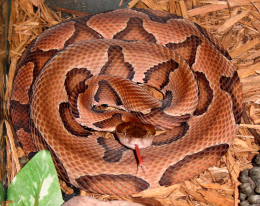
(PhysOrg.com) -- Recently an eastern diamond-backed rattlesnake gave birth to 19 offspring; not exactly headline news, except for the fact that the female had been separated from any male snakes for five years. What’s more, another snake, this one a female copperhead snake gave birth to little ones without ever having mated with a male at all.
These two examples provide the basis for a new paper published in the Biological Journal of the Linnean Society. Its authors, Warren Booth and Gordon Schuett, from North Carolina State University and Georgia State University, respectively, say that such an example provides proof that some animals are able to store sperm for extraordinarily long periods of time. They also use the paper as a means for adding the copperhead to known species of snakes that have delivered via virgin birth.
In both cases, DNA evidence was able to prove whether offspring came from a male-female pair or just a single female. In the case of the rattlesnake, the female had been captured when very young and then held in seclusion for the five year time span. Thus, it had mated before it was mature enough to produce young. The snake had somehow managed to hold on to that sperm for five years, kept it alive and viable, and then one day, though some unknown mechanism, “decided” to allow itself to become pregnant and did so, resulting in what appear to be perfectly healthy offspring. The research duo believe the snake was able to achieve this feat by folding part of its uterus into a shape that was able to hold onto the sperm for long periods of time while preventing it from sneaking out and impregnating the host until she was good and ready. While many human females might wish they could do the same, sadly, they can only do so for a few hours, and really don’t exert any control over the process at all once the sperm has entered her body.
As for the copperhead, though a first example in this particular species, scientists have known for a long time that some animals can reproduce without the need for male assistance. Called, parthenogenesis, it’s been seen in other snakes, some sharks and even some turkeys, though never in mammals. Scientists believe the process is similar to that which humans have devised for cloning animals. Animals that are able to perform this trick likely only produce all male or all female offspring and quite obviously reduce diversity in their gene pool in the process, though some point out that it could also reduce the incidence of mutations.
More information: Molecular genetic evidence for alternative reproductive strategies in North American pitvipers (Serpentes, Viperidae): long-term sperm storage and facultative parthenogenesis, Biological Journal of the Linnean Society, DOI: 10.1111/j.1095-8312.2011.01782.x
Abstract
The first documentation of facultative parthenogenesis (FP) in non-avian reptiles (snakes) occurred in 1997, following the application of molecular genetic methods for parentage analysis, and since has been described in only four additional snake species. Here, in two species of live-bearing (viviparous) North American pitviper snakes, using microsatellite DNA fingerprinting, we describe the first record of a virgin birth by FP in the copperhead (Agkistrodon contortrix), and the first genetically confirmed case of long-term sperm storage (LTSS) of exceptional duration (5 years) in the eastern diamond-backed rattlesnake (Crotalus adamanteus). The capacity of female squamate reptiles (snakes, lizards, and amphisbaenians) to store viable sperm for extended periods of time is a competing hypothesis to FP, and it is often inferred when interpreting certain births where adult females have been isolated from adult male mates for prolonged periods. On reviewing the literature of certain cases of LTSS in snakes, we provide compelling support for the prevalence of FP, casting doubt over the widespread acceptance of LTSS. Accordingly, with the discovery of FP in squamates and the results of the present study, we advocate that in order to differentiate between LTSS and FP, especially under natural conditions, rigorous molecular testing will be required.
via Discovery
© 2011 PhysOrg.com


