Hyperactive Hartley 2 has a split history
October 4, 2011

Hyperactive Hartley 2 has a split history

Enlarge

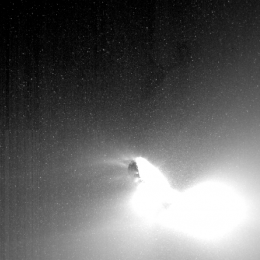
A swarm of large chunks surrounding comet Hartley 2 was imaged with the Deep Impact spacecraft's Medium Resolution Instrument. This clear filter image has been processed to enhance the visibility of the chunks. This processing saturates the comet nucleus and some of its nearby dust (lower right). The Sun is located to the right, and the spacecraft was at a distance of 807 km from the comet. (M. Kelley et al.)

The latest analysis of data from NASA's Deep Impact spacecraft shows that comet 103P/Hartley 2 is hyperactive in terms of the material it spews out, compared to the other comets observed up close to date. The comet also shows surprising diversity - ice on the comet’s sunlit surface is found in patches that are isolated from areas of dust. In addition, one lobe of the dog-bone shaped comet may have lost much more of the primordial material from the formation of the comet than the other, suggesting that Hartley 2 was originally two comets that came together in a gentle collision. Mike A’Hearn and Lori Feaga will be presenting their findings at the EPSC-DPS Joint Meeting 2011 in Nantes, France.

Deep Impact made its closest encounter of Hartley 2 on 4 November 2010. Over the past year, the science team has been pouring over the data to gain a more detailed understanding of the processes that drive the comet's activity.

"Hartley 2 works differently from Tempel 1, which was encountered by Deep Impact in 2005 and from Wild 2, which was observed by the Stardust mission. It ejects a huge amount of material for its size. Halley, which was observed by the Giotto mission lies somewhere in the middle of the spectrum of activity. Since the encounter, we have been able to dig deeper into the data and have provided more evidence of how ice and dust is released from the nucleus,” said A’Hearn, the Principal Investigator of Deep Impact's mission extension, EPOXI.

Hyperactive Hartley 2 has a split history
Enlarge

On the inbound leg of the trip past comet Hartley 2, the Deep Impact spacecraft saw water ice on the surface of the comet. The presence of water ice is suggested in an enhanced color High Resolution Instrument (HRI) image, left panel, along the morning edge of the nucleus. The blue color is indicative of ice. In the middle HRI image, bright rough terrain can be seen. In the right panel, a map of the amount and location of water ice on the large lobe of the nucleus, estimated from spectral data, is overlaid on an HRI visible image to show the collocation of water ice with the bright rough terrain. Blue indicates ice concentrations while pink indicates a warm, dusty nucleus with no ice. Spectroscopic data at this resolution of the small lobe do not exist. (J. Sunshine et al.)

Carbon dioxide gas, or dry ice, sublimates beneath the ’s surface when it feels heat from the Sun and this fuels extensive jet activity on the comet. Much more carbon dioxide is escaping Hartley 2 than the other comets observed, including Tempel 1. The Deep Impact cameras and spectrometer have observed fragile chunks of water ice and dust being dragged from the nucleus with the escaping carbon dioxide into the comet’s atmosphere, or coma. The latest results are giving the team a better understanding of the nucleus and how the micrometre-sized grains of pure ice and centimetre sized dust particles are released from Hartley 2 into the coma. They have found that, despite the hyperactive release of material, both the ice and the volatiles within the dust are actually moving and subliming very slowly.
Hyperactive Hartley 2 has a split history
Enlarge

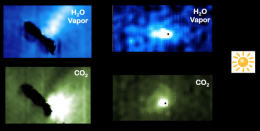
Distribution maps of the coma can be made from infrared scans. These HRI-IR maps of the near nucleus coma in the left panels, acquired during closest approach to the nucleus of Hartley 2, show an enhancement of carbon dioxide emanating from the sunward facing small lobe of the nucleus. The water vapour, however, has a different distribution implying a different source region and process. A half a rotation later, when the small lobe is pointing away from the Sun and the nucleus is no longer resolved in the HRI telescope (right panels), the carbon dioxide is still concentrated around the small lobe, and thus enhanced in the anti-sunward direction. In this larger field of view, the water is also enhanced away from the Sun, suggesting that water ice dragged out by the carbon dioxide is pushed away from the Sun by its radiation pressure and eventually sublimes. The Sun is to the right for all panels and the pixels in which the nucleus is located are black. (L. Feaga et al.)

The team has found a large region of bright, rough terrain on the surface that is covered in water ice particles, a few hundredths of a millimetre in size. Through a combination of surface temperature analysis and the fact that the ice exists on the sunlit surface, they have deduced that these ice particles must be physically separate from the warm, dark dust and not intimately mixed.

Although inferred by the wealth of approach and departure data and preliminary mapping of the coma at closest approach, the team has also definitively reported that the larger lobe of Hartley 2’s nucleus currently has less being released from it than the smaller lobe. This means that the volatile ices, primordial material from the formation of the comet located tens of centimetres deep into the nucleus, may be depleted in the larger lobe.
Hyperactive Hartley 2 has a split history
Enlarge

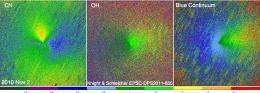
The left panel shows that CN, a breakdown product of HCN and other molecules, is concentrated in the prominent jets of comet Hartley 2. Other breakdown products have a similar distribution. However, the middle panel shows that the distribution of OH, a breakdown product of water, is mostly tailward, i.e. away from the Sun. This implies that the release of water is decoupled from other gases and is almost certainly arising from nearly pure icy grains that are starting to drift tailward. The right panel shows the distribution of reflected blue light, which is also likely dominated by icy grains, to also be predominantly tailward. These ground-based data were collected by M. Knight & D. Schleicher in November 2010 from Lowell Observatory.

Lori Feaga, from the University of Maryland, says, "The heterogeneity between lobes is most likely due to compositional differences in the originally accreted material."

"We are speculating that this means that the two lobes of the comet formed in different places in the Solar System. They came together in a gradual collision and the central part of the dog-bone was in-filled with dust and from the debris," adds A'Hearn

From observations made from telescopes here on Earth, collaborators Matthew Knight and David Schleicher have shown that the grains are gradually shedding water and all the material is slowly moving away from the sun. This result complements the findings from the spacecraft team.

A'Hearn concludes, "All of these detailed findings put together, those from the spacecraft and supporting ground-based telescopes, may require us to rethink cometary origins."

Provided by Europlanet


Rank not rated yet
Relevant PhysicsForums posts
  • Distance of planets from stars and revolution
    created4 hours ago
  • revamping general concept and cosmological principle
    createdMay 25, 2012
  • Transiting Exoplanet Light Curve
    createdMay 25, 2012
  • Math behind Theoretical Physics
    createdMay 24, 2012
  • Do we know whats at the center of galaxies yet?
    createdMay 23, 2012
  • Structure of the Milky Way?
    createdMay 20, 2012
  • More from Physics Forums - General Astronomy

More news stories

Land and sea species differ in climate change response: study

(Phys.org) -- Marine and terrestrial species will likely differ in their responses to climate warming, new research by Simon Fraser University and Australia’s University of Tasmania has found.

Space & Earth / Environment

created 2 hours ago | popularity not rated yet | comments 1 | with audio podcast

Yale study concludes public apathy over climate change unrelated to science literacy

Are members of the public divided about climate change because they don't understand the science behind it? If Americans knew more basic science and were more proficient in technical reasoning, would public consensus match ...

Space & Earth / Environment

created 4 hours ago | popularity 4 / 5 (1) | comments 10 | with audio podcast

10 million years needed to recover from mass extinction

It took some 10 million years for Earth to recover from the greatest mass extinction of all time, latest research has revealed.

Space & Earth / Earth Sciences

created 4 hours ago | popularity not rated yet | comments 1 | with audio podcast

Sophisticated simulations predict future warming

The chances of our planet being hit by a global warming of 3 degrees Celsius by 2050 is as likely as it being hit by an increase of 1.4 degrees, new research shows. Presented in the journal Nature Geoscience, the British study ...

Space & Earth / Earth Sciences

created May 22, 2012 | popularity 4.4 / 5 (9) | comments 51

Aliens don't want to eat us, says former SETI director

Alien life probably isn’t interested in having us for dinner, enslaving us or laying eggs in our bellies, according to a recent statement by former SETI director Jill Tarter.

Space & Earth / Space Exploration

created May 25, 2012 | popularity 4.4 / 5 (14) | comments 40


'Unzipped' carbon nanotubes could help energize fuel cells, batteries

Multi-walled carbon nanotubes riddled with defects and impurities on the outside could replace some of the expensive platinum catalysts used in fuel cells and metal-air batteries, according to scientists at ...

T cells 'hunt' parasites like animal predators seek prey, study shows

By pairing an intimate knowledge of immune-system function with a deep understanding of statistical physics, a cross-disciplinary team at the University of Pennsylvania has arrived at a surprising finding: T cells use a movement ...

Computer model used to pinpoint prime materials for efficient carbon capture

When power plants begin capturing their carbon emissions to reduce greenhouse gases – and to most in the electric power industry, it's a question of when, not if – it will be an expensive undertaking.

Change in developmental timing was crucial in the evolutionary shift from dinosaurs to birds: study

At first glance, it's hard to see how a common house sparrow and a Tyrannosaurus Rex might have anything in common. After all, one is a bird that weighs less than an ounce, and the other is a dinosaur that ...

Nvidia trumpets Tegra 3 phone design wins for 2012

(Phys.org) -- Nvidia’s competitive war paint has a name, Tegra 3. On the heels of Nvidia announcements about lowering costs of its Tegra 3 processors and Nvidia-enabled tablets running Android Ice Cream ...

Scientist: Evolution debate will soon be history

(AP) -- Richard Leakey predicts skepticism over evolution will soon be history. Not that the avowed atheist has any doubts himself.