To diagnose heart disease, visualization experts recommend a simpler approach
October 27, 2011

To diagnose heart disease, visualization experts recommend a simpler approach

Enlarge

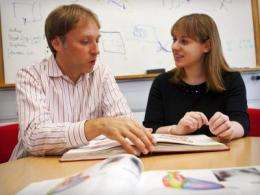
Professor Hanspeter Pfister and Michelle Borkin, at the Harvard School of Engineering and Applied Sciences, have developed a new visualization tool to improve the accuracy of clinical attempts to diagnose heart disease. Credit: Eliza Grinnell / Harvard SEAS

A team of computer scientists, physicists, and physicians at Harvard have developed a simple yet powerful method of visualizing human arteries that may result in more accurate diagnoses of atherosclerosis and heart disease.

The prototype tool, called "HemoVis," creates a 2D diagram of arteries that performs better than the traditional 3D, rainbow-colored model. In a clinical setting, the tool has been shown to increase diagnostic accuracy from 39% to 91%.

Presented today at the IEEE Information Conference (InfoVis 2011), the new visualization method offers insight to clinicians, imaging specialists, engineers, and others in a wide range of fields who need to explore and evaluate complex, branching structures.

"Our goal was to design a visual representation of the data that was as accurate and efficient for patient diagnosis as possible," says lead author Michelle Borkin, a doctoral candidate at the Harvard School of Engineering and Applied Sciences (SEAS). "What we found is that the prettiest, most popular visualization is not always the most effective."

HemoVis takes data from patient-specific blood flow simulations, combined with traditional imaging data, and visually displays a tree diagram of the arteries with areas of disease highlighted to assist in diagnosis.

Tools for artery visualization in both clinical and research settings commonly use that portray the shape and of vessels of interest. These complex tools require users to rotate the models to get a complete perspective of spatial orientation.

By contrast, the new visualization requires no such rotation or interaction. The tool utilizes 2D, circumference-adjusted cylindrical cross sections arranged in tree diagrams.

Though this visualization method may seem less high-tech, the team demonstrated through quantitative evaluation with medical experts that the 2D model is actually more accurate and efficient for patient diagnosis.
To diagnose heart disease, visualization experts recommend a simpler approach
Enlarge

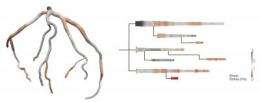
With the new visualization, an arterial system that would previously have been reconstructed in 3-D (left) is instead deconstructed and shown with each branch separated from the main vessel. Arteries are then represented as 2-D branches (right) whose dimensions are proportional to the circumference and length of the corresponding artery. Branching points and relationships between branches are also displayed. Credit: Michelle Borkin

"In the 3D case, the more complex and branched the arteries were, the longer it took to complete the patient diagnosis, and the lower the accuracy was," Borkin reflects. "In the 2D representation, it didn't matter how many branches we had or how complex they were—we got consistently fast, accurate results. We weren't expecting that."

Tree diagrams are hardly new, as evolutionary biologists will attest, but scientists in many fields are using them to solve a range of very modern and complex problems. In fact, Borkin applied her own experience in astronomy and physics to transform the concept of visualization for SEAS' Multiscale Hemodynamics research group. In prior work, she had used a very similar type of tree diagram to determine the structure of nebulae in outer space.

"With the consultation and cooperation of clinicians, we were able to draw on fairly well known visualization techniques and principles from computer science to solve a practical clinical problem," says Hanspeter Pfister, Gordon McKay Professor of the Practice of Computer Science at SEAS.

Borkin, Pfister, and their colleagues relied on the input of physicians and others with clinical or laboratory imaging experience throughout the process. Through extensive surveys and interviews, they identified the most popular options for display, accurate layout, and coloring of these arterial projections.

Doctors initially showed some resistance when asked about the benefits of an alternative color scheme, citing familiarity, chromatic vibrancy, and aesthetic appeal in support of the rainbow scheme that is currently most common in scientific visual representations.

However, Borkin drew on well supported research that is less well known outside the visualization community:
To diagnose heart disease, visualization experts recommend a simpler approach
Enlarge

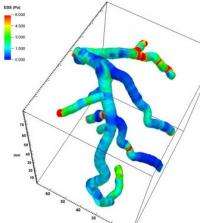
Rainbow color schemes are very common in scientific visualizations, despite the well documented fact that the coloring is not well attuned to the human visual system. Researchers at Harvard have shown that a gradient from black to red is more effective for diagnosing heart disease in visualizations of arteries. Credit: Michelle Borkin

"For years, visualization, computer science, and psychology researchers have identified that color is critical for conveying the value of data, but that the rainbow coloring is not well-attuned to the human visual system."

Accordingly, HemoVis departs from the traditional practice of rainbow color-coding in favor of a graded single-color scheme (red to black) that can represent placement along a continuum.

In tests, , as measured by the proportion of diseased areas identified, increased dramatically with the new color scheme.

Widespread adoption of visual representations like those in HemoVis could have the effect of not only optimizing tasks that are critical for doctors, but also changing long-entrenched mindsets and making scientists "think twice" about their assumptions in data visualization, Borkin says.

"This approach to visualization design and validation is broadly applicable in medicine, engineering, and science," notes Pfister. "We hope that people will use this process as a template for transforming their own visualizations."

Borkin and Pfister acknowledged that while HemoVis represents an important step forward, traditional 3D artery models still play a role, particularly in providing a spatially intuitive tool for surgical planning.

With this in mind, the next steps for this research include further development and optimization of the 2D tool and investigation into how it might complement, rather than replace, its 3D counterpart.

A paper about the work being presented today will be published later this year in the journal IEEE Transactions on Visualization and Computer Graphics.

Provided by Harvard University search and more info website

Filter


Move the slider to adjust rank threshold, so that you can hide some of the comments.


Display comments: newest first

gwrede
Oct 27, 2011

Rank: not rated yet
One feels almost ashamed. Something like this should have been standard praxis in medical drawings for a long time. There is no technical reason why, for example Galen (two thousand years ago) couldn't have used this in his drawings. And definitely, this should have been invented before the General Relativity.

This is yet another reminder to us, that even if we have the Combined Knowledge of Humankind "at our fingertips" (and other scifi adages), there's still a lot of fundamental, or even primitive, to be discovered and invented.

I wish people would tell the kids. Too many seem to think there's no use learning things "because everything is already invented".
Rank 5 /5 (2 votes)
Relevant PhysicsForums posts
  • Ideas to mitigate risk of 911 calls being misdirected
    createdMay 24, 2012
  • Live scribe pen?
    createdMay 10, 2012
  • Shallow water flow simulation
    createdMay 07, 2012
  • Tablet for taking notes?
    createdMay 05, 2012
  • Best fit tablet for me?
    createdMay 05, 2012
  • Measure of Informaton
    createdMay 04, 2012
  • More from Physics Forums - Computing & Technology

More news stories

Browser wars flare in mobile space

The browser wars are heating up again, but this time the fight is for dominance of the mobile Internet.

Technology / Software

created 11 hours ago | popularity 5 / 5 (1) | comments 3

Probability of contamination from severe nuclear reactor accidents is higher than expected: study

Catastrophic nuclear accidents such as the core meltdowns in Chernobyl and Fukushima are more likely to happen than previously assumed. Based on the operating hours of all civil nuclear reactors and the number ...

Technology / Energy & Green Tech

created May 22, 2012 | popularity 3.6 / 5 (22) | comments 56 | with audio podcast

HyperSolar shows dirty water no barrier to power world

(Phys.org) -- The Santa Barbara, California, company, HyperSolar, is set to transparently share the ups and downs of its research experiences toward the company’s ultimate vision, successfully producing ...

Technology / Energy & Green Tech

created May 24, 2012 | popularity 4.8 / 5 (16) | comments 17 | with audio podcast report

SpotterRF debuts Radar Backpack Kit (w/ Video)

(Phys.org) -- SpotterRF has announced a special radar backpack kit designed to enhance situational awareness for soldiers on the ground. The company says its special radar is designed for warfighters as part ...

Technology / Hi Tech & Innovation

created May 26, 2012 | popularity 5 / 5 (5) | comments 13 | with audio podcast report

Tesla to launch electric sedan in US on June 22

Tesla Motors said Tuesday it would begin deliveries of "the world's first premium electric sedan" on June 22, slightly ahead of schedule.

Technology / Energy & Green Tech

created May 22, 2012 | popularity 4.5 / 5 (12) | comments 18


Land and sea species differ in climate change response: study

(Phys.org) -- Marine and terrestrial species will likely differ in their responses to climate warming, new research by Simon Fraser University and Australia’s University of Tasmania has found.

'Unzipped' carbon nanotubes could help energize fuel cells, batteries

Multi-walled carbon nanotubes riddled with defects and impurities on the outside could replace some of the expensive platinum catalysts used in fuel cells and metal-air batteries, according to scientists at ...

T cells 'hunt' parasites like animal predators seek prey, study shows

By pairing an intimate knowledge of immune-system function with a deep understanding of statistical physics, a cross-disciplinary team at the University of Pennsylvania has arrived at a surprising finding: T cells use a movement ...

Computer model used to pinpoint prime materials for efficient carbon capture

When power plants begin capturing their carbon emissions to reduce greenhouse gases – and to most in the electric power industry, it's a question of when, not if – it will be an expensive undertaking.

Change in developmental timing was crucial in the evolutionary shift from dinosaurs to birds: study

At first glance, it's hard to see how a common house sparrow and a Tyrannosaurus Rex might have anything in common. After all, one is a bird that weighs less than an ounce, and the other is a dinosaur that ...

Nvidia trumpets Tegra 3 phone design wins for 2012

(Phys.org) -- Nvidia’s competitive war paint has a name, Tegra 3. On the heels of Nvidia announcements about lowering costs of its Tegra 3 processors and Nvidia-enabled tablets running Android Ice Cream ...