Experimental mathematics: Computing power leads to insights
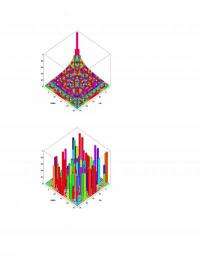
Mathematicians often work with matrices, which are arrays of numbers. When written on a page, a matrix can look like a sea of numbers, so any patterns that might occur in the numbers can be difficult to discern. More and more, mathematicians are turning to graphical representations of matrices, like the two examples here. By using color and form to indicate the values of the numbers in the matrix, these graphical representations can instantly give a sense of the patterns in the matrix. The first picture is a representation of a matrix in which the numbers exhibit a clear pattern; the second picture, by contrast, is a matrix in which the numbers are random. Graphic by David Bailey and Jonathan Borwein. Request their permission before reproducing the graphic.
In his 1989 book "The Emperor's New Mind", Roger Penrose commented on the limitations on human knowledge with a striking example: He conjectured that we would most likely never know whether a string of 10 consecutive 7s appears in the digital expansion of the number pi. Just 8 years later, Yasumasa Kanada used a computer to find exactly that string, starting at the 22869046249th digit of pi. Penrose was certainly not alone in his inability to foresee the tremendous power that computers would soon possess. Many mathematical phenomena that not so long ago seemed shrouded and unknowable, can now be brought into the light, with tremendous precision.
In their article "Exploratory Experimentation and Computation", to appear in the November 2011 issue of the Notices of the American Mathematical Society, David H. Bailey and Jonathan M. Borwein describe how modern computer technology has vastly expanded our ability to discover new mathematical results. "By computing mathematical expressions to very high precision, the computer can discover completely unexpected relationships and formulas," says Bailey.
Mathematics, the Science of Patterns
A common misperception is that mathematicians' work consists entirely of calculations. If that were true, computers would have replaced mathematicians long ago. What mathematicians actually do is to discover and investigate patterns---patterns that arise in numbers, in abstract shapes, in transformations between different mathematical objects, and so on. Studying such patterns requires subtle and sophisticated tools, and, until now, a computer was either too blunt an instrument, or insufficiently powerful, to be of much use in mathematics. But at the same time, the field of mathematics grew and deepened so much that today some questions appear to require additional capabilities beyond the human brain.
"There is a growing consensus that human minds are fundamentally not very good at mathematics, and must be trained," says Bailey. "Given this fact, the computer can be seen as a perfect complement to humans---we can intuit but not reliably calculate or manipulate; computers are not yet very good at intuition, but are great at calculations and manipulations."
Although mathematics is said to be a "deductive science", mathematicians have always used exploration, whether through calculations or pictures, to test ideas and gain intuition, in much the same way that researchers in inductive sciences carry out experiments. Today, this inductive aspect of mathematics has grown through the use of computers, which have vastly increased the amount and type of exploration that can be done. Computers are of course used to ease the burden of lengthy calculations, but they are also used for visualizing mathematical objects, discovering new relationships between such objects, and testing (and especially falsifying) conjectures. A mathematician might also use a computer to explore a result to see whether it is worthwhile to attempt a proof. If it is, then sometimes the computer can give hints about how the proof might proceed. Bailey and Borwein use the term "experimental mathematics" to describe these kinds of uses of the computer in mathematics.
Exploring Prime Numbers via Computers
Their article gives several examples of experimental mathematics; the computations of the digits of pi mentioned above is one of them. Another example is provided by computer explorations of a mathematical problem known as Giuga's Conjecture. This conjecture proposes that, for any positive integer n, one can check definitively whether n is prime by calculating a certain sum in which n appears in the exponent of the summands. That sum would have a certain value, call it S, if and only if n is prime; stated differently, that sum would not have the value S if and only if n is composite. Although the conjecture dates to 1950, it has never been proved and seems out of reach by conventional mathematical methods.
However, Bailey and Borwein, along with their collaborators, were able to use computers to show that any number that is an exception to Giuga's Conjecture must have more than 3,678 distinct prime factors and be more than 17,168 decimal digits long. That is, any shorter composite number cannot result in the value S. This does not prove Giuga's Conjecture is true, but it is a compelling piece of evidence in favor of the conjecture's truth. This kind of empirical evidence is sometimes just what is needed to generate enough confidence for a mathematician to dedicate energy to seeking a full proof. Without such confidence, the inspiration to push through to a proof might not be there.
Impact on Education
In addition to discussing state-of-the-art uses of computers in mathematics, the article also touches on the need to refashion mathematics education to give students the tools of experimental mathematics. "The students of today live, as we do, in an information-rich, judgment-poor world in which the explosion of information, and of tools, is not going to diminish," says Borwein. "So we have to teach judgment (not just concern with plagiarism) when it comes to using what is already possible digitally. Additionally, it seems to me critical that we mesh our software design---and our teaching style more generally---with our growing understanding of our cognitive strengths and limitations as a species."
Provided by American Mathematical Society
-
From lemons to lemonade: Reaction uses carbon dioxide to make carbon-based semiconductor,
32 comments
-
Thioridazine kills cancer stem cells in human while avoiding toxic side-effects of conventional cancer treatments,
3 comments
-
SpaceX private rocket blasts off for space station (Update),
42 comments
-
Climate scientists say they have solved riddle of rising sea,
31 comments
-
SpaceX capsule has 'new car' smell, astronauts say (Update),
3 comments
-
Justifying Proof by Contradiction
4 hours ago
-
Combining equations help
4 hours ago
-
About the definition of "discrete random variable"
6 hours ago
-
Limits
May 26, 2012
-
Complex numbers: Why is the modulus of z...
May 26, 2012
-
A close approximation for square root of 2.
May 25, 2012
- More from Physics Forums - General Math
More news stories
Change in developmental timing was crucial in the evolutionary shift from dinosaurs to birds: study
At first glance, it's hard to see how a common house sparrow and a Tyrannosaurus Rex might have anything in common. After all, one is a bird that weighs less than an ounce, and the other is a dinosaur that ...
Other Sciences / Archaeology & Fossils
1 hour ago |
5 / 5 (2) |
0
|
Social welfare cuts ultimately come with heavy price, researchers say
(Phys.org) -- Slashing government funding for Medicaid, food stamps and other programs that serve the poor while politically popular with some lawmakers and many conservatives may do more harm ...
Other Sciences / Social Sciences
May 24, 2012 |
4.3 / 5 (16) |
149
Ancient Bethlehem seal unearthed in Jerusalem
Israeli archaeologists have discovered a 2,700-year-old seal that bears the inscription "Bethlehem," the Israel Antiquities Authority announced Wednesday, in what experts believe to be the oldest artifact ...
Other Sciences / Archaeology & Fossils
May 23, 2012 |
3.5 / 5 (14) |
23
Oldest Jewish archaeological evidence on the Iberian Peninsula
German archaeologists of the Friedrich Schiller University Jena found one of the oldest archaeological evidence so far of Jewish Culture on the Iberian Peninsula at an excavation site in the south of Portugal, ...
Other Sciences / Archaeology & Fossils
May 25, 2012 |
4.3 / 5 (4) |
12
Dollars and sense: Why are some people morally against tax?
As the U.S. presidential election campaigns heat up, the economic debate is dominated by bailouts, austerity and, inevitably, taxation. Now a new study published in Symbolic Interaction asks why tax is such an important issue ...
Other Sciences / Social Sciences
May 23, 2012 |
3 / 5 (2) |
12
Computer model used to pinpoint prime materials for efficient carbon capture
When power plants begin capturing their carbon emissions to reduce greenhouse gases and to most in the electric power industry, it's a question of when, not if it will be an expensive undertaking.
'Unzipped' carbon nanotubes could help energize fuel cells, batteries
Multi-walled carbon nanotubes riddled with defects and impurities on the outside could replace some of the expensive platinum catalysts used in fuel cells and metal-air batteries, according to scientists at ...
T cells 'hunt' parasites like animal predators seek prey, study shows
By pairing an intimate knowledge of immune-system function with a deep understanding of statistical physics, a cross-disciplinary team at the University of Pennsylvania has arrived at a surprising finding: T cells use a movement ...
Yale study concludes public apathy over climate change unrelated to science literacy
Are members of the public divided about climate change because they don't understand the science behind it? If Americans knew more basic science and were more proficient in technical reasoning, would public consensus match ...
Same gene that stunts infants' growth also makes them grow too big: research
UCLA geneticists have identified the mutation responsible for IMAGe* syndrome, a rare disorder that stunts infants' growth. The twist? The mutation occurs on the same gene that causes Beckwith-Wiedemann syndrome, which makes ...
Scientists develop ultra-sensitive test that detects diseases in their earliest stages
Scientists have developed an ultra-sensitive test that should enable them to detect signs of a disease in its earliest stages, in research published today in the journal Nature Materials.
Oct 13, 2011
Rank: not rated yet
In the visual realm, color and form are for numbers, what in the realm of acoustics, music is for notes.
In the Quantum realm, today's computers will be the pocket calculators of yesterday.
Oct 13, 2011
Rank: not rated yet
When I was in art school I used to try to visualize equations and expressions overlaying what I was drawing, to try and help myself understand maths through physical examples.
Apples, oranges, Bob and Alice just don't seem to cut it anymore.
Oct 13, 2011
Rank: 1 / 5 (2)
Penrose was thinking about this from the wrong perspective.
A sequence of 10 7's appears in pretty much any irrational number, if you solve it to enough digits.
If you have an infinite number of digits in a non-repeating string, then there are an infinite number of sub-strings, of an infinite number of lengths, and all possible sub-strings will eventually appear at least one time.
If this were not true, then the number would not be irrational. If the main string EVER starts to repeat itself exactly, then you could find a ratio of real numbers to represent it, and it wouldn't be rational.
Example:
0.230769230769
Is not irrational.
It takes several digits before it starts to repeat, but then it repeats entirely, exactly.
This is 3/13.
So you can say with absolute certainty that there exists a string of 10, 11, 50, and 100, etc, consecutive 7's in the decimals of pi.
Oct 13, 2011
Rank: 1 / 5 (2)
then he did "double apocalyptic powers" and "triple apocalyptic powers" and so on.
Basicly, he proved that any number of consecutive digits substring can be found in some power of 2 if it is large enough.
Although you can use the computer to find specific solutions to such searches, the computer is not necessary to prove the assertion correct.
You can prove it correct intuitively by simply realizing that every combination of digits will eventually appear for some power of 2...
Oct 13, 2011
Rank: 5 / 5 (3)
Keep in mind that many, if not most, well defined numbers are not normal. PI has a very simple definition, and there exist algorithms to compute the nth digit, so it is well defined. So, on the one hand, while evidence is overwhelming that PI is normal based on empirical calculations, we also have overwhelming evidence that most well defined numbers aren't normal. Therefore, I would advise against saying things with certainty about whether certain sequences appear in PI, unless you have theoretical motivation for doing so.
Oct 13, 2011
Rank: not rated yet
Oct 13, 2011
Rank: 1 / 5 (1)
Oct 13, 2011
Rank: not rated yet
Oct 13, 2011
Rank: not rated yet
Oct 15, 2011
Rank: not rated yet
The easiest way for me to see that is to construct an irrational number that only has 0s and 1s in its decimal representation.
A quick way to do that is to look at any irrational number in its base 2 representation. As you point out, the 0s and 1s will not form a recurring pattern. Then just take this representation and use it as a decimal number instead. viola, an irrational number that has no 7s at all in its decimal representation.
Oct 17, 2011
Rank: not rated yet
I can't follow your argument at all.
Consider the decimal expansion:
0.1010010001000010000010000001...
(That's one zero, then two, then three and so on.)
It's irrational. It never repeats. Ten sevens never appear in it. Not even one seven appears in it.