Dark matter science
October 31, 2011 By Steve Nerlich, Universe Today
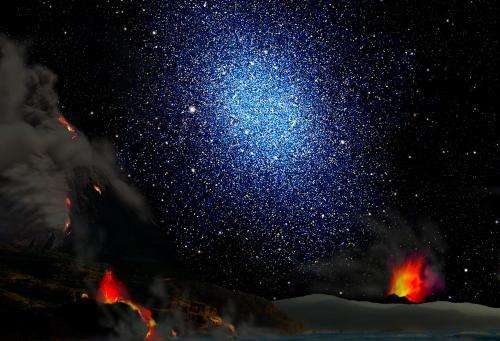
Dark matter has been found to be (unexpectedly) evenly distributed across dwarf galaxies - rather than clumping together in the centre in the way that we had expected of 'cold' dark matter. Credit NASA.
Dark matter theres a growing feeling that we are getting closer to finding out the true nature of this elusive stuff. At least we are running a number of experiments that seem (on theoretical grounds) to have the capacity to identify it and if they dont... well, maybe its time for a rethink of the whole ball game.
There are two arguably quite separate requirements for dark matter to make sense of our current dataset and our theoretical schema for the universe. Firstly, the Standard Model of cosmology (Lambda-Cold Dark Matter) requires that 96% of the universe is composed of stuff of an unknown nature that cannot be directly observed.
About two thirds of this unknown stuff cant possibly be matter since it apparently grows as the universe grows so we call it dark energy. The remaining component we call dark matter since it represents a component of the dark side that is capable of generating gravity. But thats about it. In this context, dark matter is invoked to balance the math within a set of formulae which are already straining credibility by telling us that 96% of the universe is invisible and undetectable. So, if that was all there was to argue the case for dark matter, you would be justified if feeling a little skeptical.
But the second requirement for dark matter is much more grounded in sound observation and conventional physics. Galaxies and the way in which galaxies cluster and dynamically interact dont make sense if they are composed of only the visible and other known types of matter that lie within them. The Milky Way itself is rotating in a manner that would result in much of it flying apart, if there wasnt additional invisible matter generating additional gravitational attraction. So there are sound reasons to think that there really could be something else out there.
Theres been a recent kerfuffle about dark matter in dwarf galaxies although this is largely about whether dark matter particles clump together at the centre or whether they are energetic particles whizzing about throughout the galaxy. Apparently the data better fit the latter scenario, which challenges the prevalent view that dark matter is cold and prone to clumping.
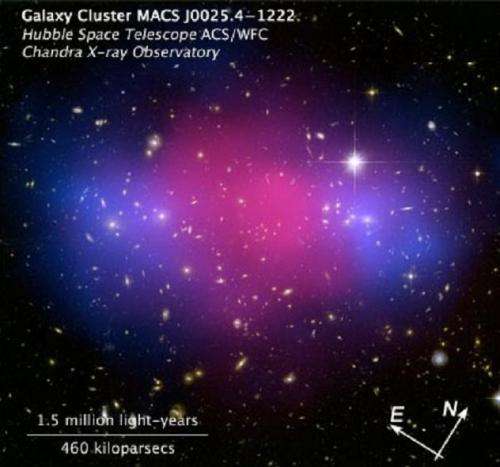
Similar to the Bullet Cluster, MACS J0025.4-1222 represents the aftermath of the collision of two galaxy clusters. Most of the mass of each cluster remnant is in the cool blue regions - each having already moved beyond the collision point due to being only weakly interacting mass. The pink region represents strongly radiating and strongly interacting mass has been slowed up within the initial collision. Credit NASA.
A recent literature review on Arxiv provides a comprehensive coverage of the current status of dark matter science. Initial data from the PAMELA spacecraft, showing an anomalous cosmic ray flux, encouraged speculation that this might result from dark matter annihilating or decaying. This theory did not receive wide support, but such speculation was more recently revived with FERMI-LAT finding unexpected flows of positrons (i.e. antimatter) followed by an announcement that FERMI-LAT and other telescopes will undertake a dedicated search for gamma ray lines arising from dark matter annihilation or decay. Here it is presumed or at least hypothesised that dark matter can be destroyed within the hot, dense and dynamic centres of galaxies, including our galaxy.
So space science could provide at least circumstantial evidence for one of the biggest mysteries in space science although all findings to date are inconclusive at best.
Earth-based experiments are looking for more direct evidence of the particle nature of dark matter. For example, the Large Hadron Collider is looking for signs of supersymmetry particle signatures. The hypothesised neutralino would nicely fit the hypothesised characteristics of a dark matter particle (a particle that weakly interacts with other matter, has neutral charge, is stable over cosmic timescales and has no color charge), but there are no signs of the neutralino, or anything else clearly supersymmetrical, so far.
There are also experiments, like DAMA/LIBRA, deep down coal mines and the like, which are designed to directly identify weakly interactive massive particles although again findings to date are all a bit inconclusive.
And all a bit inconclusive is a statement that aptly represents the current state of dark matter science we remain confident that there is something out there, but (obligatory play on words coming) we remain as much in the dark as ever about what exactly it is.
More information: Capoziello et al The missing matter problem: From the dark matter search to alternative hypotheses.
Source: Universe Today
-
From lemons to lemonade: Reaction uses carbon dioxide to make carbon-based semiconductor,
32 comments
-
Thioridazine kills cancer stem cells in human while avoiding toxic side-effects of conventional cancer treatments,
3 comments
-
SpaceX private rocket blasts off for space station (Update),
42 comments
-
Climate scientists say they have solved riddle of rising sea,
31 comments
-
SpaceX capsule has 'new car' smell, astronauts say (Update),
3 comments
-
Water flow question
3 hours ago
-
[Drift velocity] Factors affecting velocity
6 hours ago
-
does cold gasoline have less energy
6 hours ago
-
distribution of molecules throughout the atmosphere
8 hours ago
-
The Global Positioning System !
9 hours ago
-
A Question relating Power
10 hours ago
- More from Physics Forums - General Physics
More news stories
Is a classical electrodynamics law incompatible with special relativity?
(Phys.org) -- The laws of classical electromagnetism that were developed in the 19th century are the same laws that scientists use today. They include Maxwell’s four equations along with the Lorentz la ...
Landmark calculation clears the way to answering how matter is formed
(Phys.org) -- An international collaboration of scientists, including Thomas Blum, associate professor of physics, is reporting in landmark detail the decay process of a subatomic particle called a kaon ...
May 25, 2012 |
4.3 / 5 (22) |
50
|
Lying in wait for WIMPs: Researchers seek to dramatically increase sensitivity of Large Underground Xenon detector
Although it's invisible, dark matter accounts for at least 80 percent of the matter in the universe. No one knows what it is, but most scientists would bet on weakly interacting massive particles, or WIMPs.
May 23, 2012 |
4 / 5 (7) |
15
|
Hawaii lab turns laser-powered bubbles into microrobots
(Phys.org) -- A team of scientists from the University of Hawaii are working on microrobots created from bubbles of air in a saline solution. The bubbles take on their title of robots as a laser ...
Sound increases the efficiency of boiling
Scientists at the Georgia Institute of Technology achieved a 17-percent increase in boiling efficiency by using an acoustic field to enhance heat transfer. The acoustic field does this by efficiently removing vapor bubbles ...
May 24, 2012 |
5 / 5 (2) |
2
Computer model used to pinpoint prime materials for efficient carbon capture
When power plants begin capturing their carbon emissions to reduce greenhouse gases and to most in the electric power industry, it's a question of when, not if it will be an expensive undertaking.
'Unzipped' carbon nanotubes could help energize fuel cells, batteries
Multi-walled carbon nanotubes riddled with defects and impurities on the outside could replace some of the expensive platinum catalysts used in fuel cells and metal-air batteries, according to scientists at ...
T cells 'hunt' parasites like animal predators seek prey, study shows
By pairing an intimate knowledge of immune-system function with a deep understanding of statistical physics, a cross-disciplinary team at the University of Pennsylvania has arrived at a surprising finding: T cells use a movement ...
Yale study concludes public apathy over climate change unrelated to science literacy
Are members of the public divided about climate change because they don't understand the science behind it? If Americans knew more basic science and were more proficient in technical reasoning, would public consensus match ...
Same gene that stunts infants' growth also makes them grow too big: research
UCLA geneticists have identified the mutation responsible for IMAGe* syndrome, a rare disorder that stunts infants' growth. The twist? The mutation occurs on the same gene that causes Beckwith-Wiedemann syndrome, which makes ...
Change in developmental timing was crucial in the evolutionary shift from dinosaurs to birds: study
At first glance, it's hard to see how a common house sparrow and a Tyrannosaurus Rex might have anything in common. After all, one is a bird that weighs less than an ounce, and the other is a dinosaur that ...

Oct 31, 2011
Rank: 4.5 / 5 (4)
Study of the history of science has consistently revealed that these 'either or' dichotomies are somewhat unnecessary. Often it has shaken out that each school of thought had gotten part of the answer correct, but it was only realized when people decided to bridge the gaps between them.
I suspect when the dust settles, we will discover that the MOND/LCDM (and their variants) debate will follow a similar pattern, with each revealing truths about the universe.
Oct 31, 2011
Rank: not rated yet
Oct 31, 2011
Rank: 1.3 / 5 (3)
Oct 31, 2011
Rank: 0.3 / 5 (25)
Yes, but since they haven't been observed, the theorists have had to propose theoretical particles that are larger than the energies currently attainable.
Of course, those particles are just theoretical... Right?
Oct 31, 2011
Rank: 0.4 / 5 (25)
MACHOs haven't been observed either. And there have been scintillation studies done to look for them.
Nov 01, 2011
Rank: 1.7 / 5 (6)
Nov 01, 2011
Rank: 1.2 / 5 (30)
TimE wants his energy from nothing and his chicks for free.
Nov 01, 2011
Rank: 5 / 5 (2)
What kind of red blooded male are you? I would love to get my chicks for free, and i would need lots of free energy otherwise i may quickly get exausted from the efforts of, "getting the most from my free chicks".
Nov 01, 2011
Rank: not rated yet
Nov 01, 2011
Rank: 5 / 5 (1)
Ethelred
Nov 02, 2011
Rank: 3 / 5 (2)
Actually more like "Dark matter wild postulating".
When someone can post the details and parameters of a Dark Matter experiment (and don't leave out the control group!) then perhaps it might rank the label "science". As is, the "S" in "SWAG" itself is being too gracious.
Nov 03, 2011
Rank: 1 / 5 (1)
And who pays the help and the light bill? Who pays for the carpet cleaning and dumping the trash? Did the book appear out of nowhere? If so Mr. Heinlein somehow got the credit.
Nov 03, 2011
Rank: 5 / 5 (1)
Humor free.
Ethelred
Nov 04, 2011
Rank: 2.5 / 5 (2)
Nov 05, 2011
Rank: 0.4 / 5 (25)
Three are three possibilities if you are looking for missing matter.
1. Large globs of the stuff in the form of Macho's
2. Intermediate particles of charged hydrogen dust, a few billion atoms in size.
3. Some new subatomic particle that hasn't yet been discovered.
Option 2 seems the most probable to me.
Nov 05, 2011
Rank: 2.5 / 5 (2)
Dyson Spheres! Billions of them. Ok, taking off the foil hat now.
Nov 06, 2011
Rank: 5 / 5 (2)
All-sky Dyson Sphere searches have already been conducted using data from the InfRared Astronomical Satellite(IRAS). After mimicking and erroneous sources have been eliminated, a *very* few ambiguous candidates remain. IRAS' Low Resolution Spectrometer was able to sample nearly 10^6 solar-type stars out to a distance of ~300pc, while detecting no unambiguous evidence for a single DS:
http://home.fnal....arch.htm
http://iopscience...2075.pdf
Perhaps deeper, more sensitive surveys by Spitzer and Akari may find otherwise, but the prospects look dim.
Nov 06, 2011
Rank: not rated yet
Very good question.
Nov 06, 2011
Rank: 2.3 / 5 (3)
The same kind of story with neutrinos that the cross section for a cool neutrino is so small that it will be invisible. But at least the ultrahigh energy neutrino has a greater chance of interacting. So we may find that if we could accelerate protons or the like to similar energies there could be some interaction with what is otherwise cool neutrinos in order to get a measurement of the density of them around the earth. We already know for solar system gravity that there are not invisible accumulations of dark matter around the sun or earth.
And hydrogen ion clusters of billions of atoms are not likely to be stable as they would evaporate in the vacuum and heat of space.
Nov 06, 2011
Rank: 2.3 / 5 (3)
Nov 07, 2011
Rank: 0.3 / 5 (25)
Ya. Very good point. Perhaps the initial helium density of the universe was 1/4 of what is observed in the youngest objects.
Is it even possible to measure the helium content of the extended halo of matter surrounding galaxies?
"you may well ask how come the sun does not have more hydrogen?" - Graeme
Or less Helium at the outset.
"A simple experiment with a charged plate on a microphone in space should get some loud pings and pops as it attracts these ions (if they existed)." - Graeme
Also true. Has anyone been listening?
Nov 07, 2011
Rank: 5 / 5 (2)
If its ionized how the hell does it form a cluster? Ionized hydrogen is a proton. Protons are all positively charged. They CANNOT cluster except under influence of a LOT of gravity. So what is causing this purely hypothetical, no evidence of it existing, cluster and why do you even think they might exist?
So with that said the parts about the proportions of H and He in the Sun don't make any sense either since they were dependent of the bizarre concept of hydrogen ion clusters.
Ethelred
Nov 07, 2011
Rank: not rated yet
Have you heard of solar wind? You'd hear nothing but that. Please, for the love of all that is holy: why doesn't anyone use google or wikipedia before posting crap?
Nov 08, 2011
Rank: not rated yet
Nov 08, 2011
Rank: not rated yet
cluster ions with a mass of several billion would behave differently to the solar wind. They would be very little affected by magnetic fields, and would impact with a dull thud on the hypothetical cathode, unlike the protons from the solar wind. You could make a simple mass spectrometer arrangement to separate ions of different mass. My point is that these clusters probably do not exist, and if they did they should have been detected already.
I don't really believe that hydrogen ion clusters exist in such massive gigaclusters, and that if the clusters abound they are more likely to be condensed on dust grains.