CryoSat rocking and rolling
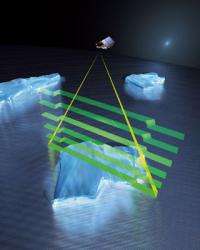
CryoSat is able to measure the freeboard (the height protruding above the water) of floating sea ice with its sensitive altimeter. From the freeboard, the ice thickness can be estimated. Credits: ESA /AOES Medialab
(PhysOrg.com) -- ESAs ice satellite is rolling left and right in orbit to help it continue its precise measurements of the vast ice sheets that blanket Greenland and Antarctica.
Since its launch 18 months ago, CryoSat-2 has been collecting data to improve our understanding of the relationship between ice and climate.
Just this year, the first map of Arctic sea-ice thickness was unveiled, and the satellite will continue to monitor the changing ice for years to come.
To ensure the precision of the measurements, an operation is under way to roll the satellite from side to side as it flies over the flat oceans.
This manoeuvre is to calibrate CryoSats radar altimeter for measuring ice thickness, especially over the margins of ice sheets.
The altimeter has two antennas mounted on a bench about a metre apart. When it is working in the SARIn mode, both antennas are used in parallel: one emits a signal and both receive the signals that bounce back.
Normally, this bench is parallel to Earths surface. But at the edges of the ice sheets, the ice surface is not always flat and the slopes affect the return signals.
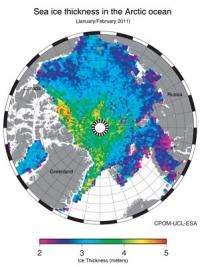
CryoSat’s exceptionally detailed data have been used to generate this map of sea-ice thickness in the Arctic. Data from January and February this year have been used to show the thickness of the ice as it approaches its annual maximum. Thanks to CryoSat’s orbit, ice thickness close to the North Pole can be seen for the first time. Credits: CPOM/UCL/ESA
Harsh conditions in space with huge temperature differences between Sun and shade can lead to the deterioration of CryoSats instruments, which can also lead to measurement errors.In order to quantify these errors, ESA ground controllers are working to recalibrate the altimeter.
They are rolling the satellite to simulate the ice slopes and holding it in this position for several minutes. This must be done while CryoSat is over large, flat surfaces. For satellite altimeters, oceans are Earths largest flat surfaces.
It will also check whether errors are related to CryoSats varying thermal conditions like when exposed to the Sun or in the shade.
With the results from the different sets of rolls over different ocean surfaces and at different ambient conditions, we are aiming to characterise the instrument to a precision better than we thought we could make at the time of the launch, said Tommaso Parrinello, CryoSat mission manager.
During several manoeuvres on Monday and Tuesday, the satellite is rolling 0.4º to both sides while over the Indian and Pacific oceans, before returning to its original position.
The preparations for the roll activities have been quite challenging, explained Nic Mardle, spacecraft operations manager.
Although we had experience of these activities from the commissioning phase, we had to iterate a few more times with the planning and mission control teams so that we could support exactly what was required.
The complex calibration is a joint effort between ESAs ESRIN centre for Earth observation in Italy and its ESOC operations centre in Germany.
CryoSat is dedicated to monitoring changes in the thickness of marine ice floating in the polar oceans and of the vast ice sheets that extend over Greenland and the Antarctic.
Satellites have already shown that the extent of sea ice in the Arctic is diminishing. In fact, this years minimum has set a new record low.
Provided by
European Space Agency
-
From lemons to lemonade: Reaction uses carbon dioxide to make carbon-based semiconductor,
32 comments
-
Thioridazine kills cancer stem cells in human while avoiding toxic side-effects of conventional cancer treatments,
3 comments
-
SpaceX private rocket blasts off for space station (Update),
42 comments
-
Climate scientists say they have solved riddle of rising sea,
31 comments
-
SpaceX capsule has 'new car' smell, astronauts say (Update),
3 comments
-
Hypothetical desert earth
16 hours ago
-
More human population = greater mass?
May 25, 2012
-
Conversion from aircraft bearing to normal degrees
May 23, 2012
-
Interpretation/Analysis of the Lab results(HEPA filter)
May 22, 2012
-
Has anyone here attended the The Urbino Summer School in Paleoclimatology?
May 22, 2012
-
Earthquakes: Mag 6 N. Italy and Mag 5.6 W. Bulgaria
May 21, 2012
- More from Physics Forums - Earth
More news stories
Yale study concludes public apathy over climate change unrelated to science literacy
Are members of the public divided about climate change because they don't understand the science behind it? If Americans knew more basic science and were more proficient in technical reasoning, would public consensus match ...
1 hour ago |
not rated yet |
4
|
10 million years needed to recover from mass extinction
It took some 10 million years for Earth to recover from the greatest mass extinction of all time, latest research has revealed.
Space & Earth / Earth Sciences
1 hour ago |
not rated yet |
1
|
Sophisticated simulations predict future warming
The chances of our planet being hit by a global warming of 3 degrees Celsius by 2050 is as likely as it being hit by an increase of 1.4 degrees, new research shows. Presented in the journal Nature Geoscience, the British study ...
Space & Earth / Earth Sciences
May 22, 2012 |
4.4 / 5 (9) |
51
Aliens don't want to eat us, says former SETI director
Alien life probably isnt interested in having us for dinner, enslaving us or laying eggs in our bellies, according to a recent statement by former SETI director Jill Tarter.
Space & Earth / Space Exploration
May 25, 2012 |
4.4 / 5 (13) |
39
Kyoto Protocol architect 'frustrated' by climate dialogue
UN climate talks are going nowhere, as politicians dither or bicker while the pace of warming dangerously speeds up, one of the architects of the Kyoto Protocol told AFP.
May 23, 2012 |
3.7 / 5 (7) |
39
Computer model used to pinpoint prime materials for efficient carbon capture
When power plants begin capturing their carbon emissions to reduce greenhouse gases and to most in the electric power industry, it's a question of when, not if it will be an expensive undertaking.
'Unzipped' carbon nanotubes could help energize fuel cells, batteries
Multi-walled carbon nanotubes riddled with defects and impurities on the outside could replace some of the expensive platinum catalysts used in fuel cells and metal-air batteries, according to scientists at ...
T cells 'hunt' parasites like animal predators seek prey, study shows
By pairing an intimate knowledge of immune-system function with a deep understanding of statistical physics, a cross-disciplinary team at the University of Pennsylvania has arrived at a surprising finding: T cells use a movement ...
Same gene that stunts infants' growth also makes them grow too big: research
UCLA geneticists have identified the mutation responsible for IMAGe* syndrome, a rare disorder that stunts infants' growth. The twist? The mutation occurs on the same gene that causes Beckwith-Wiedemann syndrome, which makes ...
Change in developmental timing was crucial in the evolutionary shift from dinosaurs to birds: study
At first glance, it's hard to see how a common house sparrow and a Tyrannosaurus Rex might have anything in common. After all, one is a bird that weighs less than an ounce, and the other is a dinosaur that ...
Scientists develop ultra-sensitive test that detects diseases in their earliest stages
Scientists have developed an ultra-sensitive test that should enable them to detect signs of a disease in its earliest stages, in research published today in the journal Nature Materials.
