Cooperative communications when collaborators are not synchronized
A promising way to improve future wireless communication speed is to have users and/or base stations help each other. This is called cooperative communications. One of the practical difficulties in cooperative communications is the synchronization problem between the helpers. A paper in the recent issue of Science in China summarizes some of the recent techniques and advances in signal design to deal with this problem.
A basic challenge for future wireless communication systems is the contradiction between the fast growing demand for high speed wireless communications and the limited electromagnetic wave frequency spectrum. The multiple-input multiple-output (MIMO) technique with space-time coding (STC) is recognized as a promising scheme for the next-generation of high speed wireless communication systems. This is mainly because of its capability of providing spatial diversity to combat fading in wireless channels and increasing the capacity without additional power consumption or bandwidth expansion. However, all these improvements come at the cost of multiple radio frequency (RF) front ends at both the transmitter and the receiver. The size of the mobile devices and the requirements for distance between antennas may limit the number of antennas that can be deployed. The exploitation of the spatial benefits for wireless terminals with only single antennas becomes an obvious question. Cooperative communications technology may provide an answer to this question.
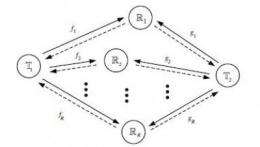
In cooperative communications, as shown in Figure 1, multiple terminals in a wireless network are capable of working together: one terminal can help others transmit their desired signals. As such, the spatial links of both the transmitter and the helper can be exploited and as a result, multiple single-antenna terminals can share their antennas to create a virtual antenna array. Meanwhile, because of their distributed nature, independently fading channels could be guaranteed to provide a spatial degree-of-freedom. Through cooperation it becomes possible to exploit the spatial resource of the traditional MIMO techniques without the need to equip each terminal with multiple antennas. Therefore, it can be considered as a distributed MIMO system, while the traditional MIMO system can be termed a co-located MIMO system. Since the early studies by Sendonaris et al. and Laneman et al., cooperative communications techniques have attracted tremendous interest over recent years, both in academia and industry. Distributed space-time coding (DSTC), i.e., the distributed counterpart of space-time coding in co-located MIMO systems, has become an efficient technique to provide spatial diversity for cooperative communication systems. On the one hand, cooperation is embedded into cellular mobile communications systems and new cooperative stations may be built in a cellular system; on the other hand, a cooperative communications technique is adopted in the physical layer of ad hoc networks and wireless sensor networks (WSN). Compared with the co-located MIMO systems, the most distinctive characteristic of cooperative communications systems is their distributed nature: multiple terminals in cooperation are spatially separated in several different physical locations. Thus, some new problems that do not exist in co-located MIMO systems have emerged: for example,
- Signal coordination: Whether and when a terminal participates in the cooperation, and what a terminal should transmit.
- Time asynchronism: Multiple cooperative terminals have different distances to the destination terminal and thus the cooperative transmission may be time-asynchronous.
- Frequency asynchronism: Each cooperative terminal has its own oscillator and thus the cooperative transmission is frequency-asynchronous.
An overview of some of the research efforts on this topic in recent years is given in the published paper below, by considering the last two problems, i.e., time and frequency asynchronism. The paper summarizes various distributed STCs and equalization methods that have been proposed for cooperative nodes and destination nodes to combat time and frequency asynchronism, all aimed at achieving as much diversity gain as possible.
More information: Hui-Ming Wang and Xiang-Gen Xia, Asynchronous cooperative communication systems: A survey of signal designs, SCI CHINA Information Sci, 2011, doi: 10.1007/s11432-011-4306-8
Provided by Science in China Press


