One clock with two times: When quantum mechanics meets general relativity
Oct 19, 2011
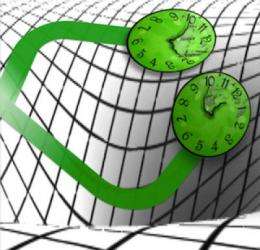
According to general relativity, time flows differently at different positions due to the distortion of space-time by a nearby massive object. A single clock being in a superposition of two locations allows probing quantum interference effects in combination with general relativity. Credit: Quantum Optics, Quantum Nanophysics, Quantum Information; University of Vienna.

The unification of quantum mechanics and Einstein's general relativity is one of the most exciting and still open questions in modern physics. General relativity, the joint theory of gravity, space and time gives predictions that become clearly evident on a cosmic scale of stars and galaxies. Quantum effects, on the other hand, are fragile and are typically observed on small scales, e.g. when considering single particles and atoms. That is why it is very hard to test the interplay between quantum mechanics and general relativity. Now theoretical physicists led by Prof. Caslav Brukner at the University of Vienna propose a novel experiment which can probe the overlap of the two theories. The focus of the work is to measure the general relativistic notion of time on a quantum scale. The findings will be published this week in Nature Communications.

One of the counterintuitive predictions of Einstein's general relativity is that gravity distorts the flow of time. The theory predicts that clocks tick slower near a massive body and tick faster the further they are away from the mass. This effect results in a so-called "twin paradox": if one twin moves out to live at a higher altitude, he will age faster than the other twin who remains on the ground. This effect has been precisely verified in classical experiments, but not in conjunction with , which is the aim of the newly proposed experiment.

The Viennese group of researchers wants to exploit the extraordinary possibility that a single can lose the classical property of having a well-defined position, or as phrased in quantum mechanical terms: it can be in a "superposition". This allows for wave-like effects, called interference, with a single particle. However, if the position of the particle is measured, or even if it can in principle be known, this effect is lost. In other words, it is not possible to observe interference and simultaneously know the position of the particle. Such a connection between information and interference is an example of quantum complementarity - a principle proposed by Niels Bohr. The experimental proposal now published in Nature Communications combines this principle with the "twin paradox" of general relativity.

The team at the University of Vienna considers a single clock (any particle with evolving internal degrees of freedom such as spin) which is brought in a superposition of two locations – one closer and one further away from the surface of the Earth. According to general relativity, the clock ticks at different rates in the two locations, in the same way as the two twins would age differently. But since the time measured by the clock reveals the information on where the clock was located, the interference and the wave-nature of the clock is lost. "It is the twin paradox for a quantum 'only child', and it requires as well as . Such an interplay between the two theories has never been probed in experiments yet" – says Magdalena Zych, the lead author of the paper and member of the Vienna Doctoral Program CoQuS. It is therefore the first proposal for an experiment that allows testing the genuine general relativistic notion of time in conjunction with quantum complementarity.

Explore further: Researchers forward quest for quantum computing

More information: "Quantum interferometric visibility as a witness of general relativistic proper time". M. Zych, F. Costa, I. Pikovski und C. Brukner. DOI: 10.1038/ncomms1498

Related Stories

Doubly special relativity

Mar 21, 2011

General relativity, Einstein’s theory of gravity, gives us a useful basis for mathematically modeling the large scale universe – while quantum theory gives us a useful basis for modeling sub-atomic ...

Quantum simulation of a relativistic particle

Jan 06, 2010

(PhysOrg.com) -- Researchers of the Institute for Quantum Optics and Quantum Information (IQOQI) in Innsbruck, Austria used a calcium ion to simulate a relativistic quantum particle, demonstrating a phenomenon ...

Recommended for you

A quantum simulator for magnetic materials

6 hours ago

Physicists understand perfectly well why a fridge magnet sticks to certain metallic surfaces. But there are more exotic forms of magnetism whose properties remain unclear, despite decades of intense research. ...

Researchers forward quest for quantum computing

12 hours ago

Research teams from UW-Milwaukee and the University of York investigating the properties of ultra-thin films of new materials are helping bring quantum computing one step closer to reality.

Hydrogen atoms under the magnifying glass

May 22, 2013

To describe the microscopic properties of matter and its interaction with the external world, quantum mechanics uses wave functions, whose structure and time dependence is governed by the Schrödinger equation. ...

Making quantum encryption practical

May 21, 2013

One of the many promising applications of quantum mechanics in the information sciences is quantum key distribution (QKD), in which the counterintuitive behavior of quantum particles guarantees that no one can eavesdrop on ...

Lab sets a new record for creating heralded photons

May 20, 2013

(Phys.org) —Entanglement, by general consensus of physicists, is the weirdest part of quantum science. To say that two particles, A and B, are entangled means that they are actually two parts of an inseparable ...

Competition in the quantum world

May 20, 2013

Innsbruck physicists led by Rainer Blatt and Peter Zoller experimentally gained a deep insight into the nature of quantum mechanical phase transitions. They are the first scientists that simulated the competition ...

User comments : 8

Adjust slider to filter visible comments by rank

Display comments: newest first

Isaacsname
not rated yet Oct 19, 2011
*Scratches head*

It would be quite a milestone to put a particle into orbit while still preserving an entanglement with one on earth. Even to the moon, Alice o,O. I read that the " speed ' of entanglemts has a minimum lower bound of 10^4c, how would they measure the discrepencies..?
hush1
1 / 5 (1) Oct 19, 2011
Different quantum states produce the same physical properties.
Both, the states and the physical underlie the same curvature.
Silverhill
5 / 5 (1) Oct 19, 2011
(from the article)
The theory predicts that clocks tick slower near a massive body and tick faster the further they are away from the mass. This effect results in a so-called "twin paradox": if one twin moves out to live at a higher altitude, he will age faster than the other twin who remains on the ground.
No. This situation has a constant, incontrovertible difference: one twin is lower in a gravity well, and the other is higher. There is not the relativistic symmetry that gave rise to the original paradox--the symmetry that Special Relativity cannot resolve but that General Relativity can.
antialias_physorg
not rated yet Oct 20, 2011
The original paradox is basically the same. The problem isn't that one twin moves faster than the other but that one twin lives in a frame of reference that gets accelerated a number of times (upon leaving the Earth, when turning around, and - optionally - upon arriving back at Earth) while the other twin does not get accelerated (for the sake of the argument the twin that is at home does not live on an Earth with a gravity field).

Living in a gravity field is like being constantly subjected to an accelerating frame of reference. So moving a non-localized entity (e.g. an electron subjected to a double slit experiment) where the paths through the slits have different gravitational situations will give us the 'twins paradox' scenario - albeit for one particle only.

But I guess making the actual experiment will be extremely hard unless you do it close to a black hole.
YawningDog
1 / 5 (1) Oct 20, 2011
"Living in a gravity field is like being constantly subjected to an accelerating frame of reference."

....should be....

Living in a gravity field is similar, in certain respects, to being subjected to an accelerating frame of reference.
El_Nose
not rated yet Oct 20, 2011
yeah and you figure out that hey time shoul dbe different - but it's not -- why cause the universe knows there is really only one particle -- and there you have it a new test to know if you have been talking to a superposition or a real person.
antialias_physorg
5 / 5 (2) Oct 20, 2011
Living in a gravity field is similar, in certain respects, to being subjected to an accelerating frame of reference.

Nope. From a Relativity point of view the two are identical.
savvys84
not rated yet Nov 19, 2011
Heck Ein stein was wrong.
Gravity speeds up time.

More news stories

A quantum simulator for magnetic materials

Physicists understand perfectly well why a fridge magnet sticks to certain metallic surfaces. But there are more exotic forms of magnetism whose properties remain unclear, despite decades of intense research. ...

Engineers pioneer flat spray-on optical lens

A University of British Columbia engineer and a team of U.S. researchers have made a breakthrough utilizing spray-on technology that could revolutionize the way optical lenses are made and used.

Researchers forward quest for quantum computing

Research teams from UW-Milwaukee and the University of York investigating the properties of ultra-thin films of new materials are helping bring quantum computing one step closer to reality.

How do cold ions slide

Things not always run smoothly. It may happen, actually, that when an object slides on another, the advancement may occur through a 'stop and go' series in the characteristic manner which scientists call ...

Controlling mood through the motions of mitochondria

(Medical Xpress)—Regulating the distribution of power in neurons is done by a system that makes the national electric grid look simple by comparison. Each neuron has several thousand mitochondria confined ...