Astronomers find elusive planets in decade-old Hubble data
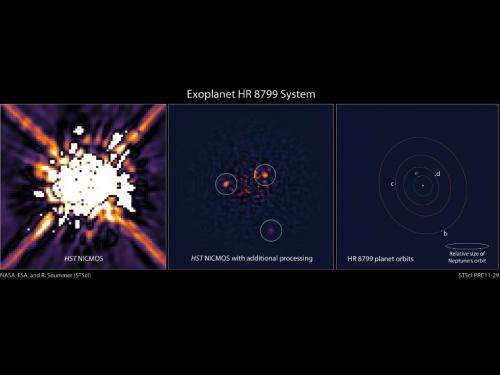
The left image shows the star HR 8799 as seen by Hubble's Near Infrared Camera and Multi-Object Spectrometer (NICMOS) in 1998. The center image shows recent processing of the NICMOS data with newer, sophisticated software. The processing removes most of the scattered starlight to reveal three planets orbiting HR 8799. Based on the reanalysis of NICMOS data and ground-based observations, the illustration on the right shows the positions of the star and the orbits of its four known planets. (Credit: NASA; ESA; STScI, R. Soummer)
(PhysOrg.com) -- In a painstaking re-analysis of Hubble Space Telescope images from 1998, astronomers have found visual evidence for two extrasolar planets that went undetected back then.
Finding these hidden gems in the Hubble archive gives astronomers an invaluable time machine for comparing much earlier planet orbital motion data to more recent observations. It also demonstrates a novel approach for planet hunting in archival Hubble data.
Four giant planets are known to orbit the young, massive star HR 8799, which is130 light-years away. In 2007 and 2008 the first three planets were discovered in near-infrared ground-based images taken with the W.M. Keck Observatory and the Gemini North telescope by Christian Marois of the National Research Council in Canada and his team. Marois and his colleagues then uncovered a fourth innermost planet in 2010. This is the only multiple exoplanetary system for which astronomers have obtained direct snapshots.
In 2009 David Lafreniere of the University of Montreal recovered hidden exoplanet data in Hubble images of HR 8799 taken in 1998 with the Near Infrared Camera and Multi-Object Spectrometer (NICMOS). He identified the position of the outermost planet known to orbit the star. This first demonstrated the power of a new data-processing technique for retrieving faint planets buried in the glow of the central star.
A new analysis of the same archival NICMOS data by Remi Soummer of the Space Telescope Science Institute in Baltimore has recovered all three of the outer planets. The fourth, innermost planet is 1.5 billion miles from the star and cannot be seen because it is on the edge of the NICMOS coronagraphic spot that blocks the light from the central star.
By finding the planets in multiple images spaced over years of time, the orbits of the planets can be tracked. Knowing the orbits is critical to understanding the behavior of multiple-planet systems because massive planets can perturb each other's orbits. "From the Hubble images we can determine the shape of their orbits, which brings insight into the system stability, planet masses and eccentricities, and also the inclination of the system," says Soummer.
These results are to be published in the Astrophysical Journal.
The three outer gas-giant planets have approximately 100-, 200-, and 400-year orbits. This means that astronomers need to wait a very long time to see how the planets move along their paths. The added time span from the Hubble data helps enormously. "The archive got us 10 years of science right now," he says. "Without this data we would have had to wait another decade. It's 10 years of science for free."
Nevertheless, the slowest-moving, outermost planet has barely changed position in 10 years. "But if we go to the next inner planet we see a little bit of an orbit, and the third inner planet we actually see a lot of motion," says Soummer.
The planets weren't found in 1998 when the Hubble observations were first taken because the methods used to detect them were not available at that time. When astronomers subtracted the light from the central star to look for the residual glow of planets, the residual light scatter was still overwhelming the faint planets.
Lafreniere developed a way to improve this type of analysis by using a library of reference stars to more precisely remove the "fingerprint" glow of the central star. Soummer's team took Lafreniere's method a step further and used 466 images of reference stars taken from a library containing over 10 years of NICMOS observations assembled by Glenn Schneider of the University of Arizona.
Soummer's team further increased contrast and minimized residual starlight. They completely removed the diffraction spikes, which are artifacts common to telescope imaging systems. This allowed them to see two of the faint inner planets in the Hubble data. The planets recovered in the NICMOS data are about 1/100,000th the brightness of the parent star when viewed in near-infrared light.
Soummer next plans to analyze approximately 400 other stars in the NICMOS archive with the same technique, improving image quality by a factor of 10 over the imaging methods used when the data were obtained.
Soummer's work demonstrates the power of the Hubble Space Telescope data archive, which harbors images and spectral information from over twenty years of Hubble observations. Astronomers tap into this library to complement new observations with a wealth of invaluable data already gathered, yielding much more discovery potential than new observations alone.
From the NICMOS archive data Soummer's team will assemble a list of planetary candidates to be confirmed by ground-based telescopes. If new planets are discovered they will once again have several years' worth of orbital motion to measure.
Provided by
JPL/NASA
-
From lemons to lemonade: Reaction uses carbon dioxide to make carbon-based semiconductor,
32 comments
-
Thioridazine kills cancer stem cells in human while avoiding toxic side-effects of conventional cancer treatments,
3 comments
-
SpaceX private rocket blasts off for space station (Update),
42 comments
-
Climate scientists say they have solved riddle of rising sea,
31 comments
-
SpaceX capsule has 'new car' smell, astronauts say (Update),
4 comments
-
Distance of planets from stars and revolution
4 hours ago
-
revamping general concept and cosmological principle
May 25, 2012
-
Transiting Exoplanet Light Curve
May 25, 2012
-
Math behind Theoretical Physics
May 24, 2012
-
Do we know whats at the center of galaxies yet?
May 23, 2012
-
Structure of the Milky Way?
May 20, 2012
- More from Physics Forums - General Astronomy
More news stories
Land and sea species differ in climate change response: study
(Phys.org) -- Marine and terrestrial species will likely differ in their responses to climate warming, new research by Simon Fraser University and Australia’s University of Tasmania has found.
2 hours ago |
not rated yet |
1
|
Yale study concludes public apathy over climate change unrelated to science literacy
Are members of the public divided about climate change because they don't understand the science behind it? If Americans knew more basic science and were more proficient in technical reasoning, would public consensus match ...
4 hours ago |
4 / 5 (1) |
10
|
10 million years needed to recover from mass extinction
It took some 10 million years for Earth to recover from the greatest mass extinction of all time, latest research has revealed.
Space & Earth / Earth Sciences
4 hours ago |
not rated yet |
1
|
Sophisticated simulations predict future warming
The chances of our planet being hit by a global warming of 3 degrees Celsius by 2050 is as likely as it being hit by an increase of 1.4 degrees, new research shows. Presented in the journal Nature Geoscience, the British study ...
Space & Earth / Earth Sciences
May 22, 2012 |
4.4 / 5 (9) |
51
Aliens don't want to eat us, says former SETI director
Alien life probably isnt interested in having us for dinner, enslaving us or laying eggs in our bellies, according to a recent statement by former SETI director Jill Tarter.
Space & Earth / Space Exploration
May 25, 2012 |
4.4 / 5 (14) |
40
'Unzipped' carbon nanotubes could help energize fuel cells, batteries
Multi-walled carbon nanotubes riddled with defects and impurities on the outside could replace some of the expensive platinum catalysts used in fuel cells and metal-air batteries, according to scientists at ...
T cells 'hunt' parasites like animal predators seek prey, study shows
By pairing an intimate knowledge of immune-system function with a deep understanding of statistical physics, a cross-disciplinary team at the University of Pennsylvania has arrived at a surprising finding: T cells use a movement ...
Computer model used to pinpoint prime materials for efficient carbon capture
When power plants begin capturing their carbon emissions to reduce greenhouse gases and to most in the electric power industry, it's a question of when, not if it will be an expensive undertaking.
Change in developmental timing was crucial in the evolutionary shift from dinosaurs to birds: study
At first glance, it's hard to see how a common house sparrow and a Tyrannosaurus Rex might have anything in common. After all, one is a bird that weighs less than an ounce, and the other is a dinosaur that ...
Nvidia trumpets Tegra 3 phone design wins for 2012
(Phys.org) -- Nvidias competitive war paint has a name, Tegra 3. On the heels of Nvidia announcements about lowering costs of its Tegra 3 processors and Nvidia-enabled tablets running Android Ice Cream ...
Scientist: Evolution debate will soon be history
(AP) -- Richard Leakey predicts skepticism over evolution will soon be history. Not that the avowed atheist has any doubts himself.
Oct 06, 2011
Rank: 5 / 5 (12)
Oct 06, 2011
Rank: 1.9 / 5 (7)
Oct 06, 2011
Rank: 5 / 5 (11)
Oct 06, 2011
Rank: 5 / 5 (1)
Oct 06, 2011
Rank: 5 / 5 (1)
Oct 07, 2011
Rank: 5 / 5 (2)
It looks like they did this similarly how radiographic/CT pictures with artifacts (e.g. metal artifacts) are treated. You model the artifact (the model being derived from standardized metal artifact phantom images) and then you substract that artifact from your initial image.
This doesn't add any information, though. Information lost due to glare from artifacts cannot be restored. but it can heighten the contrast of small details that are not part of the artifact (e.g. the planets in the Hubble pictures or the tooth decay next to a metall filling in a dental picture)
Oct 07, 2011
Rank: 5 / 5 (1)
Oct 07, 2011
Rank: 1 / 5 (1)
Oct 09, 2011
Rank: not rated yet
Oct 09, 2011
Rank: 1 / 5 (1)
However, I would not call them a "huge resource" at this point in time.
So far, no modern space telescope has ever paid for itself by discovering, say, some unknown law of physics or some super-material that improved human life.
Dark Matter, Dark Energy, but untill somebody makes a "Dark Energy Engine" or something similar, you can't even count that as a "resource".
I.E. nobody has ever made a profit or a tool or engine or computer or other technology based on the discovery of DM or DE, so those don't even count.
Discover electricity and magnetism, and you can make electric and magnetic appliances.
Do something like that with DM and DE, then the telescope will be a "resource".
Until then, it's mostly entertainment.
Oct 10, 2011
Rank: 1 / 5 (1)
Oct 11, 2011
Rank: not rated yet
This is one of the things I love the most about research, being able to re-analyze previous data and find new diamonds in the rough.
Oct 12, 2011
Rank: 5 / 5 (1)
Science does not need to be profitable to be useful... and many things that are profitable are not very useful.