Now there's an app for NASA's Swift Observatory
Oct 25, 2011
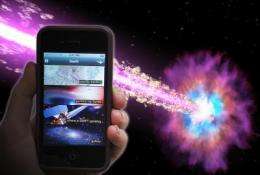
This is the NASA Swift app. A new, free iPhone application gives you the details of all the latest gamma-ray-burst discoveries that NASA's Swift observatory is making throughout the universe. The app also allows users to track, in real time, the location of Swift as it orbits the Earth, to see where Swift is pointed right now, and to view an informative gallery of beautiful images obtained by the Swift satellite. http://www.science.psu.edu/news-and-events/2011-news/Kinnea10-2011 Credit: NASA/Goddard Space Flight Center

Interested in the latest discoveries of NASA's Swift satellite? The Swift team has released a free iPhone application that gives you the details of all the latest gamma-ray-burst discoveries that the Swift observatory is making throughout the universe. The app also allows users to track, in real time, the location of Swift as it orbits the Earth, to see where Swift is pointed right now, and to view an informative gallery of beautiful images obtained by the Swift satellite.

"We developed the iPhone app to be fun and informative, but also to be useful for both amateur and professional astronomers," said Jamie Kennea, science operations team leader for NASA's Swift Mission and a researcher at Penn State University. Kennea and Patrizia Caraveo, the director of the Italian Institute of Space Astrophysics in Milano, conceived of this project and presented it in a talk during the "Time Domain Astrophysics" conference at Clemson University on Monday, 24 October 2011.

The new smartphone app for the iPhone, iPod, and allows anyone to obtain up-to-date information on gamma-ray-burst discoveries in real time and to see the same data that scientists are using to better understand gamma-ray bursts. The app even will send a message to your phone when a gamma-ray burst is discovered. So whether you are an amateur astronomer or a professional, you can point your telescope in the direction of these bursts to hunt for the light from the most powerful explosions in the universe.

The iPhone app was developed at the Swift near the Penn State University Park campus in Pennsylvania U.S.A. by a student from the University of Trento in Italy, Giacomo Saccardo. The "NASA Swift" app has four different features:

  • An interactive map of the world, showing Swift's current location in its .
  • A list and a map showing the recently discovered gamma-ray-bursts, including and data from all three of Swift's detector.
  • A real-time, updated guide to Swift's current observations;
  • A gallery of Swift-related images with full descriptions, compiled by Swift scientists.
You can download the Swift app from Apple's App Store by using the search term "NASA Swift" or by going to the URL http://itunes.apple.com/us/app/nasa-swift/id465669299

Explore further: Trip into space with DiCaprio costs $1.55m

add to favorites email to friend print save as pdf

Related Stories

Worldwide hunt to solve the mystery of gamma-ray bursts

Feb 16, 2008

UK space scientist Emeritus Professor Alan Wells is to speak at the American Association for the Advancement of Science (AAAS) in Boston in February on International Cooperation in Developing Swift and its Scientific Achievements.

Swift Satellite Finds Newborn Black Holes

Aug 19, 2005

Scientists using NASA's Swift satellite say they have found newborn black holes, just seconds old, in a confused state of existence. The holes are consuming material falling into them while somehow propelling ...

Swift Satellite records early phase of gamma ray burst

Mar 02, 2009

(PhysOrg.com) -- UK astronomers, using a telescope aboard the NASA Swift Satellite, have captured information from the early stages of a gamma ray burst - the most violent and luminous explosions occurring ...

Recommended for you

Trip into space with DiCaprio costs $1.55m

3 minutes ago

Leonardo DiCaprio is going to get closer to stars of a different kind as he heads into space aboard the Virgin Galactic, and a well-heeled bidder at the Cannes Film Festival has paid 1.2 million euros (1.5 million) to be ...

Forecast for Titan: Wild weather could be ahead

May 22, 2013

(Phys.org) —Saturn's moon Titan might be in for some wild weather as it heads into its spring and summer, if two new models are correct. Scientists think that as the seasons change in Titan's northern hemisphere, ...

SDO observes mid-level solar flare

May 22, 2013

UPDATE 16:30 p.m. EDT: The M7-class flare was also associated with a coronal mass ejection or CME, another solar phenomenon that can send billions of tons of particles into space. While this CME was not Ea ...

User comments : 0

More news stories

A hidden population of exotic neutron stars

(Phys.org) —Magnetars – the dense remains of dead stars that erupt sporadically with bursts of high-energy radiation - are some of the most extreme objects known in the Universe. A major campaign using ...

Century-old science helps confirm global warming

(Phys.org) —Ocean measurements taken more than 135 years ago during the scientific expedition of HMS Challenger have provided further confirmation of human-produced global warming over the past century.