Amateur skywatchers help space hazards team
October 13, 2011

Amateur skywatchers help space hazards team

Enlarge

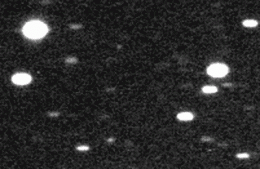
In this animation , the newly discovered asteroid is the white blob moving left-to-right in the upper centre of the image. The white blob moving left-to-right at the lower centre is a known asteroid and the single pixle jumping at upper-centre-left is a digital artefact. Credits: ESA/TOTAS Survey Team

For the first time, observations coordinated by ESA's space hazards team have found an asteroid that comes close enough to Earth to pose an impact threat. The space rock was found by amateur astronomers, highlighting the value of 'crowd-sourcing' to science and planetary defence.


The discovery of asteroid 2011 SF108 was made by the Teide Observatory Tenerife Asteroid Survey (TOTAS) team during an observation slot sponsored by ESA's Space Situational Awareness (SSA) programme in September.
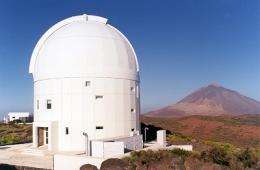
The four-night survey used the 1m-aperture telescope at ESA's Optical Ground Station at Teide on Tenerife in the .

This is not the first asteroid found under SSA sponsorship, but it is the first that qualifies as a 'near Earth object' – an object that passes close enough to Earth during its orbit around the Sun that it could pose an impact threat.

Images require human evaluation

During TOTAS observations, the telescope runs automated asteroid surveys for several hours using software developed by amateur astronomer and computer scientist Matthias Busch from the Starkenburg Amateur in Heppenheim, Germany.

Amateur skywatchers help space hazards team
Enlarge

ESA's Optical Ground Station (OGS)is located at the Observatorio del Teide on Tenerife, and is situated at an altitude of 2393 metres. Credits: ESA

However, potential sightings must still be evaluated by humans.

The team comprises 20 volunteers, most of whom took part in the manual evaluation of images captured during the session on 28/29 September.

Safe distance: 30 million km

"Images are distributed to the entire team for review, and any one of them could be the discoverer of a new asteroid," says Detlef Koschny, Head of NEO activity for SSA. "This time, the luck of the draw fell to Rainer Kracht."

"As volunteer work, it is very rewarding. When you do spot something, you contribute to Europe's efforts in defending against asteroid hazards."

The orbit of asteroid 2011 SF108 brings it no closer than about 30 million km to Earth – a safe distance.

The object is the 46th discovered by Mr Kracht, a retired school teacher who lives in Elmshorn, near Hamburg, Germany. "Eight of us reviewed images on the night of the discovery, and I was lucky to be the one who found 2011 SF108 as part of this team," says Mr Kracht.

"The discovery was only possible with the excellent software developed by Matthias Busch, who also spotted this object in the images on the second night and sent the observations to the Minor Planet Center."

To date, some 8000 NEOs have been discovered worldwide but many thousands more are suspected to exist, particularly in the size of metres to hundreds of metres. It is important to find and track these to determine if any pose an impact threat to Earth.

Provided by European Space Agency search and more info website


Rank 5 /5 (2 votes)
Relevant PhysicsForums posts
  • Distance of planets from stars and revolution
    created4 hours ago
  • revamping general concept and cosmological principle
    createdMay 25, 2012
  • Transiting Exoplanet Light Curve
    createdMay 25, 2012
  • Math behind Theoretical Physics
    createdMay 24, 2012
  • Do we know whats at the center of galaxies yet?
    createdMay 23, 2012
  • Structure of the Milky Way?
    createdMay 20, 2012
  • More from Physics Forums - General Astronomy

More news stories

Land and sea species differ in climate change response: study

(Phys.org) -- Marine and terrestrial species will likely differ in their responses to climate warming, new research by Simon Fraser University and Australia’s University of Tasmania has found.

Space & Earth / Environment

created 2 hours ago | popularity not rated yet | comments 1 | with audio podcast

Yale study concludes public apathy over climate change unrelated to science literacy

Are members of the public divided about climate change because they don't understand the science behind it? If Americans knew more basic science and were more proficient in technical reasoning, would public consensus match ...

Space & Earth / Environment

created 4 hours ago | popularity 4 / 5 (1) | comments 10 | with audio podcast

10 million years needed to recover from mass extinction

It took some 10 million years for Earth to recover from the greatest mass extinction of all time, latest research has revealed.

Space & Earth / Earth Sciences

created 4 hours ago | popularity not rated yet | comments 1 | with audio podcast

Sophisticated simulations predict future warming

The chances of our planet being hit by a global warming of 3 degrees Celsius by 2050 is as likely as it being hit by an increase of 1.4 degrees, new research shows. Presented in the journal Nature Geoscience, the British study ...

Space & Earth / Earth Sciences

created May 22, 2012 | popularity 4.4 / 5 (9) | comments 51

Aliens don't want to eat us, says former SETI director

Alien life probably isn’t interested in having us for dinner, enslaving us or laying eggs in our bellies, according to a recent statement by former SETI director Jill Tarter.

Space & Earth / Space Exploration

created May 25, 2012 | popularity 4.4 / 5 (14) | comments 40


'Unzipped' carbon nanotubes could help energize fuel cells, batteries

Multi-walled carbon nanotubes riddled with defects and impurities on the outside could replace some of the expensive platinum catalysts used in fuel cells and metal-air batteries, according to scientists at ...

T cells 'hunt' parasites like animal predators seek prey, study shows

By pairing an intimate knowledge of immune-system function with a deep understanding of statistical physics, a cross-disciplinary team at the University of Pennsylvania has arrived at a surprising finding: T cells use a movement ...

Computer model used to pinpoint prime materials for efficient carbon capture

When power plants begin capturing their carbon emissions to reduce greenhouse gases – and to most in the electric power industry, it's a question of when, not if – it will be an expensive undertaking.

Change in developmental timing was crucial in the evolutionary shift from dinosaurs to birds: study

At first glance, it's hard to see how a common house sparrow and a Tyrannosaurus Rex might have anything in common. After all, one is a bird that weighs less than an ounce, and the other is a dinosaur that ...

Nvidia trumpets Tegra 3 phone design wins for 2012

(Phys.org) -- Nvidia’s competitive war paint has a name, Tegra 3. On the heels of Nvidia announcements about lowering costs of its Tegra 3 processors and Nvidia-enabled tablets running Android Ice Cream ...

Scientist: Evolution debate will soon be history

(AP) -- Richard Leakey predicts skepticism over evolution will soon be history. Not that the avowed atheist has any doubts himself.