Stardust discovered in far-off planetary systems
Sep 29, 2011
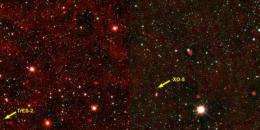
Astronomers from Jena University found a stardust belt around the stars TrES-2 in the Draco constellation and XO-5 in the Lynx constellation. Credit: WISE Image Service

Searching for extra-solar planets -- which are planets outside of our solar system -- is very popular these days. About 700 planets are known at the moment, a number that is continuously rising due to refined observational techniques. Professor Alexander Krivov and his team of astronomers of the Friedrich Schiller University Jena (Germany) just made a remarkable discovery: the scientists from the Astrophysical Institute were able to establish proof of so-called debris discs around two stars.

The debris discs are remnants of the formation of the planets. "We are dealing with enormous accumulations of chunks of matter which create dust when they collide", Alexander Krivov says. This dust is of greatest importance for the astronomers, because it helps to draw conclusions about the . There are even two debris discs in our solar system, the and the amongst whose bodies the dwarf planet Pluto belongs.

What makes the Jena discovery so special is the tremendous distance from our to the stars with the debris discs. "These stars are hundreds of light years away from the Earth", according to Krivov. The particular focus is on TrES-2 in the Draco constellation and XO-5 in the Lynx constellation. Planets orbiting these stars can only be detected with the help of the transit method. It sounds like a simple principle: The is photographed in regular intervals. Special software then checks the brightness of the stars on the images. If, in regular intervals, there are differences in brightness it is likely that a planet passes between the star and its observers.

The astronomers found evidence for the stardust with the help of photometric analysis. At first the characteristics of the stars can be analysed with it. If there are irregularities in the invisible , they point to the existence of stardust. Krivov says: "The dust is warmed up by the star and radiates heat. We see that radiation curve is above the radiation curve of the star as a clear sign of the existence of stardust."

Professor Krivov draws an impressive comparison for the search of debris discs in the vastness of the universe: it is as if you would detect an ice-cream cooled down to minus 130 degrees with a heat detector in a 5,000 kilometer distance from Jena.

Explore further: Galaxy's Ring of Fire

More information: Alexander Krivov's team of scientists concentrated its search for debris disc candidates on about 100 known extra-solar systems with transiting planets. Of these systems, they found 52 in the observational results of the US-American space telescope WISE published in April this year. The Jena scientists got lucky with two systems. As early as June 1 Alexander Krivov, Martin Reidemeister, Simone Fiedler, Dr. Torsten Löhne und Professor Ralph Neuhäuser submitted their paper to the science magazine 'Monthly Notices of the Royal Astronomical Society' for publication in the 'Letters' section. Meanwhile the paper has been published under the title 'Debris disc candidates in systems with transiting planets' doi:10.1111/j.1745-3933.2011.01133.x

Provided by Friedrich-Schiller-Universitaet Jena

5 /5 (4 votes)
add to favorites email to friend print save as pdf

Related Stories

Exoplanet caught on the move (w/ Video)

Jun 10, 2010

(PhysOrg.com) -- Only 12 million years old, or less than three-thousandths of the age of the Sun, Beta Pictoris is 75% more massive than our parent star. It is located about 60 light-years away towards the ...

Baby stars born to 'napping' parents

Mar 09, 2011

(PhysOrg.com) -- Cardiff University astronomers believe that a young star's long "napping" could trigger the formation of a second generation of smaller stars and planets orbiting around it.

Planets Living on the Edge

Dec 17, 2008

(PhysOrg.com) -- Some stars have it tough when it comes to raising planets. A new image from NASA's Spitzer Space Telescope shows one unlucky lot of stars, born into a dangerous neighborhood. The stars themselves ...

Making Jupiters

Aug 21, 2009

IC348 is a glowing nebula of young stars, hot gas, and cold dust seen in the direction of the constellation of Perseus. It is the nearest rich cluster of young stars to earth, being only about one thousand ...

Recommended for you

Galaxy's Ring of Fire

May 18, 2013

Johnny Cash may have preferred this galaxy's burning ring of fire to the one he sang about falling into in his popular song. The "starburst ring" seen at center in red and yellow hues is not the product of ...

4C+29.30: Black hole powered jets plow into galaxy

May 15, 2013

(Phys.org) —This composite image of a galaxy illustrates how the intense gravity of a supermassive black hole can be tapped to generate immense power. The image contains X-ray data from NASA's Chandra X-ray ...

A space-time magnifying glass

May 15, 2013

(Phys.org) —Bright arcs are smeared around the heart of galaxy cluster Abell S1077 in this image taken by the NASA/ESA Hubble space telescope. The arcs are stretched images of distant galaxies distorted ...

User comments : 1

Adjust slider to filter visible comments by rank

Display comments: newest first

omatumr
1 / 5 (6) Sep 29, 2011
scientists were able to establish proof of so-called debris discs around two stars.


Congratulations!

First-formed dust in the solar system was poorly-mixed stellar debris!

Here are a few of the experimental data:

www.omatumr.com/D...Data.htm

www.omatumr.com/D...Data.htm

www.omatumr.com/D...Data.htm

www.omatumr.com/D...Data.htm

www.omatumr.com/D...Data.htm

Here are a few of the conclusions:

1. "Elemental and isotopic inhomogeneities in noble gases: The case for local synthesis of the chemical elements", Trans MO Acad Sci 9, 104-122 (1975)

2. "Strange xenon, extinct super-heavy elements, and the solar neutrino puzzle", Science 195, 208-209 (1977)

www.omatumr.com/a...enon.pdf

3. "Isotopes of tellurium, xenon and krypton in the Allende meteorite retain record of nucleosynthesis", Nature 277, 615-620 (1979)

www.nature.com/na...5a0.html

Oliver K. Manuel
http://myprofile....anuelo09

More news stories

Heat-related deaths in Manhattan projected to rise

Residents of Manhattan will not just sweat harder from rising temperatures in the future, says a new study; many may die. Researchers say deaths linked to warming climate may rise some 20 percent by the 2020s, ...

Mice, gerbils perish in Russia space flight

A number of mice and eight gerbils sent into space in a Russian capsule destined to find out how well organisms can withstand extended flights perished during their journey, scientists said Sunday as the ...

Kinks and curves at the nanoscale

One of the basic principles of nanotechnology is that when you make things extremely small—one nanometer is about five atoms wide, 100,000 times smaller than the diameter of a human hair—they are going ...

Honeybees trained in Croatia to find land mines

(AP)—Mirjana Filipovic is still haunted by the land mine blast that killed her boyfriend and blew off her left leg while on a fishing trip nearly a decade ago. It happened in a field that was supposedly ...