Star formation laws

September 26, 2011 By Steve Nerlich, Universe Today

Star formation laws

Enlarge

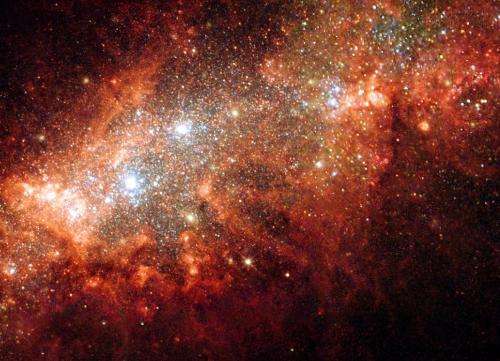
NGC 1569 - a relatively close (11 million light years) starburst galaxy - presumably the result of some fairly efficient star formation processes. Credit: NASA/HST.

Take a cloud of molecular hydrogen add some turbulence and you get star formation – that’s the law. The efficiency of star formation (how big and how populous they get) is largely a function of the density of the initial cloud.

At a galactic or star cluster level, a low gas density will deliver a sparse population of generally small, dim stars – while a high gas density should result in a dense population of big, bright stars. However, overlying all this is the key issue of metallicity – which acts to reduce efficiency.

So firstly, the strong relationship between the density of molecular hydrogen (H2) and star formation efficiency is known as the Kennicutt-Schmidt Law. Atomic hydrogen is not considered to be able to support star formation, because it is too hot. Only when it cools to form molecular hydrogen can it start to clump together – after which we can expect star formation to become possible. Of course, this creates some mystery about how the first stars might have formed within a denser and hotter primeval universe. Perhaps dark matter played a key role there.

Nonetheless, in the modern universe, unbound gas can more readily cool down to molecular hydrogen due the presence of metals, which have been added to the interstellar medium by previous populations of stars. Metals, which are any elements heavier than hydrogen and helium, are able to absorb a wider range of radiation energy levels, leaving hydrogen less exposed to heating. Hence, a metal-rich gas cloud is more likely to form , which is then more likely to support star formation.
Star formation laws
Enlarge

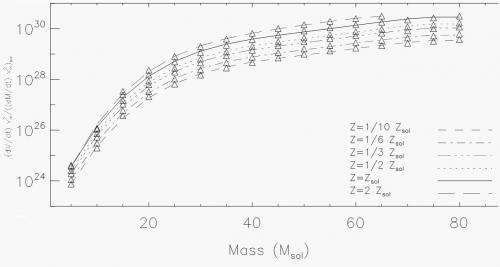
Relationship between the power of stellar winds and stellar mass (i.e. big star has big wind) - with the effect of metallicity overlaid. The solid line is the metallicity of the Sun (Z=Zsol). High metallicity produces more powerful winds for the same stellar mass. Credit: Dib et al.

But this does not mean that star formation is more efficient in the modern universe – and again this is because of metals. A recent paper about the dependence of star formation on metallicity proposes that a cluster of stars develops from H2 clumping within a gas cloud, first forming prestellar cores which draw in more matter via gravity, until they become stars and then begin producing stellar wind.

Before long, the stellar wind begins to generate ‘feedback’, countering the infall of further material. Once the outward push of stellar wind achieves unity with the inward gravitational pull, further star growth ceases – and bigger O and B class stars clear out any remaining gas from the cluster region, so that all star formation is quenched.

The dependence of star formation efficiency on metallicity arises from the effect of metallicity on stellar wind. High metal stars always have more powerful winds than any equivalent mass, but lower metal, stars. Thus, a star cluster – or even a galaxy – formed from a gas cloud with high metallicity, will have lower efficiency star formation. This is because all stars’ growth is inhibited by their own stellar wind feedback in late stages of growth and any large O or B class stars will clear out any remaining unbound gas more quickly than their low metal equivalents.

This metallicity effect is likely to be the product of ‘radiative line acceleration’, arising from the ability of metals to absorb radiation across a wide range of radiation energy levels – that is, metals present many more radiation absorption lines than hydrogen has on its own. The absorption of radiation by an ion means that some of the momentum energy of a photon is imparted to the ion, to the extent that such ions may be blown out of the star as . The ability of metals to absorb more radiation energy than hydrogen can, means you should always get more wind (i.e. more ions blown out) from high metal .

More information: Dib et al. The Dependence of the Galactic Star Formation Laws on Metallicity.

Source: Universe Today

4.7 /5 (3 votes)  

Filter


Move the slider to adjust rank threshold, so that you can hide some of the comments.


Display comments: newest first

omatumr
Sep 26, 2011

Rank: 1 / 5 (11)
Star formation laws, . . .


Are actually mislabeled star formation models, . . .

That are almost certainly wrong [1-4].

1. "Elemental and isotopic inhomogeneities in noble gases:
The case for local synthesis of the chemical elements",
Transactions Missouri Academy Sciences 9, 104-122 (1975)

2. "Isotopes of tellurium, xenon and krypton in the
Allende meteorite retain record of nucleosynthesis",
Nature 277, 615-620 (1979)

www.nature.com/na...5a0.html

3. "Solar abundances of the elements", Meteoritics 18, 209-222 (1983)

www.omatumr.com/a...nces.pdf

4. "Is the Universe Expanding?" The Journal of Cosmology 13, 4187-4190 (2011)

http://journalofc...102.html

With kind regards,
Oliver K. Manuel
Former NASA Principal
Investigator for Apollo
http://myprofile....anuelo09
omatwankr
Sep 26, 2011

Rank: 3.9 / 5 (11)

Star Light Star bright,
The first star I see tonight,
I wish I may, I wish I might,
Have someone believe a thing I Write.

Yes I am a poet as well, I have been hiding my light under a bush too long. modesty forbade.

There once was a Man from Nantucket
who had some neutrons in a bucket
umm, err-um Repulsive Neutrons

"Any of you who does not give up everything he has cannot be my disciple." Luke 14:33
omatumr
Sep 27, 2011

Rank: 1.4 / 5 (10)
omatwankr displays the same brilliance as the Presidents of NAS and RS who encouraged government scientists to select the computer output that most pleased the politicians and ignored, hid, or manipulated experimental observations [1] that falsified their story of human control over Earth's climate!

1. "Video Summary of Research Career (1961-2011)"
http://dl.dropbox...reer.pdf

With kind regards,
Oliver K. Manuel

Lao Tzu: "To know that you do not know is best,
To pretend to know what you do not know is a disease."
jsdarkdestruction
Sep 27, 2011

Rank: 4.1 / 5 (9)
You are a very sick man oliver. You cant back up anything you say and ignore/run away from any real scientific question asked of you. Honestly oliver its you who understands nothing. What happened to your kissinger and mao nonsense you were spamming? you think people dont notice how often you say nonsense and then run away and refuse to admit you were wrong when done so. instead you just think up some new fantasy conspiracy plot.
Rank 4.7 /5 (3 votes)
Relevant PhysicsForums posts
  • Distance of planets from stars and revolution
    created5 hours ago
  • revamping general concept and cosmological principle
    createdMay 25, 2012
  • Transiting Exoplanet Light Curve
    createdMay 25, 2012
  • Math behind Theoretical Physics
    createdMay 24, 2012
  • Do we know whats at the center of galaxies yet?
    createdMay 23, 2012
  • Structure of the Milky Way?
    createdMay 20, 2012
  • More from Physics Forums - General Astronomy

More news stories

Land and sea species differ in climate change response: study

(Phys.org) -- Marine and terrestrial species will likely differ in their responses to climate warming, new research by Simon Fraser University and Australia’s University of Tasmania has found.

Space & Earth / Environment

created 2 hours ago | popularity 5 / 5 (2) | comments 2 | with audio podcast

Yale study concludes public apathy over climate change unrelated to science literacy

Are members of the public divided about climate change because they don't understand the science behind it? If Americans knew more basic science and were more proficient in technical reasoning, would public consensus match ...

Space & Earth / Environment

created 4 hours ago | popularity 4 / 5 (1) | comments 11 | with audio podcast

10 million years needed to recover from mass extinction

It took some 10 million years for Earth to recover from the greatest mass extinction of all time, latest research has revealed.

Space & Earth / Earth Sciences

created 4 hours ago | popularity not rated yet | comments 1 | with audio podcast

Sophisticated simulations predict future warming

The chances of our planet being hit by a global warming of 3 degrees Celsius by 2050 is as likely as it being hit by an increase of 1.4 degrees, new research shows. Presented in the journal Nature Geoscience, the British study ...

Space & Earth / Earth Sciences

created May 22, 2012 | popularity 4.4 / 5 (9) | comments 51

Aliens don't want to eat us, says former SETI director

Alien life probably isn’t interested in having us for dinner, enslaving us or laying eggs in our bellies, according to a recent statement by former SETI director Jill Tarter.

Space & Earth / Space Exploration

created May 25, 2012 | popularity 4.4 / 5 (14) | comments 40


Nvidia trumpets Tegra 3 phone design wins for 2012

(Phys.org) -- Nvidia’s competitive war paint has a name, Tegra 3. On the heels of Nvidia announcements about lowering costs of its Tegra 3 processors and Nvidia-enabled tablets running Android Ice Cream ...

'Unzipped' carbon nanotubes could help energize fuel cells, batteries

Multi-walled carbon nanotubes riddled with defects and impurities on the outside could replace some of the expensive platinum catalysts used in fuel cells and metal-air batteries, according to scientists at ...

T cells 'hunt' parasites like animal predators seek prey, study shows

By pairing an intimate knowledge of immune-system function with a deep understanding of statistical physics, a cross-disciplinary team at the University of Pennsylvania has arrived at a surprising finding: T cells use a movement ...

Computer model used to pinpoint prime materials for efficient carbon capture

When power plants begin capturing their carbon emissions to reduce greenhouse gases – and to most in the electric power industry, it's a question of when, not if – it will be an expensive undertaking.

Change in developmental timing was crucial in the evolutionary shift from dinosaurs to birds: study

At first glance, it's hard to see how a common house sparrow and a Tyrannosaurus Rex might have anything in common. After all, one is a bird that weighs less than an ounce, and the other is a dinosaur that ...

Scientist: Evolution debate will soon be history

(AP) -- Richard Leakey predicts skepticism over evolution will soon be history. Not that the avowed atheist has any doubts himself.