Sri Lankan elephant numbers are 'healthy': survey
September 2, 2011 by Amal Jayasinghe

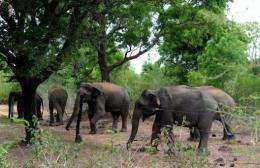
Wild elephants gather near an electric fence holding them back at the Udawalawe wildlife sanctuary in Sri Lanka today

Enlarge

Sri Lanka's elephant population remains healthy despite decades of fighting between government and rebel forces, the first survey since the end of the nation's bloody civil war showed Friday.

Sri Lanka's elephant population remains healthy despite decades of fighting between government and rebel forces, the first survey since the end of the nation's bloody civil war showed Friday.

Wildlife officials said Sri Lanka has 7,379 . Of that number, some 5,879 wild elephants are living near wildlife parks and sanctuaries while another 1,500 were estimated to be in other areas.

"We have an elephant population which is in good health and its is also very good," Wildlife Conservation Department director H.D. Ratnayake told reporters in Colombo.

Before the count, the department said it believed the totalled just 5,350. The country boasted 12,000 elephants in 1900.

The survey counted 1,107 baby elephants, Ratnayake added.

It is the first count since Sri Lanka's military crushed Tamil Tiger separatist rebels in May 2009, making wildlife sanctuaries and jungles more accessible to officials.

About 3,500 people took part in the four-day survey, checking watering holes, ancient irrigation tanks and lakes commonly used by elephants, Ratnayake said, adding that they had set up 1,553 counting posts.

suggest elephants may have moved out of the island's embattled northern region during the conflict and moved to neighbouring areas to avoid the fighting, officials said.

Wildlife authorities have treated elephants who stepped on anti-personnel mines or been shot during the decades-long separatist war.

But the count carried out last month was marked by controversy.

Hundreds of conservationists did not take part because of worries the survey would be used to seize elephants and send them to temples for use in religious ceremonies.

Elephants are treated as sacred animals in Buddhist-majority Sri Lanka and domesticated pachyderms are paraded during temple ceremonies as well as at cultural events.

Wildlife Minister S. M. Chandrasena denied on Friday media reports quoting him as saying that the survey was to identify wild animals to be domesticated.

He told reporters that there would be no move to capture elephants.

"Not a single wild elephant will be captured. It is illegal to capture wild animals," the minister said.

However, he said baby elephants at two orphanages run by the government may be given to temples on a case-by-case basis.

Wildlife Conservation Department director Ratnayake said the survey numbers were especially encouraging as the count was carried out at a time when the conflict between humans and elephants has increased sharply.

Nearly 200 elephants are being killed each year by villagers as the animals stray into agricultural areas and some 50 people also are killed each year by marauding jumbos, officials say.

The authorities hope the survey results will be used to better target conservation efforts and minimise clashes with farmers.

(c) 2011 AFP


Rank not rated yet
Relevant PhysicsForums posts

More news stories

Scientist: Evolution debate will soon be history

(AP) -- Richard Leakey predicts skepticism over evolution will soon be history. Not that the avowed atheist has any doubts himself.

Biology / Evolution

created 23 hours ago | popularity 3.5 / 5 (20) | comments 86

Manufacturing genes to attack flu virus

An international research team has manufactured a new protein that can combat deadly flu epidemics.

Biology / Biotechnology

created 4 hours ago | popularity not rated yet | comments 0 | with audio podcast

More plant species responding to global warming than previously thought

(Phys.org) -- Far more wild plant species may be responding to global warming than previous large-scale estimates have suggested.

Biology / Ecology

created May 22, 2012 | popularity 4.6 / 5 (14) | comments 18 | with audio podcast

For monogamous sparrows, it doesn't pay to stray (but they do it anyway)

It's quite common for a female song sparrow to stray from her breeding partner and mate with the male next door, but a new study shows that sleeping around can be costly.

Biology / Plants & Animals

created May 22, 2012 | popularity 5 / 5 (2) | comments 8 | with audio podcast

Thousands of shellfish found dead in Peru

Thousands of crustaceans were found dead off the coast of Lima following the mystery mass death of dolphins and pelicans, the Peruvian Navy said Friday.

Biology / Ecology

created May 26, 2012 | popularity 4.7 / 5 (6) | comments 7


Nvidia trumpets Tegra 3 phone design wins for 2012

(Phys.org) -- Nvidia’s competitive war paint has a name, Tegra 3. On the heels of Nvidia announcements about lowering costs of its Tegra 3 processors and Nvidia-enabled tablets running Android Ice Cream ...

'Unzipped' carbon nanotubes could help energize fuel cells, batteries

Multi-walled carbon nanotubes riddled with defects and impurities on the outside could replace some of the expensive platinum catalysts used in fuel cells and metal-air batteries, according to scientists at ...

T cells 'hunt' parasites like animal predators seek prey, study shows

By pairing an intimate knowledge of immune-system function with a deep understanding of statistical physics, a cross-disciplinary team at the University of Pennsylvania has arrived at a surprising finding: T cells use a movement ...

Computer model used to pinpoint prime materials for efficient carbon capture

When power plants begin capturing their carbon emissions to reduce greenhouse gases – and to most in the electric power industry, it's a question of when, not if – it will be an expensive undertaking.

Change in developmental timing was crucial in the evolutionary shift from dinosaurs to birds: study

At first glance, it's hard to see how a common house sparrow and a Tyrannosaurus Rex might have anything in common. After all, one is a bird that weighs less than an ounce, and the other is a dinosaur that ...

Land and sea species differ in climate change response: study

(Phys.org) -- Marine and terrestrial species will likely differ in their responses to climate warming, new research by Simon Fraser University and Australia’s University of Tasmania has found.