Five sea turtle populations are endangered
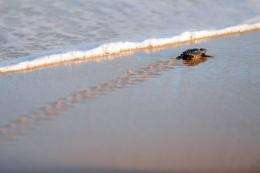
A newborn Loggerhead turtle walks into the sea in Praia do Forte, Brazil, 2009. The United States issued a ruling on Friday saying that five world populations of loggerhead sea turtles are endangered species but four are only "threatened."
The United States issued a ruling on Friday saying that five world populations of loggerhead sea turtles are endangered species but four are only "threatened."
The decision to split up loggerhead turtles into nine separate populations for conservation efforts was detailed in a 331-page document by the US Fish and Wildlife Service and the National Oceanic and Atmospheric Administration.
"This division... will help us focus more on the individual threats turtles face in different areas," said Jim Lecky, NOAA Fisheries director of protected resources.
"Wide-ranging species, such as the loggerhead, benefit from assessing and addressing threats on a regional scale."
However, Oceana, a leading conservation group which had pressed for more protections for sea turtles, described the move as "bittersweet."
"Sea turtles are disappearing right before this generation's eyes," said Whit Sheard, Pacific counsel and senior adviser for Oceana.
"While today's designation gives new hope for North Pacific loggerheads, it leaves the fate of the species in the Atlantic at risk."
Two turtle populations -- those in the Southeast Indo-Pacific Ocean and Northwest Atlantic Ocean -- were changed from endangered to threatened because their nesting areas are in protected lands and their numbers are stabilizing.
Improvements to fishing nets, which now include turtle excluder devices in shrimp trawlers allowing turtles to escape, have also helped save turtle populations.
The five that retained their endangered status were in the Northeast Atlantic Ocean, Mediterranean Sea, North Indian Ocean, North Pacific Ocean and South Pacific.
Oceana and the Center for Biological Diversity were among the environmental groups that petitioned in 2007 for loggerhead sea turtles in the North Pacific and Northwest Atlantic to be reclassified as endangered.
"Loggerheads have declined by at least 80 percent in the North Pacific and could become functionally or ecologically extinct by the mid-21st century if additional protections are not put into place," said a statement by Oceana.
"Florida beaches, which host the largest nesting population of loggerheads in the Northwest Atlantic, have seen more than a 25 percent decline in nesting since 1998."
Earlier this week, a study in the US journal Biological Conservation said that improved fishing nets have saved tens of thousands of endangered sea turtles in recent years, but 4,600 are still dying annually, mainly in Gulf of Mexico shrimp trawls.
(c) 2011 AFP
-
From lemons to lemonade: Reaction uses carbon dioxide to make carbon-based semiconductor,
32 comments
-
Thioridazine kills cancer stem cells in human while avoiding toxic side-effects of conventional cancer treatments,
3 comments
-
SpaceX private rocket blasts off for space station (Update),
42 comments
-
Climate scientists say they have solved riddle of rising sea,
31 comments
-
SpaceX capsule has 'new car' smell, astronauts say (Update),
4 comments
-
What would stain as translucent on light-coloured fabric?
23 hours ago
-
How do I identify different bacteria on culture plates?
May 26, 2012
-
Why Do Dogs do Strange things...
May 25, 2012
-
What does exophillic and endophillic mean in terms of mosquito and their control?
May 24, 2012
-
Semen stains glows under black lights (uv light)?
May 23, 2012
-
Question on Human Chromosome 2
May 23, 2012
- More from Physics Forums - Biology
More news stories
Scientist: Evolution debate will soon be history
(AP) -- Richard Leakey predicts skepticism over evolution will soon be history. Not that the avowed atheist has any doubts himself.
23 hours ago |
3.5 / 5 (20) |
86
Manufacturing genes to attack flu virus
An international research team has manufactured a new protein that can combat deadly flu epidemics.
4 hours ago |
not rated yet |
0
|
More plant species responding to global warming than previously thought
(Phys.org) -- Far more wild plant species may be responding to global warming than previous large-scale estimates have suggested.
May 22, 2012 |
4.6 / 5 (14) |
18
|
For monogamous sparrows, it doesn't pay to stray (but they do it anyway)
It's quite common for a female song sparrow to stray from her breeding partner and mate with the male next door, but a new study shows that sleeping around can be costly.
May 22, 2012 |
5 / 5 (2) |
8
|
Thousands of shellfish found dead in Peru
Thousands of crustaceans were found dead off the coast of Lima following the mystery mass death of dolphins and pelicans, the Peruvian Navy said Friday.
May 26, 2012 |
4.7 / 5 (6) |
7
Nvidia trumpets Tegra 3 phone design wins for 2012
(Phys.org) -- Nvidias competitive war paint has a name, Tegra 3. On the heels of Nvidia announcements about lowering costs of its Tegra 3 processors and Nvidia-enabled tablets running Android Ice Cream ...
'Unzipped' carbon nanotubes could help energize fuel cells, batteries
Multi-walled carbon nanotubes riddled with defects and impurities on the outside could replace some of the expensive platinum catalysts used in fuel cells and metal-air batteries, according to scientists at ...
T cells 'hunt' parasites like animal predators seek prey, study shows
By pairing an intimate knowledge of immune-system function with a deep understanding of statistical physics, a cross-disciplinary team at the University of Pennsylvania has arrived at a surprising finding: T cells use a movement ...
Computer model used to pinpoint prime materials for efficient carbon capture
When power plants begin capturing their carbon emissions to reduce greenhouse gases and to most in the electric power industry, it's a question of when, not if it will be an expensive undertaking.
Change in developmental timing was crucial in the evolutionary shift from dinosaurs to birds: study
At first glance, it's hard to see how a common house sparrow and a Tyrannosaurus Rex might have anything in common. After all, one is a bird that weighs less than an ounce, and the other is a dinosaur that ...
Land and sea species differ in climate change response: study
(Phys.org) -- Marine and terrestrial species will likely differ in their responses to climate warming, new research by Simon Fraser University and Australia’s University of Tasmania has found.