Scientists discover 12 new frog species in India
September 17, 2011 By KATY DAIGLE , Associated Press
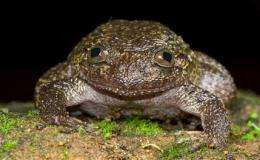
In this September 2011 photo released by Systematics Lab, Delhi University, a Wayanad night frog sits in the forests of the Western Ghats in Kerala. A team of Indian scientists have discovered 12 new frog species, plus another three thought to have been extinct. The Wayanad night frog grows to about the size of a baseball or cricket ball. (AP Photo/Systematics, Lab Delhi University, Sathyabhama Das Biju) EDITORIAL USE ONLY
Years of combing tropical mountain forests, shining flashlights under rocks and listening for croaks in the night have paid off for a team of Indian scientists which has discovered 12 new frog species plus three others thought to have been extinct.
It's a discovery the team hopes will bring attention to India's amphibians and their role in gauging the health of the environment.
Worldwide, 32 percent of the world's known amphibian species are threatened with extinction, largely because of habitat loss or pollution, according to the group Global Wildlife Conservation.
"Frogs are extremely important indicators not just of climate change, but also pollutants in the environment," said the project's lead scientist, biologist Sathyabhama Das Biju of the University of Delhi.
Many of the newly found frogs in India are rare and are living in just a single area, so they will need rigorous habitat protection, Biju told The Associated Press on Saturday. "Unfortunately in India, conservation has basically focused on the two most charismatic animals - the elephant and the tiger. For amphibians there is little interest, little funding, and frog research is not easy."
Night frogs are extremely hard to find, coming out only at dark and during the monsoon season, living either in fast-flowing streams or on moist forest ground.
Biju said he and his student researchers had to sit in dark, damp forests listening for frog sounds and shining flashlights under rocks and across riverbeds. They confirmed the new species by description as well as genetics.
The 12 new species include the meowing night frog, whose croak sounds more like a cat's call, the jog night frog, unique in that both the males and females watch over the eggs, and the Wayanad night frog, which grows to about the size of a baseball or cricket ball. "It's almost like a monster in the forest floor, a huge animal for a frog, leaping from one rock to another," Biju said.
Three other species were rediscovered, including the Coorg night frog described 91 years ago, after scientists "had completely ignored these animals, thinking they were lost."
The discoveries - published in the latest issue of international taxonomy journal Zootaxa - bring the known number of frogs in India to 336. Biju estimated this was only around half of what is in the wild, and said none of India's amphibians are yet being studied for biological compounds that could be of further use in science.
"We first have to find the species, know them and protect them, so that we can study them for their clinical importance," he said.
Biju is credited with discovering dozens of new Indian frog species during his 35-year career.
©2011 The Associated Press. All rights reserved. This material may not be published, broadcast, rewritten or redistributed.
-
From lemons to lemonade: Reaction uses carbon dioxide to make carbon-based semiconductor,
32 comments
-
Thioridazine kills cancer stem cells in human while avoiding toxic side-effects of conventional cancer treatments,
3 comments
-
SpaceX private rocket blasts off for space station (Update),
42 comments
-
Climate scientists say they have solved riddle of rising sea,
31 comments
-
SpaceX capsule has 'new car' smell, astronauts say (Update),
4 comments
-
What would stain as translucent on light-coloured fabric?
May 26, 2012
-
How do I identify different bacteria on culture plates?
May 26, 2012
-
Why Do Dogs do Strange things...
May 25, 2012
-
What does exophillic and endophillic mean in terms of mosquito and their control?
May 24, 2012
-
Semen stains glows under black lights (uv light)?
May 23, 2012
-
Question on Human Chromosome 2
May 23, 2012
- More from Physics Forums - Biology
More news stories
Scientist: Evolution debate will soon be history
(AP) -- Richard Leakey predicts skepticism over evolution will soon be history. Not that the avowed atheist has any doubts himself.
23 hours ago |
3.5 / 5 (20) |
86
Manufacturing genes to attack flu virus
An international research team has manufactured a new protein that can combat deadly flu epidemics.
4 hours ago |
not rated yet |
0
|
More plant species responding to global warming than previously thought
(Phys.org) -- Far more wild plant species may be responding to global warming than previous large-scale estimates have suggested.
May 22, 2012 |
4.6 / 5 (14) |
18
|
For monogamous sparrows, it doesn't pay to stray (but they do it anyway)
It's quite common for a female song sparrow to stray from her breeding partner and mate with the male next door, but a new study shows that sleeping around can be costly.
May 22, 2012 |
5 / 5 (2) |
8
|
Thousands of shellfish found dead in Peru
Thousands of crustaceans were found dead off the coast of Lima following the mystery mass death of dolphins and pelicans, the Peruvian Navy said Friday.
May 26, 2012 |
4.7 / 5 (6) |
7
Nvidia trumpets Tegra 3 phone design wins for 2012
(Phys.org) -- Nvidias competitive war paint has a name, Tegra 3. On the heels of Nvidia announcements about lowering costs of its Tegra 3 processors and Nvidia-enabled tablets running Android Ice Cream ...
'Unzipped' carbon nanotubes could help energize fuel cells, batteries
Multi-walled carbon nanotubes riddled with defects and impurities on the outside could replace some of the expensive platinum catalysts used in fuel cells and metal-air batteries, according to scientists at ...
T cells 'hunt' parasites like animal predators seek prey, study shows
By pairing an intimate knowledge of immune-system function with a deep understanding of statistical physics, a cross-disciplinary team at the University of Pennsylvania has arrived at a surprising finding: T cells use a movement ...
Computer model used to pinpoint prime materials for efficient carbon capture
When power plants begin capturing their carbon emissions to reduce greenhouse gases and to most in the electric power industry, it's a question of when, not if it will be an expensive undertaking.
Change in developmental timing was crucial in the evolutionary shift from dinosaurs to birds: study
At first glance, it's hard to see how a common house sparrow and a Tyrannosaurus Rex might have anything in common. After all, one is a bird that weighs less than an ounce, and the other is a dinosaur that ...
Land and sea species differ in climate change response: study
(Phys.org) -- Marine and terrestrial species will likely differ in their responses to climate warming, new research by Simon Fraser University and Australia’s University of Tasmania has found.