Quantum behavior with a flash
September 16, 2011

Quantum behavior with a flash

Enlarge

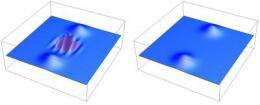
Pulsed quantum optomechanics can directly probe quantum mechanical behavior, which is seen as the central rippling in this representation of a Schrödinger-cat state (left). Under constant observation these quantum features are washed out (right). Credit: VCQ/University of Vienna

Just as a camera flash illuminates unseen objects hidden in darkness, a sequence of laser pulses can be used to study the elusive quantum behavior of a large "macroscopic" object. This method provides a novel tool of unprecedented performance for current experiments that push the boundaries of the quantum world to larger and larger scales. A collaboration of scientists led by researchers from the Vienna Center for Quantum Science and Technology (VCQ) at the University of Vienna report this new scheme in the forthcoming issue of PNAS.

One of the most fascinating and still open questions in physics is how far extend into our everyday world. To answer that, experiments need to peer into the quantum world at a completely new scale of mass and size. This is a bumpy road: it becomes increasingly difficult to detect the genuine quantum features as mass and size are increased.

Publishing under the title "Pulsed quantum optomechanics" the research team proposes a method that uses flashes of light to observe quantum features of large objects with unprecedented resolution. The main idea is based on the fact that quantum objects, in contrast to classical objects, behave differently when they are being watched. "In current approaches, objects are constantly monitored and the possible quantum features are being washed out. This is in many ways analogous to the blurring of a photograph of a fast moving object", says Michael R. Vanner, lead author of the paper and member of the Vienna Doctoral School Complex (CoQuS). "Loosely speaking, the flashes freeze the motion and create a sharp image of the ."

With this new tool, experiments will be able to peer into the at a completely new scale of mass and size. In particular, the scheme can be directly applied to the ongoing experiments that attempt to prepare quantum phenomena in micro-mechanical resonators, i.e. mechanically vibrating massive objects. "By analyzing the dynamics of such behavior, pulsed quantum optomechanics provides a path for investigating whether macroscopic mechanical objects can be used in future quantum technologies. It will also help shed light on nature's apparent division between the quantum and the classical worlds."

More information: Pulsed quantum optomechanics. M. R. Vanner, I. Pikovski, G. D. Cole, M. S. Kim, Č. Brukner, K. Hammerer, G. J. Milburn, and M. Aspelmeyer. Proceedings of the National Academy of Sciences (PNAS). DOI: 10.1073/pnas.1105098108

Provided by University of Vienna search and more info website

4.3 /5 (4 votes)  

Filter


Move the slider to adjust rank threshold, so that you can hide some of the comments.


Display comments: newest first

Park
Sep 17, 2011

Rank: not rated yet
Check this out.
Callippo
Sep 18, 2011

Rank: not rated yet
Rank 4.3 /5 (4 votes)
Relevant PhysicsForums posts
  • Calculating Saturation Vapor Pressure?
    created2 hours ago
  • Question about high electric charge.
    created7 hours ago
  • eyeglasses with smallest chromatic abberation
    created10 hours ago
  • Linear momentum converted to angular momentum?!
    created10 hours ago
  • Physics laboratory project - bumpers/crash tests
    created11 hours ago
  • How to open a winebottle with a shoe
    created11 hours ago
  • More from Physics Forums - Classical Physics

More news stories

Is a classical electrodynamics law incompatible with special relativity?

(Phys.org) -- The laws of classical electromagnetism that were developed in the 19th century are the same laws that scientists use today. They include Maxwell’s four equations along with the Lorentz la ...

Physics / General Physics

created May 24, 2012 | popularity 4.7 / 5 (17) | comments 43 | with audio podcast feature

Landmark calculation clears the way to answering how matter is formed

(Phys.org) -- An international collaboration of scientists, including Thomas Blum, associate professor of physics, is reporting in landmark detail the decay process of a subatomic particle called a kaon – ...

Physics / General Physics

created May 25, 2012 | popularity 4.3 / 5 (22) | comments 51 | with audio podcast

Lying in wait for WIMPs: Researchers seek to dramatically increase sensitivity of Large Underground Xenon detector

Although it's invisible, dark matter accounts for at least 80 percent of the matter in the universe. No one knows what it is, but most scientists would bet on weakly interacting massive particles, or WIMPs.

Physics / General Physics

created May 23, 2012 | popularity 4 / 5 (7) | comments 15 | with audio podcast

Hawaii lab turns laser-powered bubbles into microrobots

(Phys.org) -- A team of scientists from the University of Hawaii are working on microrobots created from bubbles of air in a saline solution. The bubbles take on their title of “robots” as a laser ...

Physics / General Physics

created May 23, 2012 | popularity 5 / 5 (4) | comments 2 | with audio podcast weblog

Sound increases the efficiency of boiling

Scientists at the Georgia Institute of Technology achieved a 17-percent increase in boiling efficiency by using an acoustic field to enhance heat transfer. The acoustic field does this by efficiently removing vapor bubbles ...

Physics / Soft Matter

created May 24, 2012 | popularity 5 / 5 (2) | comments 2


Land and sea species differ in climate change response: study

(Phys.org) -- Marine and terrestrial species will likely differ in their responses to climate warming, new research by Simon Fraser University and Australia’s University of Tasmania has found.

Almost half of new vets seek disability

(AP) -- America's newest veterans are filing for disability benefits at a historic rate, claiming to be the most medically and mentally troubled generation of former troops the nation has ever seen.

'Unzipped' carbon nanotubes could help energize fuel cells, batteries

Multi-walled carbon nanotubes riddled with defects and impurities on the outside could replace some of the expensive platinum catalysts used in fuel cells and metal-air batteries, according to scientists at ...

T cells 'hunt' parasites like animal predators seek prey, study shows

By pairing an intimate knowledge of immune-system function with a deep understanding of statistical physics, a cross-disciplinary team at the University of Pennsylvania has arrived at a surprising finding: T cells use a movement ...

Computer model used to pinpoint prime materials for efficient carbon capture

When power plants begin capturing their carbon emissions to reduce greenhouse gases – and to most in the electric power industry, it's a question of when, not if – it will be an expensive undertaking.

Change in developmental timing was crucial in the evolutionary shift from dinosaurs to birds: study

At first glance, it's hard to see how a common house sparrow and a Tyrannosaurus Rex might have anything in common. After all, one is a bird that weighs less than an ounce, and the other is a dinosaur that ...