In neck and neck competition, Team Voyager wins the Caltech space challenge
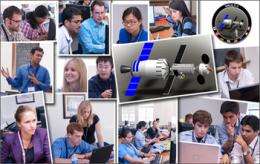
Last week, two teams of students from around the world rose to the Caltech Space Challenge, delivering plans for deep-space missions that could carry humans to an asteroid and back. The competing mission descriptions, from Team Explorer and Team Voyager, were so evenly matched that the jurors had to use three different judging methods to finally settle on a winner. In the end, the victory and shiny new iPads went to Team Voyager.
"The whole team was actually really shocked," says Emmet Cleary, a senior chemical engineering major at Caltech and a member of Team Voyager. "Explorer did such a good job. We were shaking in our seats because we had to present second."
Each team, made up of 16 undergrad and grad students, presented an overview of its mission Friday, September 16, as a culmination of just five days spent working on the challenge. As previously reported, the teams were tasked with designing the best mission to an asteroid or comet in Earth's neighborhood—a so-called Near-Earth Object (NEO)—that would return a sample of rock or ice.
Mentors from the Jet Propulsion Laboratory and the University of Stuttgart were on hand throughout the week to help the teams, and the students attended a series of lectures presented by leaders in the field. The teams worked in a fast and furious style, and as is true of many endeavors on campus, the effort involved many sleepless nights.
"I haven't slept in the last 30-something hours now," Cleary said after the awards banquet on Friday night. "This week really was a challenge, just getting through it. It's been so intense and so exciting all at the same time."
During their final presentations, both teams described missions to an asteroid known as 1999 AO10, which is between 45 and 100 meters in length and is thought to have a relatively slow spin rate. Since relatively little is known about this asteroid, both teams called for robotic precursor missions that could gather information needed to help plan the later human mission—things like the physical characteristics of the asteroid and details of its orbit.
Both teams also described a two-launch strategy that would bring necessary cargo to a meeting place first and then deliver the crew vehicle later, allowing them to bring more equipment and fuel and requiring a rendezvous. In both cases, the cargo would be sent years in advance, relying in part on solar electric propulsion to carry heavier loads more cheaply.
The Voyager team dubbed its mission Vault-1, with the catchy tagline, "One small step for man . . . one giant leap for mankind . . . and now the first Vault for humanity." Both teams emphasized the importance of international cooperation and contributions, as well as the need for public engagement and support. The audience laughed when Team Voyager went as far as to suggest a possible reality TV show about the mission.
In all seriousness, both teams talked about the importance of such a mission to a NEO. In addition to being in line with the goal announced by President Obama in April 2010 to land an astronaut on an asteroid by 2025, such a mission could help scientists learn more about the origins of the solar system and could provide valuable information about possible ways to divert a future, life-threatening asteroid impact.
The Vault-1 mission would leave Earth on August 23, 2025, arriving at the asteroid on New Year's Eve. A team of three astronauts would spend two weeks at the asteroid, collecting samples and using a whole cadre of scientific instruments to learn about everything from the physical properties and composition of the asteroid to the radiation and dust environment there. The mission would bring the astronauts back to Earth on March 3, 2026, keeping the total transit time to less than 180 days in order to limit radiation exposure.
Details of the Vault-1 mission description included contingency plans, secondary asteroid targets in case the first window was missed, ranking of scientific instruments by importance, breakdowns of habitable space per person (18 cubic meters), even a description of an Asteroid Mobility Platform that the astronauts could use to move around the asteroid more easily and to carry instruments and samples.
At the award banquet on Friday night, Paul Dimotakis, the Northrop Professor of Aeronautics and professor of applied physics at Caltech, explained the judging process. First, the 11 jurors were asked to assign a score to each team based on how well they answered each of seven questions such as, "How will the project be implemented? How will you make sure that it will succeed?" and "How will the future be different because of it?" Results of that first scoring yielded a statistical tie. Next, the jurors were asked to simply vote for the best team. Five judges voted for Team Explorer, five voted for Team Voyager, and one judge said the teams were equal. Finally, the jurors were asked to give one point to the team that answered each question best. With this scoring method Team Voyager wound up with 26 points compared to Team Explorer's 21.
"The real winners in this were all of us that participated with the students and interacted with them—the mentors, the judges, the speakers," says Tom Prince, director of the W.M. Keck Institute for Space Studies and professor of physics at Caltech. "I think that if this is the future of space exploration, we are in very good shape."
Provided by California Institute of Technology


