An impermeable wrap for future electronics
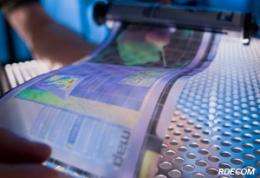
A moisture-resistant coating that extends the lifetime and reliability of plastic electronic devices, such as organic solar cells or flexible displays, has garnered the intense interest of developers of next-generation lighting materials. By cranking out large sheets of polymers bearing electronic circuitry using roll-to-roll technology, electronics manufacturers can substantially reduce their capital and processing costs. The possibilities for low-cost flexible panel lighting inspiring, says Senthil Ramadas, co-founder and chief technology officer of Tera-Barrier Films—a company spun-out of the A*STAR Institute of Materials Research and Engineering (IMRE) in 2009. “Flexible devices can take any form—thin films of organic lighting could cover entire ceilings or wrap around pillars.”
Despite their promise, however, flexible polymer-based electronics remain highly vulnerable to the elements, as water and oxygen molecules can easily seep into these plastic devices and degrade sensitive internal components. Current protection technologies involve the deposition of multiple layers of inorganic and organic films over the active substrate, but such ‘stacks’ of protection still allow permeation at a rate of one-thousandth of a gram per square meter per day—three orders of magnitude higher than an ‘ideal’ barrier, Ramadas explains.
In 1999, Ramadas and his colleagues at the IMRE spearheaded research into organic light-emitting diodes (OLEDs) and barrier substrates to protect them. They quickly discovered that sandwiching a polymer blend containing an innovative ingredient—metal oxide nanoparticles—between two inorganic films greatly reduced the moisture intrusion rate to just one-millionth of a gram per square meter per day. These metal nanoparticles play a dual role by sealing pinholes and cracks in barrier films and at the same time reacting with and deactivating incoming water and oxygen molecules.
By adjusting the nanoparticle mix, the researchers also found that they could incorporate new functionalities into the plastic moisture barriers. Using this approach, the team have created a range of tailor-made products including ultraviolet light-blocking films, heat-extracting films and even a calcium-based integrated sensor that precisely measures moisture permeation. These innovations have been recognized by the granting of 50 patents for systems developed by the Tera-Barrier Films team.
The ability to provide individualized protection and encapsulation solutions to customers played a key role in the decision of Exploit Technologies, the commercialization arm of A*STAR, and Applied Ventures, a US-based investment firm, to finance and incubate the new start-up. A recent substantial investment by Japanese multinational KISCO promises to boost the company’s projected revenues to $500 million in 2018 by spreading their proprietary technology throughout the critical Asia-Pacific manufacturing region.
KISCO has worked closely with the researchers since 2003, marketing the nanotechnology-based films and distributing samples throughout Japan, Korea, China and Taiwan. KISCO’s latest investment promises to enable immediate delivery of Tera-Barrier Films’ unique products to clients for testing, validation and eventual implementation into product lines, according to CEO Mark Auch.
“KISCO has linked a lot of customers to us—it’s a strategic partnership,” says Auch. “They see a very big potential for solar cells and OLED devices in the Asia-Pacific region, and it’s a large market.”
In addition to these applications, Tera-Barrier Films’ products have potential for use in food and medical packaging—positioning the company to achieve high profitability once mass-production begins in the next few years.
Provided by Agency for Science, Technology and Research (A*STAR)


