Human brain evolution, new insight through X-rays
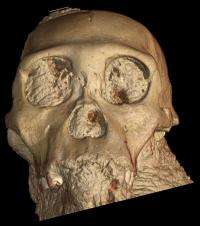
This is a 3-D rendering of the skull of Australopithecus sediba made from X-ray data gathered an experiment at the ESRF beamline ID19. Credit: ESRF/P. Tafforeau
A paper published today in Science reveals the highest resolution and most accurate X-ray scan ever made of the brain case of an early human ancestor. The insight derived from this data is like a powerful beacon on the hazy landscape of brain evolution across the transition from Australopithecus to Homo.
The publication is part of a series of five papers based on new evidence pertaining to various aspects of the anatomy of the species Australopithecus sediba (announced in April 2010 by Berger et al.) published in Science on 9 September 2011. Led by the University of the Witwatersrand in Johannesburg (South Africa), over 80 scientists from numerous institutes in Germany, the U.S., UK, Australia, Germany South Africa and Switzerland worked on the project. The work on the brain includes a scientist from the European Synchrotron Radiation Facility (ESRF) in Grenoble (France), where the X-ray micro-tomography scan was performed.
The exceptionally well-preserved cranium of MH 1 (Australopithecus sediba) was scanned at the ESRF at a resolution (3-D pixel size) of around 45 microns, just below the size of a human hair. Thanks to this high resolution, incredible details of the anatomy of sediba's endocast could be revealed.
According to Prof. Lee Berger from the University of the Witwatersrand in Johannesburg (South Africa) who found the fossil in 2009, "the many very advanced features found in the brain and body make it possibly the best candidate ancestor for our genus, the genus Homo, more so than previous discoveries such as Homo habilis."
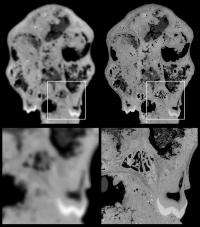
This image shows a comparison of a classical computer tomography (CT) scan (left) with a scan using synchrotron microtomography at the ESRF (right). The much higher resolution and contrast are clearly visible. The lower part depicts a zoom-in view of an area which on the upper part is indicated with a square. This area includes a tooth and a cavity in the skull. Credit: ESRF/P. Tafforeau
Humans have a very large brain relative to their body size, about four times that of chimpanzees. Evolution from the brain of our shared ancestor with chimpanzees has seen this radical size increase. However, the reconstructed endocast (volume of the cranium) of MH1 is surprisingly small, with a volume of 420 cm3, on average only about 40 cm3 larger than chimpanzees.The study of this brain shows a surprising mix of characteristics. Its overall shape resembles humans more than chimpanzees and, given its small volume, this result is consistent with a model of gradual neural (brain) reorganisation in the front part of the brain. "Indeed, one of our major discoveries is that the shape and form of sediba's brain is not consistent with a model of gradual brain enlargement, which has been hypothesised previously for the transition from Australopithecus to Homo", adds Dr Kristian Carlson from the University of the Witwatersrand, who is the main author of the paper.
This image shows a reconstruction of the skull of MH1 (partially transparent) with the brain endocast depicted in green. Dentition also visible and the specimen is viewed from slightly above and anterolateral. Credit: Witwatersrand University/K. Carlson
Use of synchrotron X-rays was instrumental for this discovery. The external shape of a brain is reflected, like in a mould, in the inner surface of a cranium. By mapping the contours of this internal surface, an image of the original brain located in the skull can therefore be produced. However, the skull of MH-1 was not emptied from bedrock after its discovery, and only the powerful X-rays at the ESRF could penetrate deep into the fossil to reveal the cranium's interior shape at the desired resolution. Leaving the rock inside the cranium also ensured that its delicate inner surface was not damaged or altered during its extraction."The ESRF is the most powerful installation worldwide for scanning fossils, setting the standard for what can be achieved during non-destructive studies of internal structures of fossils," concludes Paul Tafforeau, staff scientists at the ESRF and a co-author of the paper.
More information: The Endocast of MH 1, Australopithecus sediba, Kristian J. Carlson, Dietrich Stout, Tea Jashashvili, Darryl J. de Ruiter, Paul Tafforeau, Keely Carlson, Lee R. Berger, SCIENCE 9 September 2011
Provided by European Synchrotron Radiation Facility
-
From lemons to lemonade: Reaction uses carbon dioxide to make carbon-based semiconductor,
32 comments
-
Thioridazine kills cancer stem cells in human while avoiding toxic side-effects of conventional cancer treatments,
3 comments
-
SpaceX private rocket blasts off for space station (Update),
42 comments
-
Climate scientists say they have solved riddle of rising sea,
31 comments
-
SpaceX capsule has 'new car' smell, astronauts say (Update),
4 comments
-
What would stain as translucent on light-coloured fabric?
22 hours ago
-
How do I identify different bacteria on culture plates?
May 26, 2012
-
Why Do Dogs do Strange things...
May 25, 2012
-
What does exophillic and endophillic mean in terms of mosquito and their control?
May 24, 2012
-
Semen stains glows under black lights (uv light)?
May 23, 2012
-
Question on Human Chromosome 2
May 23, 2012
- More from Physics Forums - Biology
More news stories
Change in developmental timing was crucial in the evolutionary shift from dinosaurs to birds: study
At first glance, it's hard to see how a common house sparrow and a Tyrannosaurus Rex might have anything in common. After all, one is a bird that weighs less than an ounce, and the other is a dinosaur that ...
Other Sciences / Archaeology & Fossils
3 hours ago |
5 / 5 (2) |
0
|
Social welfare cuts ultimately come with heavy price, researchers say
(Phys.org) -- Slashing government funding for Medicaid, food stamps and other programs that serve the poor while politically popular with some lawmakers and many conservatives may do more harm ...
Other Sciences / Social Sciences
May 24, 2012 |
4.3 / 5 (16) |
152
Ancient Bethlehem seal unearthed in Jerusalem
Israeli archaeologists have discovered a 2,700-year-old seal that bears the inscription "Bethlehem," the Israel Antiquities Authority announced Wednesday, in what experts believe to be the oldest artifact ...
Other Sciences / Archaeology & Fossils
May 23, 2012 |
3.5 / 5 (14) |
24
Oldest Jewish archaeological evidence on the Iberian Peninsula
German archaeologists of the Friedrich Schiller University Jena found one of the oldest archaeological evidence so far of Jewish Culture on the Iberian Peninsula at an excavation site in the south of Portugal, ...
Other Sciences / Archaeology & Fossils
May 25, 2012 |
4.2 / 5 (6) |
12
Dollars and sense: Why are some people morally against tax?
As the U.S. presidential election campaigns heat up, the economic debate is dominated by bailouts, austerity and, inevitably, taxation. Now a new study published in Symbolic Interaction asks why tax is such an important issue ...
Other Sciences / Social Sciences
May 23, 2012 |
3 / 5 (2) |
12
Land and sea species differ in climate change response: study
(Phys.org) -- Marine and terrestrial species will likely differ in their responses to climate warming, new research by Simon Fraser University and Australia’s University of Tasmania has found.
'Unzipped' carbon nanotubes could help energize fuel cells, batteries
Multi-walled carbon nanotubes riddled with defects and impurities on the outside could replace some of the expensive platinum catalysts used in fuel cells and metal-air batteries, according to scientists at ...
T cells 'hunt' parasites like animal predators seek prey, study shows
By pairing an intimate knowledge of immune-system function with a deep understanding of statistical physics, a cross-disciplinary team at the University of Pennsylvania has arrived at a surprising finding: T cells use a movement ...
Computer model used to pinpoint prime materials for efficient carbon capture
When power plants begin capturing their carbon emissions to reduce greenhouse gases and to most in the electric power industry, it's a question of when, not if it will be an expensive undertaking.
Almost half of new vets seek disability
(AP) -- America's newest veterans are filing for disability benefits at a historic rate, claiming to be the most medically and mentally troubled generation of former troops the nation has ever seen.
Nvidia trumpets Tegra 3 phone design wins for 2012
(Phys.org) -- Nvidias competitive war paint has a name, Tegra 3. On the heels of Nvidia announcements about lowering costs of its Tegra 3 processors and Nvidia-enabled tablets running Android Ice Cream ...

