Facebook rolling out 'smart lists' of friends
September 13, 2011 by Glenn Chapman
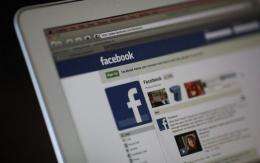
The Facebook website is displayed on a laptop computer. Facebook on Tuesday introduced "smart lists" that automatically sort friends into categories and prioritize news from those dearest to members of the world's largest online social network.
Facebook on Tuesday introduced "smart lists" that automatically sort friends into categories and prioritize news from those dearest to members of the world's largest online social network.
The rollout of smart lists commences on Wednesday and comes as rival Google+ seeks to win over users by providing sharing in "circles" that mirror real-world social groups such as family, friends, and co-workers.
"This is really something we have been working on for four years," Facebook director of product management Blake Ross said as he gave AFP a preview of smart lists.
"We think this is the way people will make lists going forward," he continued.
Facebook began in 2007 letting members individually sort friends into lists for targeted sharing of comments, photos and other digitized snippets of life.
The smart lists feature spares Facebook users the tedium of creating lists by automatically putting friends into groups, with the first four categories being work, school, family and city.
"It is silly for you to spend a Saturday afternoon categorizing your friends on Facebook," Ross said. "We want to make it as easy as possible to organize your friends."
Smart lists are created and updated based on information people consent to share with friends on Facebook, according to Ross.
"Smart lists take all the pain out of organizing friends on Facebook," Ross said, noting that the feature was optional. "You can always add to or remove people from a smart list after Facebook makes a recommendation."
Smart lists start out by mining profiles of friends to figure out details such as ages or colleges attended to create lists of likely current or former classmates.
The city category will categorize by designated regions, since friends who live near one another might reside in different towns.
Facebook will also let each member create a list of people who are "closer to them than anyone else in the world," according to Ross.
News from friends in that list is given high-priority delivery.
People can also get separate Facebook news feeds based on lists.
"I think my friends love me, but I don't know if they want to hear about my baby every time it takes another step," Ross said.
"This lets people take slices of life and share them with different audiences," he continued.
Facebook will also let members list "acquaintances" whose posts they don't want to see very often.
"Facebook is used by more than 750 million people worldwide, and just like in the real world you are friends with a diverse group of people," Blake said.
"We heard from users that it is hard to talk to all these people at one time, and maybe harder to hear from them at one time," he added.
Facebook last month announced other improvements aimed at letting users be more selective about who gets to see what they post at the social network.
The moves follow the successful launch of an online social network by Internet titan Google. Google+ social network has won legions of fans by allowing people to share content based on which "circles" friends fall into.
Google is a latecomer to social networking but its new site, Google+, has grown rapidly to more than 10 million members since its launch on June 28 although questions have been raised recently as to how active its users are.
In unveiling Google+, Google stressed the ability it gives users to separate online friends and family into different "Circles," or networks, and to share information only with members of a particular circle.
One of the criticisms of Facebook has been that updates are shared with all of one's friends unless a user has gone through a relatively complicated process to create separate Facebook Groups.
While Google+ may be the fastest-growing social network ever, it remains to be seen whether it can pose a serious threat to the social networking titan Facebook.
Google has a billion users worldwide that could be drawn into the California-based Internet giant's social network.
(c) 2011 AFP
-
From lemons to lemonade: Reaction uses carbon dioxide to make carbon-based semiconductor,
32 comments
-
Thioridazine kills cancer stem cells in human while avoiding toxic side-effects of conventional cancer treatments,
3 comments
-
SpaceX private rocket blasts off for space station (Update),
42 comments
-
Climate scientists say they have solved riddle of rising sea,
31 comments
-
SpaceX capsule has 'new car' smell, astronauts say (Update),
4 comments
-
Need a rigid insulation material???
17 hours ago
-
magnets or EMF in car bumpers to protect from fender bender
May 26, 2012
-
length of wire in a coil of known dimensions?
May 25, 2012
-
India Engineering Powerhouse
May 25, 2012
-
electromagnet core dereference between hard and soft iron
May 25, 2012
-
Measuring water pressure in an open tank
May 24, 2012
- More from Physics Forums - General Engineering
More news stories
Browser wars flare in mobile space
The browser wars are heating up again, but this time the fight is for dominance of the mobile Internet.
10 hours ago |
5 / 5 (1) |
3
Probability of contamination from severe nuclear reactor accidents is higher than expected: study
Catastrophic nuclear accidents such as the core meltdowns in Chernobyl and Fukushima are more likely to happen than previously assumed. Based on the operating hours of all civil nuclear reactors and the number ...
Technology / Energy & Green Tech
May 22, 2012 |
3.6 / 5 (22) |
56
|
HyperSolar shows dirty water no barrier to power world
(Phys.org) -- The Santa Barbara, California, company, HyperSolar, is set to transparently share the ups and downs of its research experiences toward the companys ultimate vision, successfully producing ...
SpotterRF debuts Radar Backpack Kit (w/ Video)
(Phys.org) -- SpotterRF has announced a special radar backpack kit designed to enhance situational awareness for soldiers on the ground. The company says its special radar is designed for warfighters as part ...
Tesla to launch electric sedan in US on June 22
Tesla Motors said Tuesday it would begin deliveries of "the world's first premium electric sedan" on June 22, slightly ahead of schedule.
Technology / Energy & Green Tech
May 22, 2012 |
4.5 / 5 (12) |
18
Land and sea species differ in climate change response: study
(Phys.org) -- Marine and terrestrial species will likely differ in their responses to climate warming, new research by Simon Fraser University and Australia’s University of Tasmania has found.
'Unzipped' carbon nanotubes could help energize fuel cells, batteries
Multi-walled carbon nanotubes riddled with defects and impurities on the outside could replace some of the expensive platinum catalysts used in fuel cells and metal-air batteries, according to scientists at ...
T cells 'hunt' parasites like animal predators seek prey, study shows
By pairing an intimate knowledge of immune-system function with a deep understanding of statistical physics, a cross-disciplinary team at the University of Pennsylvania has arrived at a surprising finding: T cells use a movement ...
Computer model used to pinpoint prime materials for efficient carbon capture
When power plants begin capturing their carbon emissions to reduce greenhouse gases and to most in the electric power industry, it's a question of when, not if it will be an expensive undertaking.
Change in developmental timing was crucial in the evolutionary shift from dinosaurs to birds: study
At first glance, it's hard to see how a common house sparrow and a Tyrannosaurus Rex might have anything in common. After all, one is a bird that weighs less than an ounce, and the other is a dinosaur that ...
Almost half of new vets seek disability
(AP) -- America's newest veterans are filing for disability benefits at a historic rate, claiming to be the most medically and mentally troubled generation of former troops the nation has ever seen.