Living out Einstein's dreams - French researchers make quantum breakthrough
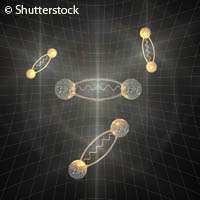
A team of EU-funded researchers has, for the first time, successfully carried out a constant stabilisation experiment of a quantum state - something Albert Einstein himself once dreamt of.
Einstein famously stated he wanted to trap a photon in a box for around a second, and now a team of French scientists has managed to go one step further by maintaining a constant number of photons in a high-quality microwave cavity in a permanent manner, as they outline in a new study published in the journal Nature.
The study was led by scientists from the Laboratoire Kastler Brossel in Paris.
Building on a breakthrough they made four years ago, where they observed a single and same microwave photon trapped in a box hundreds of times over, in this new study the team stabilised a given number of photons in a 'photon box', a cavity formed of two superconducting mirrors. It is the first time a complete experiment of quantum stabilisation has occurred.
Usually the photon, the basic unit of light, can only be observed when it disappears. The eye absorbs photons, destroying them and translating the information they carry as it is recorded.
Stabilisations play a major role in our everyday lives as they ensure the operation of many systems that surround us, such as in an oven where its heating temperature is dependent on a set value. As long as the ideal temperature has not been reached, the oven continues to heat up then maintains its state according to the thermostat readings.
The main aim of the DECLIC project is to understand the transition from quantum to classical devices. Quantum information thrives to build large quantum systems for tasks in communication or computing beyond the reach of classical devices; but questions remain surrounding whether another mechanism responsible for the disappearance of state super-positions at the macroscopic scale could exist, in addition to environment-induced decoherence.
The DECLIC project, which runs until 2015, was set up to explore the dynamics of fields trapped in cavities and to study their decoherence under various perspectives. It will implement novel ways to generate non-classical states with large photon numbers stored in one cavity or non-locally split between two.
The AQUTE project's main aims are to develop quantum technologies based on atomic, molecular and optical (AMO) systems for scalable quantum computation and entanglement-enabled technologies like metrology and sensing.
More information: Sayrin, C., et al. (2011) 'Real-time quantum feedback prepares and stabilizes photon number states', Nature, 477, 73-77. doi:10.1038/nature10376
Provided by CORDIS
-
From lemons to lemonade: Reaction uses carbon dioxide to make carbon-based semiconductor,
32 comments
-
Thioridazine kills cancer stem cells in human while avoiding toxic side-effects of conventional cancer treatments,
3 comments
-
SpaceX private rocket blasts off for space station (Update),
42 comments
-
Climate scientists say they have solved riddle of rising sea,
31 comments
-
SpaceX capsule has 'new car' smell, astronauts say (Update),
2 comments
-
Question about high electric charge.
3 hours ago
-
eyeglasses with smallest chromatic abberation
6 hours ago
-
Linear momentum converted to angular momentum?!
6 hours ago
-
Physics laboratory project - bumpers/crash tests
7 hours ago
-
How to open a winebottle with a shoe
7 hours ago
-
magnetic field from stream of protons
17 hours ago
- More from Physics Forums - Classical Physics
More news stories
Is a classical electrodynamics law incompatible with special relativity?
(Phys.org) -- The laws of classical electromagnetism that were developed in the 19th century are the same laws that scientists use today. They include Maxwell’s four equations along with the Lorentz la ...
Landmark calculation clears the way to answering how matter is formed
(Phys.org) -- An international collaboration of scientists, including Thomas Blum, associate professor of physics, is reporting in landmark detail the decay process of a subatomic particle called a kaon ...
May 25, 2012 |
4.2 / 5 (21) |
47
|
Lying in wait for WIMPs: Researchers seek to dramatically increase sensitivity of Large Underground Xenon detector
Although it's invisible, dark matter accounts for at least 80 percent of the matter in the universe. No one knows what it is, but most scientists would bet on weakly interacting massive particles, or WIMPs.
May 23, 2012 |
4 / 5 (7) |
15
|
Hawaii lab turns laser-powered bubbles into microrobots
(Phys.org) -- A team of scientists from the University of Hawaii are working on microrobots created from bubbles of air in a saline solution. The bubbles take on their title of robots as a laser ...
Sound increases the efficiency of boiling
Scientists at the Georgia Institute of Technology achieved a 17-percent increase in boiling efficiency by using an acoustic field to enhance heat transfer. The acoustic field does this by efficiently removing vapor bubbles ...
May 24, 2012 |
5 / 5 (2) |
2
Nvidia trumpets Tegra 3 phone design wins for 2012
(Phys.org) -- Nvidias competitive war paint has a name, Tegra 3. On the heels of Nvidia announcements about lowering costs of its Tegra 3 processors and Nvidia-enabled tablets running Android Ice Cream ...
Browser wars flare in mobile space
The browser wars are heating up again, but this time the fight is for dominance of the mobile Internet.
Scientist: Evolution debate will soon be history
(AP) -- Richard Leakey predicts skepticism over evolution will soon be history. Not that the avowed atheist has any doubts himself.
Dell tablet leak: 10.1-inch display, two-battery choice
(Phys.org) -- Headline after headline talks about vendors tablets in the wings as likely number-one contenders for the iPad. Such claims have justifiably been taken with a grain of salt, considering ...
Keep food safety in mind this memorial day weekend
(HealthDay) -- Picnics, parades and cookouts are as much a part of Memorial Day weekend as tributes to the United States' war veterans.
Social welfare cuts ultimately come with heavy price, researchers say
(Phys.org) -- Slashing government funding for Medicaid, food stamps and other programs that serve the poor while politically popular with some lawmakers and many conservatives may do more harm ...
Sep 24, 2011
Rank: not rated yet