CT scanning shows how ants build without an architect
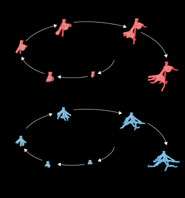
Four-dimensional ants nests from the same donor colony under different experimental treatments Image by Minter et al
Ant nests are some of the most remarkable structures in nature. Their relative size is rivalled only by our own skyscrapers but there is no architect or blueprint. Instead they are built collectively, through self-organization and the local interactions of ants with one another and their environment. So, how do ants decide what and where to build?
To answer these questions, geologist Dr Nicholas Minter, archaeologist, Dr Kate Robson Brown, and biologist Professor Nigel Franks used high-resolution CT scanning to obtain repeated three-dimensional images of ant nests throughout their excavation.
This video is not supported by your browser at this time.
Previous research on ant nests involved making plaster casts but such methods are destructive. By using CT scanning, this study avoided any destruction and also allowed the researchers to scan the same nest on multiple occasions, thus making it possible to observe individual nests as they were being excavated.The resulting high-resolution dataset on the four-dimensional growth of ant nests the first of its kind allowed the researchers to study in much greater detail the rules of ant nest excavation and the effect of sediment structure on nest architecture.
Dr Robson Brown said: Our results show that excavation is controlled by the density of ants and is also influenced by the structure of the sediment through which they tunnel. So, ant nest architecture is influenced by both social and environmental factors.
The findings of this unique interdisciplinary collaboration are published in the Journal of the Royal Society Interface.
More information: Minter, N. J., Franks, N. R. and Robson Brown, K. A. 2011. Morphogenesis of an extended phenotype: four-dimensional ant nest excavation J. R. Soc. Interface doi:10.1098/rsif.2011.0377
Provided by
University of Bristol
-
From lemons to lemonade: Reaction uses carbon dioxide to make carbon-based semiconductor,
32 comments
-
Thioridazine kills cancer stem cells in human while avoiding toxic side-effects of conventional cancer treatments,
3 comments
-
SpaceX private rocket blasts off for space station (Update),
42 comments
-
Climate scientists say they have solved riddle of rising sea,
31 comments
-
SpaceX capsule has 'new car' smell, astronauts say (Update),
2 comments
-
What would stain as translucent on light-coloured fabric?
17 hours ago
-
How do I identify different bacteria on culture plates?
May 26, 2012
-
Why Do Dogs do Strange things...
May 25, 2012
-
What does exophillic and endophillic mean in terms of mosquito and their control?
May 24, 2012
-
Semen stains glows under black lights (uv light)?
May 23, 2012
-
Question on Human Chromosome 2
May 23, 2012
- More from Physics Forums - Biology
More news stories
Scientist: Evolution debate will soon be history
(AP) -- Richard Leakey predicts skepticism over evolution will soon be history. Not that the avowed atheist has any doubts himself.
16 hours ago |
3.3 / 5 (17) |
51
More plant species responding to global warming than previously thought
(Phys.org) -- Far more wild plant species may be responding to global warming than previous large-scale estimates have suggested.
May 22, 2012 |
4.6 / 5 (14) |
18
|
Thousands of shellfish found dead in Peru
Thousands of crustaceans were found dead off the coast of Lima following the mystery mass death of dolphins and pelicans, the Peruvian Navy said Friday.
May 26, 2012 |
4.8 / 5 (4) |
7
For monogamous sparrows, it doesn't pay to stray (but they do it anyway)
It's quite common for a female song sparrow to stray from her breeding partner and mate with the male next door, but a new study shows that sleeping around can be costly.
May 22, 2012 |
5 / 5 (2) |
7
|
Study uncovers secret to speedy burrowing by razor clams
(Phys.org) -- If you look at a razor burrowing clam sitting in a bucket, youd never guess that it could burrow itself down into the soil, much less do it with any speed. Razor clams look like fat straws, ...
Nvidia trumpets Tegra 3 phone design wins for 2012
(Phys.org) -- Nvidias competitive war paint has a name, Tegra 3. On the heels of Nvidia announcements about lowering costs of its Tegra 3 processors and Nvidia-enabled tablets running Android Ice Cream ...
Browser wars flare in mobile space
The browser wars are heating up again, but this time the fight is for dominance of the mobile Internet.
Dell tablet leak: 10.1-inch display, two-battery choice
(Phys.org) -- Headline after headline talks about vendors tablets in the wings as likely number-one contenders for the iPad. Such claims have justifiably been taken with a grain of salt, considering ...
Keep food safety in mind this memorial day weekend
(HealthDay) -- Picnics, parades and cookouts are as much a part of Memorial Day weekend as tributes to the United States' war veterans.
Social welfare cuts ultimately come with heavy price, researchers say
(Phys.org) -- Slashing government funding for Medicaid, food stamps and other programs that serve the poor while politically popular with some lawmakers and many conservatives may do more harm ...
Is a classical electrodynamics law incompatible with special relativity?
(Phys.org) -- The laws of classical electromagnetism that were developed in the 19th century are the same laws that scientists use today. They include Maxwell’s four equations along with the Lorentz la ...
Sep 26, 2011
Rank: not rated yet