Rehabilitating cats one pat at a time
September 12, 2011

Rehabilitating cats one pat at a time

Enlarge

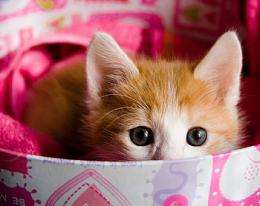
Grooming and petting aggressive cats could assist with their rehabilitation, UQ research has found

Traumatised cats are getting another shot at rehabilitation thanks to a novel research method being explored at The University of Queensland.

PhD student Nadine Gourkow is looking into a technique known as "gentling", where cats receive petting that mimics allorubbing and allogrooming (rubbing or grooming by another cat) in short and repetitive sessions to change their from negative to positive.

The exercises are designed to change cats' perspective of the shelter environment, give them control over the situation, help relieve them of and teach acceptance of association with unfamiliar humans.

“The research aims to understand the relationship between a cat's emotions and the body's defence mechanisms and manipulate both of them,” Ms Gourkow said.

During her research Ms Gourkow worked with 238 cats, out of which 45 were rescued from a hoarder and were living in unhealthy conditions without adequate care.

“Many of the cats were terrified and showed defensive aggression and were poorly socialised to humans,” Ms Gourkow said.

But after a few days of Ms Gourkow's “gentling” therapy, the cats began responding positively to people. They were eventually transformed into friendly, domesticated cats and were re-homed with new owners.

“We are hoping that by inducing positive emotions we can increase secretions of mucosal antibodies, which will help prevent them from becoming infected with pathogens that cause upper respiratory disease,” Ms Gourkow said.

Ms Gourkow is seeking financial support to develop a mechanical gentling tool that provides similar therapeutic benefits for very fearful cats that are too aggressive to touch.

Her study was supported by Morris Foundation and an anonymous donor who wanted to alleviate emotional stress in cats and give them healthier and happier lives.

It is hoped that Ms Gourkow's work will help in understanding the emotional states of living in shelters, reduce upper respiratory disease and allow many more of them to eventually find new homes.

Provided by University of Queensland search and more info website

Filter


Move the slider to adjust rank threshold, so that you can hide some of the comments.


Display comments: newest first

89118a
Sep 12, 2011

Rank: 5 / 5 (1)
Where's Mrs. Slocombe?
Vendicar_Decarian
Sep 12, 2011

Rank: not rated yet
Where'z Waldo?
Magnette
Sep 12, 2011

Rank: 5 / 5 (1)
Where's Mrs. Slocombe?


I wonder how many non-Brits will understand that one! :-)
Rank 5 /5 (1 vote)
Relevant PhysicsForums posts

More news stories

Scientist: Evolution debate will soon be history

(AP) -- Richard Leakey predicts skepticism over evolution will soon be history. Not that the avowed atheist has any doubts himself.

Biology / Evolution

created 17 hours ago | popularity 3.3 / 5 (17) | comments 54

More plant species responding to global warming than previously thought

(Phys.org) -- Far more wild plant species may be responding to global warming than previous large-scale estimates have suggested.

Biology / Ecology

created May 22, 2012 | popularity 4.6 / 5 (14) | comments 18 | with audio podcast

Thousands of shellfish found dead in Peru

Thousands of crustaceans were found dead off the coast of Lima following the mystery mass death of dolphins and pelicans, the Peruvian Navy said Friday.

Biology / Ecology

created May 26, 2012 | popularity 4.8 / 5 (4) | comments 7

For monogamous sparrows, it doesn't pay to stray (but they do it anyway)

It's quite common for a female song sparrow to stray from her breeding partner and mate with the male next door, but a new study shows that sleeping around can be costly.

Biology / Plants & Animals

created May 22, 2012 | popularity 5 / 5 (2) | comments 7 | with audio podcast

Study uncovers secret to speedy burrowing by razor clams

(Phys.org) -- If you look at a razor burrowing clam sitting in a bucket, you’d never guess that it could burrow itself down into the soil, much less do it with any speed. Razor clams look like fat straws, ...

Biology / Plants & Animals

created May 25, 2012 | popularity 1 / 5 (1) | comments 3 | with audio podcast report


Browser wars flare in mobile space

The browser wars are heating up again, but this time the fight is for dominance of the mobile Internet.

Nvidia trumpets Tegra 3 phone design wins for 2012

(Phys.org) -- Nvidia’s competitive war paint has a name, Tegra 3. On the heels of Nvidia announcements about lowering costs of its Tegra 3 processors and Nvidia-enabled tablets running Android Ice Cream ...

Dell tablet leak: 10.1-inch display, two-battery choice

(Phys.org) -- Headline after headline talks about vendors’ tablets in the wings as likely number-one contenders for the iPad. Such claims have justifiably been taken with a grain of salt, considering ...

Keep food safety in mind this memorial day weekend

(HealthDay) -- Picnics, parades and cookouts are as much a part of Memorial Day weekend as tributes to the United States' war veterans.

Social welfare cuts ultimately come with heavy price, researchers say

(Phys.org) -- Slashing government funding for Medicaid, food stamps and other programs that serve the poor – while politically popular with some lawmakers and many conservatives – may do more harm ...

Is a classical electrodynamics law incompatible with special relativity?

(Phys.org) -- The laws of classical electromagnetism that were developed in the 19th century are the same laws that scientists use today. They include Maxwell’s four equations along with the Lorentz la ...