The arXiv at 20: a global resource
September 28, 2011 By Bill Steele
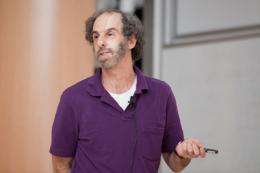
Paul Ginsparg, professor of physics and information science and creator the arXiv, commemorates the website's 20th anniversary.
As the e-print arXiv of scientific publications celebrates its 20th anniversary, what started as an effort to "level the playing field" for researchers has created a whole new playing field on which the white lines are still not clearly drawn.
Long before Paul Ginsparg, professor of physics and information science, created the arXiv, it was common practice for scientists to circulate to their friends a few paper preprints of their articles before the articles appeared in scholarly journals. Ginsparg created a simple website -- at first housed in a single workstation on a cluttered desk -- to turn the preprints into "e-prints" made available electronically.
"I've heard a lot about how democratic the arXiv is," Ginsparg said Sept. 23 in a talk commemorating the anniversary. People have, for example, praised the fact that the arXiv makes scientific papers easily available to scientists in developing countries where subscriptions to journals are not always affordable. "But what I was trying to do was set up a system that eliminated the hierarchy in my field," he said. As a physicist at Los Alamos National Laboratory, "I was receiving preprints long before graduate students further down the food chain," Ginsparg said. "When we have success we like to think it was because we worked harder, not just because we happened to have access."
The idea caught on, submissions multiplied, the subject matter expanded to include mathematics, astrophysics, computer science and, most recently, biology, and the arXiv has inspired online repositories in other fields. Ten years ago Ginsparg joined the Cornell faculty, bringing the arXiv with him. It is maintained by Cornell University Library.
As of September 2011, the system had accumulated more than 700,000 papers, with more than 6,000 new submissions arriving each month; in 2010 65 million full-text articles were downloaded. The history of submissions reflects the history of public acceptance, Ginsparg noted. The number of submissions in high-energy physics increased year by year but finally leveled out, meaning, Ginsparg said, that the field had reached saturation. Despite all this traffic, Ginsparg remarked, the system is still using some of the software written 20 years ago.
One of the surprises, Ginsparg said, is that electronic publishing has not transformed the seemingly irrational scholarly publishing system in which researchers give their work to publishing houses from which their academic institutions buy it back by subscribing to journals. Scholarly publishing is still in transition, Ginsparg said, due to questions about how to fund electronic publication and how to maintain quality control. The arXiv has no peer-review process, although it does restrict submissions to those with scientific credentials.
But the lines of communication are definitely blurring. Ginsparg reported that a recent paper posted on the arXiv by Alexander Gaeta, Cornell professor of applied and engineering physics, was picked up by bloggers and spread out from there. The paper is to be published in the journal Nature and is still under a press embargo, but an article about it has appeared in the journal Science.
Electronic publishing makes supporting data available alongside a paper and offers new ways to manage information, including searches, data mining and detection of plagiarism. "Concept searching," Ginsparg said, is a sought-after feature but is still in the works. And Facebook-style social interaction may become part of the system, he said.
But however wide the new field grows it is still level. The arXiv is, Ginsparg concluded, a global resource "where everybody has access to the same information on the same system."
Provided by
Cornell University
-
From lemons to lemonade: Reaction uses carbon dioxide to make carbon-based semiconductor,
32 comments
-
Thioridazine kills cancer stem cells in human while avoiding toxic side-effects of conventional cancer treatments,
3 comments
-
SpaceX private rocket blasts off for space station (Update),
42 comments
-
Climate scientists say they have solved riddle of rising sea,
31 comments
-
SpaceX capsule has 'new car' smell, astronauts say (Update),
2 comments
-
Interesting WWII Public INformation Leaflet
May 19, 2012
-
Treaty of the Pyrenees
May 08, 2012
- More from Physics Forums - History & Humanities
More news stories
Social welfare cuts ultimately come with heavy price, researchers say
(Phys.org) -- Slashing government funding for Medicaid, food stamps and other programs that serve the poor while politically popular with some lawmakers and many conservatives may do more harm ...
Other Sciences / Social Sciences
May 24, 2012 |
4.3 / 5 (16) |
144
Ancient Bethlehem seal unearthed in Jerusalem
Israeli archaeologists have discovered a 2,700-year-old seal that bears the inscription "Bethlehem," the Israel Antiquities Authority announced Wednesday, in what experts believe to be the oldest artifact ...
Other Sciences / Archaeology & Fossils
May 23, 2012 |
3.5 / 5 (14) |
23
Oldest Jewish archaeological evidence on the Iberian Peninsula
German archaeologists of the Friedrich Schiller University Jena found one of the oldest archaeological evidence so far of Jewish Culture on the Iberian Peninsula at an excavation site in the south of Portugal, ...
Other Sciences / Archaeology & Fossils
May 25, 2012 |
4.3 / 5 (4) |
12
Dollars and sense: Why are some people morally against tax?
As the U.S. presidential election campaigns heat up, the economic debate is dominated by bailouts, austerity and, inevitably, taxation. Now a new study published in Symbolic Interaction asks why tax is such an important issue ...
Other Sciences / Social Sciences
May 23, 2012 |
3 / 5 (2) |
12
Oldest art even older
New dates from Geißenklösterle Cave in Southwest Germany document the early arrival of modern humans and early appearance of art and music.
Other Sciences / Archaeology & Fossils
May 24, 2012 |
4.3 / 5 (3) |
6
Browser wars flare in mobile space
The browser wars are heating up again, but this time the fight is for dominance of the mobile Internet.
Nvidia trumpets Tegra 3 phone design wins for 2012
(Phys.org) -- Nvidias competitive war paint has a name, Tegra 3. On the heels of Nvidia announcements about lowering costs of its Tegra 3 processors and Nvidia-enabled tablets running Android Ice Cream ...
Scientist: Evolution debate will soon be history
(AP) -- Richard Leakey predicts skepticism over evolution will soon be history. Not that the avowed atheist has any doubts himself.
Dell tablet leak: 10.1-inch display, two-battery choice
(Phys.org) -- Headline after headline talks about vendors tablets in the wings as likely number-one contenders for the iPad. Such claims have justifiably been taken with a grain of salt, considering ...
Keep food safety in mind this memorial day weekend
(HealthDay) -- Picnics, parades and cookouts are as much a part of Memorial Day weekend as tributes to the United States' war veterans.
Is a classical electrodynamics law incompatible with special relativity?
(Phys.org) -- The laws of classical electromagnetism that were developed in the 19th century are the same laws that scientists use today. They include Maxwell’s four equations along with the Lorentz la ...
Oct 02, 2011
Rank: not rated yet
But anyway, as a scientist from developing country, I'd like to say "Thank you arXiv for the access to all those quality (or not so) articles!" It really made a difference! I cannot even imagine what science was 15 years ago, when you had to have subscription to every journal out there to do your research. It's just a different world in science!