Ariane rocket to hoist Europe-Japan Mercury mission
September 15, 2011

Mercury has been little explored

Enlarge

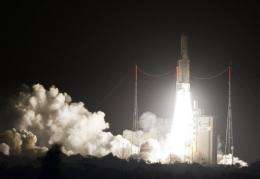
An Ariane-5 rocket blasts off on August 6 from the European space centre at Kourou, French Guiana. An unmanned European-Japanese mission to Mercury will be launched by Ariane 5 rocket in July 2014 under a contract announced by Arianespace.

An unmanned European-Japanese mission to Mercury will be launched by Ariane 5 rocket in July 2014 under a contract announced on Thursday by Arianespace.

The BepiColombo mission, named after a 20th-century Italian mathematician who studied the rotation of , comprises two probes that will enter orbit around the closest planet to the Sun after a six-year trek.

The rocket for the 4.4-tonne payload will be a heavy-lift Ariane 5 ECA, hoisted from the (ESA) base in Kourou, French Guiana, the European launch operator said in a press release.

The partners in the mission are ESA, providing the Mercury Planetary Orbiter, and the Japan Aerospace Exploration Agency (), whose contribution is the Mercury Magnetospheric Orbiter.

Mercury is listed in ESA's "cornerstone" investigations of the Solar System, which include the ongoing missions to Mars and Venus, as well as the , which was sent down to the Saturnian moon of Titan in January 2005 by the US spacecraft Cassini.

BepiColombo will use slow-but-steady solar propulsion and gravitational boosts from swings around Earth, Venus and Mercury itself to arrive at its destination in 2020.

The two orbiters will carry instruments to explore Mercury's crater-pocked surface, its magnetic field and thin vestigial atmosphere. Because of budgetary constraints, plans to add a small lander, the Mercury Surface Element (MSE), have been scrapped.

Mercury is one of the most enigmatic planets of the Solar System.

Temperatures reach 425 degrees Celsius (800 degrees Fahrenheit) during the day but plummet to -100 C (-150 F) at night.

Even though the planet is relatively close to Earth, it has been little explored, mainly because of the challenge of shielding scoutcraft from the radiation blasted out by the nearby Sun.

A NASA probe, MESSENGER, went into orbit around Mercury on March 17 for a year-long investigation after a six-and-a-half-year trip.

(c) 2011 AFP

Filter


Move the slider to adjust rank threshold, so that you can hide some of the comments.


Display comments: newest first

Nanobanano
Sep 15, 2011

Rank: 1 / 5 (2)
Because of budgetary constraints, plans to add a small lander, the Mercury Surface Element (MSE), have been scrapped.


hilarious, so now its just another pointless orbiter mission.

What's the point anyway?

We've sent basic probes in the past, and they're useless.

Wow. It's a hot rock, and will never be safe to mine or anything else like that.

It's not like you're going to discover some new revolution in physics by sending multiple extra probes to Mercury.

You wont solve the theory of everything there, and you won't find the higgs, and you won't find a way to sythesize anti-matter, and you won't find time travel or warp propulsion, or anything useful in finding any of those things either.

So what's the big deal?

It's wasting all this time and money on a science mission that is extremely, EXTREMELY unlikely to provide any new discovery of any significant economic value, if anything whatsoever, besides some statistic in a wikipedia article....
Nanobanano
Sep 15, 2011

Rank: 1 / 5 (2)
That's about all this mission will do...

...add another paragraph or two to the wikipedia article on "Mercury", but not provide one damn thing that benefits any of the citizens who paid for this program with tax payers money. Not only that, but the tax payers paid for these programs, but the companies and organizations who got the contracts to build all this stuff owns all the patents on the technologies, and the "investors" who were the tax payers, got none of the "rights" to it.

Everybody is a fricken serf for the contractors for government space programs.

Nobody has ever invented something based on a discovery made in space through space exploration. not even one thing.

GPS and satellites don't count, since GPS is based on relativity, which was known before the space age even began, and has little to do with planetary exploration, and regular satellites were always part of the plan of the early space age anyway, before exploration even began...

so what's the point?
Rank 5 /5 (2 votes)
Relevant PhysicsForums posts
  • revamping general concept and cosmological principle
    createdMay 25, 2012
  • Transiting Exoplanet Light Curve
    createdMay 25, 2012
  • Math behind Theoretical Physics
    createdMay 24, 2012
  • Do we know whats at the center of galaxies yet?
    createdMay 23, 2012
  • Structure of the Milky Way?
    createdMay 20, 2012
  • What would it take to terraform Pluto and Charon?
    createdMay 19, 2012
  • More from Physics Forums - General Astronomy

More news stories

Sophisticated simulations predict future warming

The chances of our planet being hit by a global warming of 3 degrees Celsius by 2050 is as likely as it being hit by an increase of 1.4 degrees, new research shows. Presented in the journal Nature Geoscience, the British study ...

Space & Earth / Earth Sciences

created May 22, 2012 | popularity 4.4 / 5 (9) | comments 51

Kyoto Protocol architect 'frustrated' by climate dialogue

UN climate talks are going nowhere, as politicians dither or bicker while the pace of warming dangerously speeds up, one of the architects of the Kyoto Protocol told AFP.

Space & Earth / Environment

created May 23, 2012 | popularity 3.7 / 5 (7) | comments 39

Aliens don't want to eat us, says former SETI director

Alien life probably isn’t interested in having us for dinner, enslaving us or laying eggs in our bellies, according to a recent statement by former SETI director Jill Tarter.

Space & Earth / Space Exploration

created May 25, 2012 | popularity 4.4 / 5 (13) | comments 37

Dragon arrives at space station in historic 1st (Update 2)

The privately bankrolled Dragon capsule made a historic arrival at the International Space Station on Friday, triumphantly captured by astronauts wielding a giant robot arm.

Space & Earth / Space Exploration

created May 25, 2012 | popularity 5 / 5 (10) | comments 19

What's the big deal about private space launches?

(AP) -- The first private spaceship is headed to the International Space Station. Some questions and answers about the cargo mission by Space Exploration Technologies, known as SpaceX:

Space & Earth / Space Exploration

created May 22, 2012 | popularity 5 / 5 (6) | comments 35


Browser wars flare in mobile space

The browser wars are heating up again, but this time the fight is for dominance of the mobile Internet.

Nvidia trumpets Tegra 3 phone design wins for 2012

(Phys.org) -- Nvidia’s competitive war paint has a name, Tegra 3. On the heels of Nvidia announcements about lowering costs of its Tegra 3 processors and Nvidia-enabled tablets running Android Ice Cream ...

Scientist: Evolution debate will soon be history

(AP) -- Richard Leakey predicts skepticism over evolution will soon be history. Not that the avowed atheist has any doubts himself.

Dell tablet leak: 10.1-inch display, two-battery choice

(Phys.org) -- Headline after headline talks about vendors’ tablets in the wings as likely number-one contenders for the iPad. Such claims have justifiably been taken with a grain of salt, considering ...

Keep food safety in mind this memorial day weekend

(HealthDay) -- Picnics, parades and cookouts are as much a part of Memorial Day weekend as tributes to the United States' war veterans.

Social welfare cuts ultimately come with heavy price, researchers say

(Phys.org) -- Slashing government funding for Medicaid, food stamps and other programs that serve the poor – while politically popular with some lawmakers and many conservatives – may do more harm ...