Most accurate measurements of big-city pollution
September 23, 2011 by Lin Edwards report

Most accurate measurements of big-city pollution

Enlarge

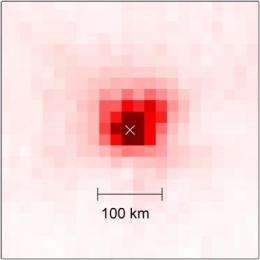
Sequence of mean NO2 column densities around Riyadh (white cross) for different wind conditions. Credit: Steffen Beirl

(PhysOrg.com) -- One of NASA's satellites has provided the most detailed map yet of the pollution generated by some of the world’s biggest cities, and given an indication of the volume of emissions of the nitrogen oxides from direct measurements rather than relying on computer models and a range of assumptions.

The scientists, from Germany and the Netherlands, led by Steffen Beirle of the Max Planck Institute for Chemistry in Mainz, Germany, combined the data from ’s Aura satellite with data on known wind patterns. The satellite is equipped with four measuring instruments, including an Ozone Monitoring Instrument (OMI), which measures a range of atmospheric particles such as dust, smoke, and chemicals such as the nitrogen oxides. It also measures cloud cover and pressure, which enables tropospheric ozone to be calculated. The OMI was built by the Agency for Aerospace Programs in the Netherlands and the Finnish Meteorological Institute.

The focus of Beirle’s study was the nitrogen oxides (NOx, comprising nitric oxide, NO, and nitrogen dioxide, NO2), since they contribute to smog, acid rain, and ozone depletion, and have been linked to health problems in human populations.

Nitrogen oxides form part of vehicle emissions, and in the past have tended to be estimated from data on traffic volumes, fuel consumption, and NOx lifetimes, rather than by direct measurement. The satellite data gave the researchers a direct measurement of the emissions, and the data on wind patterns enabled them to identify the sources, resulting in the most accurate information available to date.

The study, published in the journal Science, found that the emissions of from Riyadh (the capital of Saudi Arabia) were three times greater than previous estimates, while those of megacities such as Tokyo, Madrid, and Moscow were more similar to previous estimates. Some megacities, such as Hong Kong and New York, yielded less useful data because they are so close to other large metropolitan areas producing , which makes the situation more complex.

The results of the research could help scientists obtain more reliable information that does not depend on models, which can introduce biases. The results could also lead to the development of better pollution control measures, especially for large cities in the developing world.

The Aura satellite was launched in 2004 as part of a program aimed at monitoring the Earth’s atmosphere and effects such as the depletion of the ozone layer. Among the other atmospheric measurements made are changes in levels of aerosols, carbon dioxide, water vapor, and methane. The also monitors cloud cover around the globe.

More information: http://aura.gsfc.nasa.gov/

Paper: Megacity Emissions and Lifetimes of Nitrogen Oxides Probed from Space, Science 23 September 2011: Vol. 333 no. 6050 pp. 1737-1739. DOI: 10.1126/science.1207824

Abstract
Megacities are immense sources of air pollutants, with large impacts on air quality and climate. However, emission inventories in many of them still are highly uncertain, particularly in developing countries. Satellite observations allow top-down estimates of emissions to be made for nitrogen oxides (NOx = NO + NO2), but require poorly quantified a priori information on the NOx lifetime. We present a method for the simultaneous determination of megacity NOx emissions and lifetimes from satellite measurements by analyzing the downwind patterns of NO2 separately for different wind conditions. Daytime lifetimes are ~4 hours at low and mid-latitudes, but ~8 hours in wintertime for Moscow. The derived NOx emissions are generally in good agreement with existing emission inventories, but are higher by a factor of 3 for the Saudi Arabian capital Riyadh.

© 2011 PhysOrg.com

Filter


Move the slider to adjust rank threshold, so that you can hide some of the comments.


Display comments: newest first

omatumr
Sep 24, 2011

Rank: 1 / 5 (3)
Yes, big cities and industries generate lots of emissions.

The public has lost confidence in leaders who proposed moving industries overseas.

Reality can be a merciless taskmaster - even of world leaders.

The danger is that world leaders and leaders of science aligned themselves with two scientific falsehoods about four decades ago [1]:

a.) Anthropogenic climate change, and the
b.) Bilderberg model of the Sun as a stable H-fusion reactor.

Having failed to whitewash Climategate, their only escape is to:

c.) Admit deceit and risk retaliation, or
d.) Ban open discussion of Climategate.

Statesmanship is needed to resolve the situation and restore:

e.) Integrity to government science.
f.) Citizen control over government.

With kind regards,
Oliver K. Manuel

[1] "Deep roots of Climategate" (2011)
http://dl.dropbox...oots.pdf
Rank 5 /5 (1 vote)
Relevant PhysicsForums posts

More news stories

Sophisticated simulations predict future warming

The chances of our planet being hit by a global warming of 3 degrees Celsius by 2050 is as likely as it being hit by an increase of 1.4 degrees, new research shows. Presented in the journal Nature Geoscience, the British study ...

Space & Earth / Earth Sciences

created May 22, 2012 | popularity 4.4 / 5 (9) | comments 51

Kyoto Protocol architect 'frustrated' by climate dialogue

UN climate talks are going nowhere, as politicians dither or bicker while the pace of warming dangerously speeds up, one of the architects of the Kyoto Protocol told AFP.

Space & Earth / Environment

created May 23, 2012 | popularity 3.7 / 5 (7) | comments 39

Aliens don't want to eat us, says former SETI director

Alien life probably isn’t interested in having us for dinner, enslaving us or laying eggs in our bellies, according to a recent statement by former SETI director Jill Tarter.

Space & Earth / Space Exploration

created May 25, 2012 | popularity 4.4 / 5 (13) | comments 37

Dragon arrives at space station in historic 1st (Update 2)

The privately bankrolled Dragon capsule made a historic arrival at the International Space Station on Friday, triumphantly captured by astronauts wielding a giant robot arm.

Space & Earth / Space Exploration

created May 25, 2012 | popularity 5 / 5 (10) | comments 19

What's the big deal about private space launches?

(AP) -- The first private spaceship is headed to the International Space Station. Some questions and answers about the cargo mission by Space Exploration Technologies, known as SpaceX:

Space & Earth / Space Exploration

created May 22, 2012 | popularity 5 / 5 (6) | comments 35


Browser wars flare in mobile space

The browser wars are heating up again, but this time the fight is for dominance of the mobile Internet.

Nvidia trumpets Tegra 3 phone design wins for 2012

(Phys.org) -- Nvidia’s competitive war paint has a name, Tegra 3. On the heels of Nvidia announcements about lowering costs of its Tegra 3 processors and Nvidia-enabled tablets running Android Ice Cream ...

Scientist: Evolution debate will soon be history

(AP) -- Richard Leakey predicts skepticism over evolution will soon be history. Not that the avowed atheist has any doubts himself.

Dell tablet leak: 10.1-inch display, two-battery choice

(Phys.org) -- Headline after headline talks about vendors’ tablets in the wings as likely number-one contenders for the iPad. Such claims have justifiably been taken with a grain of salt, considering ...

Keep food safety in mind this memorial day weekend

(HealthDay) -- Picnics, parades and cookouts are as much a part of Memorial Day weekend as tributes to the United States' war veterans.

Social welfare cuts ultimately come with heavy price, researchers say

(Phys.org) -- Slashing government funding for Medicaid, food stamps and other programs that serve the poor – while politically popular with some lawmakers and many conservatives – may do more harm ...