Abrupt escape from flatness
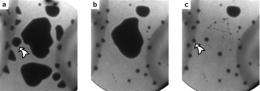
At first glance, it seems as if billions of lead atoms have mysteriously disappeared. When exposed to heat, a layer of lead coated onto a nickel surface becomes almost invisible from one moment to the next. In reality, the slightest disturbance causes these atoms to suddenly switch from a broad flat pancake shape to a compact hemisphere. This remarkable phenomenon was first revealed by researchers at the University of Twentes MESA+ Institute for Nanotechnology, who have since published their results in Physical Review Letters.
A lead coating on a nickel surface has unusual electronic properties which cause it to form flat "pancakes", consisting of billions of atoms arranged in a crystalline structure. These "pancakes" of solid lead are quantum mechanically stabilized and just a couple of dozen atoms thick. When exposed to gradual heating, nothing much changes at first. At about 520 Kelvin (247 degrees Celsius), however, the lead coating suddenly seems to disappear completely. Within the space of a few milliseconds, the lead "slivers" transform into hemispheres with a radius (or "height") of a few micrometers. Interestingly, this all takes place at a temperature below the melting point of lead. The hemispheres, too, consist of solid lead. So no mass has been lost, the material has simply taken on a different spatial configuration.
The technique used by the researchers to observe this process is known as Low Energy Electron Microscopy (LEEM). There are only a few such microscopes in existence, but two have recently been installed in the Netherlands. They are designed to bombard surfaces with low energy electrons. This makes them especially well suited to making accurate observations of surface phenomena and events in thin films.
The abrupt transformation from flat to spherical can be explained in terms of the most energetically favourable shape. From this viewpoint, hemispheres make much more effective use of surfaces, whereas pancakes are not very stable. There has recently been a massive expansion in our understanding of atomic processes right down to the level of single atoms, facilitated by experimental techniques such as Scanning Tunnelling Microscopy (STM), together with newly developed theories. Even so, we cannot account for the sheer speed at which this transition takes place.
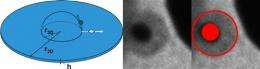
When transposing a two-dimensional sliver into a three-dimensional hemisphere, it is possible to calculate the height of the latter structure. For this purpose, the sliver is assumed to be circular in shape.
However, this recently discovered super-fast transition from two to three dimensions is based on a delicate interplay between several atoms, a kind of group process. In their published article, these researchers from Twente express the view that a more detailed explanation of the very rapid transition from flat to spherical will only be possible when we have a better fundamental theoretical understanding of meso-level phenomena. LEEM can be used to make direct observations of new phenomena at the meso-scale, thereby generating data crucial to our knowledge of this field. The importance of these results is that they will give us a more profound understanding of the stability of nanostructures.
The article entitled "Anomalous decay of electronically stabilized lead mesas on Ni(111)" by Tjeerd Bollmann, Raoul van Gastel, Harold Zandvliet and Bene Poelsema has been published in Physical Review Letters. This September, Tjeerd Bollmann successfully defended his PhD thesis entitled "Escape from Flatland", which was supervised by Prof. Bene Poelsema (UT) and Prof. Joost Frenken (UL).
Provided by
University of Twente
-
From lemons to lemonade: Reaction uses carbon dioxide to make carbon-based semiconductor,
32 comments
-
Thioridazine kills cancer stem cells in human while avoiding toxic side-effects of conventional cancer treatments,
3 comments
-
SpaceX private rocket blasts off for space station (Update),
42 comments
-
Climate scientists say they have solved riddle of rising sea,
31 comments
-
SpaceX capsule has 'new car' smell, astronauts say (Update),
2 comments
-
Water flow question
1 hour ago
-
[Drift velocity] Factors affecting velocity
3 hours ago
-
does cold gasoline have less energy
4 hours ago
-
distribution of molecules throughout the atmosphere
6 hours ago
-
The Global Positioning System !
7 hours ago
-
A Question relating Power
8 hours ago
- More from Physics Forums - General Physics
More news stories
In nanorod crystal growth, nanoparticles seen as artificial atoms
In the growth of crystals, do nanoparticles act as "artificial atoms" forming molecular-type building blocks that can assemble into complex structures? This is the contention of a major but controversial theory ...
May 24, 2012 |
4.8 / 5 (6) |
0
|
First direct observation of oriented attachment in nanocrystal growth
Berkeley Lab researchers have reported the first direct observation of nanoparticles undergoing oriented attachment, the critical step in biomineralization and the growth of nanocrystals. A better understanding ...
May 24, 2012 |
4.7 / 5 (3) |
0
|
Dopant gives graphene solar cells highest efficiency yet
(Phys.org) -- By taking advantage of graphenes favorable electrical and optical properties, and then adding an organic dopant, researchers have achieved the highest power conversion efficiency yet for ...
Synthetic nano-waste does not disappear
(Phys.org) -- Tiny particles of cerium oxide do not burn or change in the heat of a waste incineration plant. They remain intact on combustion residues or in the incineration system, as a new study by Swiss ...
Nanotechnology / Bio & Medicine
May 25, 2012 |
5 / 5 (2) |
1
|
'Metamaterials,' quantum dots show promise for new technologies
(Phys.org) -- Researchers are edging toward the creation of new optical technologies using "nanostructured metamaterials" capable of ultra-efficient transmission of light, with potential applications including ...
May 24, 2012 |
5 / 5 (7) |
1
|
Browser wars flare in mobile space
The browser wars are heating up again, but this time the fight is for dominance of the mobile Internet.
Nvidia trumpets Tegra 3 phone design wins for 2012
(Phys.org) -- Nvidias competitive war paint has a name, Tegra 3. On the heels of Nvidia announcements about lowering costs of its Tegra 3 processors and Nvidia-enabled tablets running Android Ice Cream ...
Scientist: Evolution debate will soon be history
(AP) -- Richard Leakey predicts skepticism over evolution will soon be history. Not that the avowed atheist has any doubts himself.
Dell tablet leak: 10.1-inch display, two-battery choice
(Phys.org) -- Headline after headline talks about vendors tablets in the wings as likely number-one contenders for the iPad. Such claims have justifiably been taken with a grain of salt, considering ...
Keep food safety in mind this memorial day weekend
(HealthDay) -- Picnics, parades and cookouts are as much a part of Memorial Day weekend as tributes to the United States' war veterans.
Social welfare cuts ultimately come with heavy price, researchers say
(Phys.org) -- Slashing government funding for Medicaid, food stamps and other programs that serve the poor while politically popular with some lawmakers and many conservatives may do more harm ...

Sep 29, 2011
Rank: 1 / 5 (8)
If I get a bad rating (1 star) from a given member of physorg, that would be due to their ignorance, not knowledge. Whoever you are, thank you for pointing yourself out.
Sep 30, 2011
Rank: 5 / 5 (1)
Sep 30, 2011
Rank: 5 / 5 (1)
Oct 03, 2011
Rank: not rated yet
http://www.lbl.go...ion.html