Webb Telescope's MIRI flight instrument completes cryogenic testing in the UK
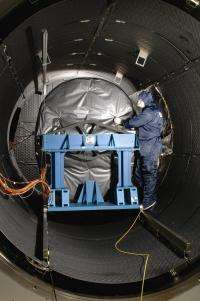
The Mid-Infrared Instrument underwent testing inside the thermal space test chamber at the Science and Technology Facilities Council's Rutherford Appleton Laboratory Space in Oxfordshire, U.K. Credit: RAL
A pioneering camera and spectrometer that will fly aboard NASA's James Webb Space Telescope has completed cryogenic testing designed to mimic the harsh conditions it will experience in space. The Mid-Infrared Instrument (MIRI) underwent testing inside the thermal space test chamber at the Science and Technology Facilities Council's Rutherford Appleton Laboratory (RAL) Space in Oxfordshire, U.K. The sophisticated instrument is designed to examine the first light in the universe and the formation of planets around other stars.
A team of more than 50 scientists from 11 countries tested MIRI for 86 days, representing the longest and most exhaustive testing at cryogenic temperatures of an astronomy instrument in Europe prior to delivery for its integration into a spacecraft.
"The successful completion of the test program, involving more than 2,000 individual tests, marks a major milestone for the Webb telescope mission," said Matthew Greenhouse, Webb telescope project scientist for the Science Instrument Payload, at NASA's Goddard Space Flight Center in Greenbelt, Md.
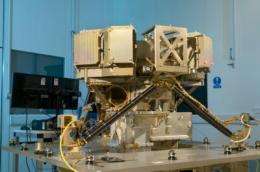
The Mid-Infrared Instrument undergoing alignment testing at the RAL. Credit: RAL
Along with the Webb telescope's other instruments, MIRI will help scientists better understand how the universe formed following the Big Bang and ultimately developed star systems that may be capable of supporting life. In particular, scientists hope to explore young planets around distant stars that are shrouded by gas and dust when viewed in visible light. Because infrared light penetrates these obstructions, MIRI can acquire images of planetary nurseries sharper than ever before possible. With its spectrometer, MIRI could potentially reveal the existence of water on these planets as well, informing future investigations into their habitability for humans.To capture some of the earliest, infrared light in the cosmos, MIRI has to be cooled to 7 Kelvin (-266 Celsius/-447 Fahrenheit), which brings tough challenges for testing the instrument. Inside the RAL Space thermal space test chamber, specially constructed shrouds, cooled to 40K (-233C/-388F), surround MIRI while scientists observe simulated background stars. The tests were designed to ensure that MIRI can operate successfully in the cold vacuum of space and allow scientists to gather vital calibration and baseline data.
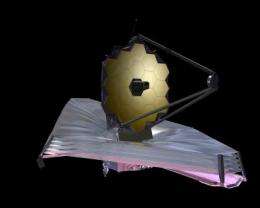
This is an artist's conception of the James Webb Space Telescope. Credit: NASA
The MIRI team is now analyzing data from the cryogenic test campaign, completing remaining "warm testing," and will prepare the instrument for delivery to NASA Goddard. There it will be integrated with the other instruments, and the telescope."Thousands of astronomers will use the Webb telescope to extend the reach of human knowledge far beyond today's limits. Just as the Hubble Space Telescope rewrote textbooks everywhere, Webb will find new surprises and help to answer some of the most pressing questions in astronomy," said John Mather, Nobel laureate and Webb senior project scientist at NASA Goddard.
Provided by
NASA's Goddard Space Flight Center
-
From lemons to lemonade: Reaction uses carbon dioxide to make carbon-based semiconductor,
32 comments
-
Thioridazine kills cancer stem cells in human while avoiding toxic side-effects of conventional cancer treatments,
3 comments
-
SpaceX private rocket blasts off for space station (Update),
42 comments
-
Climate scientists say they have solved riddle of rising sea,
31 comments
-
SpaceX capsule has 'new car' smell, astronauts say (Update),
2 comments
-
revamping general concept and cosmological principle
May 25, 2012
-
Transiting Exoplanet Light Curve
May 25, 2012
-
Math behind Theoretical Physics
May 24, 2012
-
Do we know whats at the center of galaxies yet?
May 23, 2012
-
Structure of the Milky Way?
May 20, 2012
-
What would it take to terraform Pluto and Charon?
May 19, 2012
- More from Physics Forums - General Astronomy
More news stories
Yale study concludes public apathy over climate change unrelated to science literacy
Are members of the public divided about climate change because they don't understand the science behind it? If Americans knew more basic science and were more proficient in technical reasoning, would public consensus match ...
32 minutes ago |
not rated yet |
2
|
10 million years needed to recover from mass extinction
It took some 10 million years for Earth to recover from the greatest mass extinction of all time, latest research has revealed.
Space & Earth / Earth Sciences
33 minutes ago |
not rated yet |
0
|
Sophisticated simulations predict future warming
The chances of our planet being hit by a global warming of 3 degrees Celsius by 2050 is as likely as it being hit by an increase of 1.4 degrees, new research shows. Presented in the journal Nature Geoscience, the British study ...
Space & Earth / Earth Sciences
May 22, 2012 |
4.4 / 5 (9) |
51
Aliens don't want to eat us, says former SETI director
Alien life probably isnt interested in having us for dinner, enslaving us or laying eggs in our bellies, according to a recent statement by former SETI director Jill Tarter.
Space & Earth / Space Exploration
May 25, 2012 |
4.4 / 5 (13) |
39
Kyoto Protocol architect 'frustrated' by climate dialogue
UN climate talks are going nowhere, as politicians dither or bicker while the pace of warming dangerously speeds up, one of the architects of the Kyoto Protocol told AFP.
May 23, 2012 |
3.7 / 5 (7) |
39
Change in developmental timing was crucial in the evolutionary shift from dinosaurs to birds: study
At first glance, it's hard to see how a common house sparrow and a Tyrannosaurus Rex might have anything in common. After all, one is a bird that weighs less than an ounce, and the other is a dinosaur that ...
Computer model used to pinpoint prime materials for efficient carbon capture
When power plants begin capturing their carbon emissions to reduce greenhouse gases and to most in the electric power industry, it's a question of when, not if it will be an expensive undertaking.
'Unzipped' carbon nanotubes could help energize fuel cells, batteries
Multi-walled carbon nanotubes riddled with defects and impurities on the outside could replace some of the expensive platinum catalysts used in fuel cells and metal-air batteries, according to scientists at ...
T cells 'hunt' parasites like animal predators seek prey, study shows
By pairing an intimate knowledge of immune-system function with a deep understanding of statistical physics, a cross-disciplinary team at the University of Pennsylvania has arrived at a surprising finding: T cells use a movement ...
Manufacturing genes to attack flu virus
An international research team has manufactured a new protein that can combat deadly flu epidemics.
Same gene that stunts infants' growth also makes them grow too big: research
UCLA geneticists have identified the mutation responsible for IMAGe* syndrome, a rare disorder that stunts infants' growth. The twist? The mutation occurs on the same gene that causes Beckwith-Wiedemann syndrome, which makes ...


Aug 22, 2011
Rank: not rated yet