Unsociable networks

August 18, 2011

Unsociable networks

Enlarge

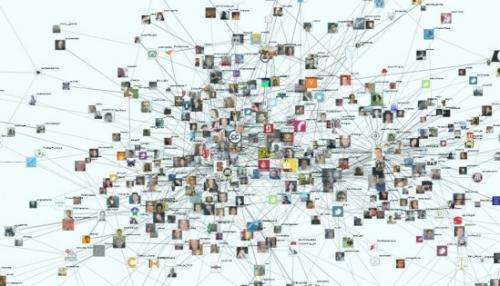
Twitter network visualizations. Credit: Mark Smith from Flickr

Innovation and high-tech "clusters" inspired by the success of Silicon Valley in the United States are, ironically, struggling to get much social networking out of the scientists who inhabit them, a new study suggests.

Research into the "Silicon Fen", a collection of high-tech businesses around Cambridge named in direct homage to the Californian that spawned sites like and , has found that real-life among the people who work there rarely takes place.

The findings are a direct contradiction of much of the reasoning behind creating such knowledge hubs in the first place. Policy-makers and theorists have long argued that wherever firms working in related industries are clustered together, people will start to share ideas across company boundaries as they socialize and meet.

This is supposed to result in a “spillover” effect, turning the area into a vibrant nerve centre that stimulates the local economy as news, gossip, rumours and recommendations about what different businesses are up to spreads. Many countries have sought to create and tech clusters as a result; in the UK, other examples include the M4 corridor, and the so-called “Silicon Glen” in Scotland’s central belt.

While the knowledge spillover theory sounds convincing, however, it has never been properly tested, until now. When University of Cambridge Gates Scholar Franz Huber decided to do so, he discovered that it doesn’t really work.

Writing in the Journal of Economic Geography, Huber reports that, far from developing the informal social networks that are supposed to stimulate knowledge exchange, most people working in the Cambridge cluster don’t feel that they need to, and don’t have the time.

His study, of 105 people from 46 different hardware and software companies revealed that many of them feel that they work in too closely-specialised a field to benefit from casual ideas-swapping outside the workplace. Often, when they do share knowledge or test ideas, they do it online with other specialists, who are just as likely to live in California as Cambridge.

“Cambridge has one of the most prominent and successful IT clusters in Europe, but many people working there don’t feel that they benefit professionally from being located within it,” Huber said. “The advantage of being there seems to have more to do with the labor market opportunities it offers, and the benefits of having their company associated with the global reputation of Cambridge.”

“We need to rethink the assumption that tech clusters automatically lead to spillovers and knowledge sharing. Most of the people who took part in this research, in particular the engineers, don’t feel that they need to have personal contact outside of their firms to be successful. ”

Huber interviewed a mixture of research and development workers, technology officers and managing directors. Using a standardised set of questions, he investigated their day-to-day working habits, the mechanisms by which they form social relationships, their interactions with people from other companies and the perceived advantages and disadvantages of working in the Cambridge cluster.

He found that, particularly below management level, very few participants felt that being there affected their ability to do their jobs. At one stage they were asked: “To what extent is it beneficial for your work in your current firm to have many innovative firms / research institutions located in the Cambridge region?” Participants were asked to respond on a scale of 1 to 7 where 1 meant “very much” and 7 “not at all”. The most popular response was 7, and almost two-thirds of technical engineers put down a 5, 6, or 7.

The most common explanation for this given by the interviewees was that there is no need for interaction in order for them to be able to do their jobs. Many of the companies in the cluster have a global focus, meaning that when they need to recruit or source information, they use the internet to share knowledge with other firms around the world.

Their perceived benefits of working in Cambridge were very different. Most interviewees wanted to work in the area because if they lost their job or decided to move, they felt that there would be a good chance of finding other work nearby, which meant that they wouldn’t have to uproot their family and move. Many also felt that being near to Cambridge and the University was of benefit, because it reflected positively on their firm’s image.

Interestingly, some of the participants had worked in and referred to its more sociable culture. “There seems to be a different environment there, where people are much more talkative,” Huber said.

His paper concludes that tech clusters can still be of benefit to a regional or national economy – but only if they are created for the right reasons.

“Knowledge Networking just doesn’t drive these sectors as much as we might think,” Huber added. “The idea that putting all these people in one place will enable knowledge to flow sounds good on paper, but it doesn’t take into account people’s individual behaviour. We should be careful about our belief that encouraging networking will drive these industries – nobody is going to use a network, however convenient and local it is, if they don’t feel it’s relevant to their job.”

Provided by University of Cambridge search and more info website

Filter


Move the slider to adjust rank threshold, so that you can hide some of the comments.


Display comments: newest first

jscroft
Aug 18, 2011

Rank: 1 / 5 (1)
So... engineers don't make a whole lot of social contact in the physical world, even with other engineers? I don't know how much this research cost, but I bet it would have been cheaper to buy a couple of Dilbert comic books.
Nanobanano
Aug 18, 2011

Rank: 5 / 5 (1)
This is a significant problem of why so much of our technology has been developed in such narrow-minded ways. We need people to be interacting across multiple disciplines of engineering and science in order to develop technologies and applications which make the best usage of our emerging computers, materials and nano sciences.

It's not enough to build a better PC, or discover a marginally better alloy.

We need devices which solve real world, cross-disciplinary computations, automations, medical, and environmental problems that nobody has ever even thought of trying to solve, because they thought it was impossible.

Being a specialist might get an individual a bigger pay check, but it then makes them less likely to develop cross-disciplinary technologies, which is a problem for future nano science.
Recovering_Human
Aug 18, 2011

Rank: not rated yet
What's a better way to get accurate, useful information: chatting with someone who might be somewhat up-to-date on what's going on and might remember some of the facts, or browsing the web and immediately having as many fresh, detailed and accurate articles at your disposal as you want? Except for direct man-to-man communication with co-workers who are willing to share otherwise unavailable information, the type of social networking described in this article is becoming obsolete, and naturally STEM people realize this.
david_42
Aug 18, 2011

Rank: not rated yet
I spent many years in Silicon Valley and I can't call it a social environment at any level. 60-80 hour work weeks leave you with zero desire to interact with other professionals outside work.
Moebius
Aug 19, 2011

Rank: 1 / 5 (1)
Right, all you have to do is be active on physicsforums.com to find out why this theory is baloney. A bigger bunch of egghead prima donna's who think they know a lot more than they really do can't be found in many other places. And you expect a bunch of jerks like that to socialize? Check that forum out for a while and you will see an inordinate number of names crossed out. They ban users on a daily basis for 'violations'. Which is generally anyone that challenges anything the moderators and their chosen few say. By the way, if you get banned delete your cookies and make a new user name.
jscroft
Aug 21, 2011

Rank: not rated yet
banoney... egghead prima donnas... jerks... but here's how to recover from being banned.


Admit it, Moebius. You're my ex-wife, aren't you?
Rank 5 /5 (5 votes)
Relevant PhysicsForums posts
  • Consumption rivalry
    createdMay 25, 2012
  • Bilateral trade between all countries
    createdMay 24, 2012
  • Is the economic foundation of social media in jeopardy?
    createdMay 20, 2012
  • Psychology: Rosenthal and Hawthorne Effect
    createdMay 15, 2012
  • Is GDP and National Income the Same Thing?
    createdMay 13, 2012
  • Difference between hourly wage and real GDP per hour worked?
    createdMay 12, 2012
  • More from Physics Forums - Social Sciences

More news stories

Change in developmental timing was crucial in the evolutionary shift from dinosaurs to birds: study

At first glance, it's hard to see how a common house sparrow and a Tyrannosaurus Rex might have anything in common. After all, one is a bird that weighs less than an ounce, and the other is a dinosaur that ...

Other Sciences / Archaeology & Fossils

created 5 minutes ago | popularity not rated yet | comments 0 | with audio podcast

Social welfare cuts ultimately come with heavy price, researchers say

(Phys.org) -- Slashing government funding for Medicaid, food stamps and other programs that serve the poor – while politically popular with some lawmakers and many conservatives – may do more harm ...

Other Sciences / Social Sciences

created May 24, 2012 | popularity 4.3 / 5 (16) | comments 147

Ancient Bethlehem seal unearthed in Jerusalem

Israeli archaeologists have discovered a 2,700-year-old seal that bears the inscription "Bethlehem," the Israel Antiquities Authority announced Wednesday, in what experts believe to be the oldest artifact ...

Other Sciences / Archaeology & Fossils

created May 23, 2012 | popularity 3.5 / 5 (14) | comments 23

Oldest Jewish archaeological evidence on the Iberian Peninsula

German archaeologists of the Friedrich Schiller University Jena found one of the oldest archaeological evidence so far of Jewish Culture on the Iberian Peninsula at an excavation site in the south of Portugal, ...

Other Sciences / Archaeology & Fossils

created May 25, 2012 | popularity 4.3 / 5 (4) | comments 12

Dollars and sense: Why are some people morally against tax?

As the U.S. presidential election campaigns heat up, the economic debate is dominated by bailouts, austerity and, inevitably, taxation. Now a new study published in Symbolic Interaction asks why tax is such an important issue ...

Other Sciences / Social Sciences

created May 23, 2012 | popularity 3 / 5 (2) | comments 12


Computer model used to pinpoint prime materials for efficient carbon capture

When power plants begin capturing their carbon emissions to reduce greenhouse gases – and to most in the electric power industry, it's a question of when, not if – it will be an expensive undertaking.

'Unzipped' carbon nanotubes could help energize fuel cells, batteries

Multi-walled carbon nanotubes riddled with defects and impurities on the outside could replace some of the expensive platinum catalysts used in fuel cells and metal-air batteries, according to scientists at ...

T cells 'hunt' parasites like animal predators seek prey, study shows

By pairing an intimate knowledge of immune-system function with a deep understanding of statistical physics, a cross-disciplinary team at the University of Pennsylvania has arrived at a surprising finding: T cells use a movement ...

Manufacturing genes to attack flu virus

An international research team has manufactured a new protein that can combat deadly flu epidemics.

Yale study concludes public apathy over climate change unrelated to science literacy

Are members of the public divided about climate change because they don't understand the science behind it? If Americans knew more basic science and were more proficient in technical reasoning, would public consensus match ...

Same gene that stunts infants' growth also makes them grow too big: research

UCLA geneticists have identified the mutation responsible for IMAGe* syndrome, a rare disorder that stunts infants' growth. The twist? The mutation occurs on the same gene that causes Beckwith-Wiedemann syndrome, which makes ...