University of Missouri completes first drought simulator
August 18, 2011

University of Missouri completes first drought simulator

Enlarge

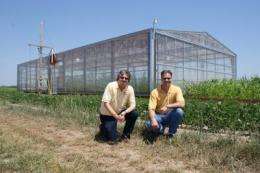
MU plant sciences researchers Bob Sharp (left) and Felix Fritschi have just completed a drought simulator that will allow them to simulate drought conditions in the field. Thirteen co-investigators from several disciplines including water quality, soil biology, soil physics, plant-insect and plant-disease interaction, and plant breeding, genetics and plant root biology will collaborate on the project. Credit: MU College of Agriculture, Food and Natural Resources

Historically, droughts have had devastating effects on agriculture, causing famine and increasing consumer food costs. Now, researchers at the University of Missouri College of Agriculture, Food and Natural Resources (CAFNR) have completed two drought simulators designed to test the effects of water deficiency on crops. The simulators are located at the University of Missouri's Bradford Research and Extension Center east of Columbia.

The simulators, part of a $1.5 million Missouri Life Sciences Research Board grant, are essentially mobile greenhouses measuring 50 feet by 100 feet. To simulate drought, researchers move the greenhouses over plants when it is raining and move them away from plants when it is sunny. A test plot of the same plants will be kept next to the simulator to provide a comparison. The drought simulators will increase the real-world application of scientific research, as they allow researchers to more closely mimic actual .

When funding is available, additional simulators will be built at the Delta Research Center in Portageville, Mo., in the southeastern part of the state, and at the Horticulture and Agroforestry Research Center in New Franklin, Mo. These locations represent a variety of environments, and soil types, allowing researchers to test any agriculturally important crop, forage and turf species grown in Missouri and surrounding states.

This video is not supported by your browser at this time.

A new drought simulator at the University of Missouri will help scientists study how plants react to a lack of water in a variety of different soils. Credit: Kent Faddis/University of Missouri Cooperative Media Group

"This network of drought simulators will be unlike any other network in the U.S., providing Missouri scientists with state-of-the-art field facilities to conduct a broad range of drought-related research," said Felix Fritschi, assistant professor in the CAFNR Division of Plant Sciences. "Our objective is to develop real-world products and practices to improve food security and increase profitability for farmers."

"The ability to manage the timing, duration and intensity of water-deficit stress under field conditions is essential to examine plant responses to drought," said Bob Sharp, a co-investigator and director of MU's Interdisciplinary Plant Group. "Thus, the drought simulators will bridge the gap between controlled-environment facilities, such as growth chambers and greenhouses, and real conditions encountered in the field."

This video is not supported by your browser at this time.

With new drought simulators, University of Missouri researchers will be able to study plants, such as corn and soybeans, and test their drought resistance in the field. Credit: Debbie Johnson/MU Cooperative Media Group

Thirteen co-investigators from several disciplines, including water quality, soil biology, soil physics, plant-insect and plant-disease interaction, and plant breeding, genetics and plant root biology will collaborate on the project. Another focus area is tissue dehydration tolerance. Researchers plan to study the genetic characteristics of plants that are extremely tolerant to dry climates and how these characteristics might be used to improve commercial crops.

Provided by University of Missouri-Columbia search and more info website

Filter


Move the slider to adjust rank threshold, so that you can hide some of the comments.


Display comments: newest first

Vendicar_Decarian
Aug 18, 2011

Rank: not rated yet
TeaPublicans are demanding that this government research be defunded.
Rank not rated yet
Relevant PhysicsForums posts

More news stories

Yale study concludes public apathy over climate change unrelated to science literacy

Are members of the public divided about climate change because they don't understand the science behind it? If Americans knew more basic science and were more proficient in technical reasoning, would public consensus match ...

Space & Earth / Environment

created 32 minutes ago | popularity not rated yet | comments 2 | with audio podcast

10 million years needed to recover from mass extinction

It took some 10 million years for Earth to recover from the greatest mass extinction of all time, latest research has revealed.

Space & Earth / Earth Sciences

created 33 minutes ago | popularity not rated yet | comments 0 | with audio podcast

Sophisticated simulations predict future warming

The chances of our planet being hit by a global warming of 3 degrees Celsius by 2050 is as likely as it being hit by an increase of 1.4 degrees, new research shows. Presented in the journal Nature Geoscience, the British study ...

Space & Earth / Earth Sciences

created May 22, 2012 | popularity 4.4 / 5 (9) | comments 51

Aliens don't want to eat us, says former SETI director

Alien life probably isn’t interested in having us for dinner, enslaving us or laying eggs in our bellies, according to a recent statement by former SETI director Jill Tarter.

Space & Earth / Space Exploration

created May 25, 2012 | popularity 4.4 / 5 (13) | comments 39

Kyoto Protocol architect 'frustrated' by climate dialogue

UN climate talks are going nowhere, as politicians dither or bicker while the pace of warming dangerously speeds up, one of the architects of the Kyoto Protocol told AFP.

Space & Earth / Environment

created May 23, 2012 | popularity 3.7 / 5 (7) | comments 39


Change in developmental timing was crucial in the evolutionary shift from dinosaurs to birds: study

At first glance, it's hard to see how a common house sparrow and a Tyrannosaurus Rex might have anything in common. After all, one is a bird that weighs less than an ounce, and the other is a dinosaur that ...

Computer model used to pinpoint prime materials for efficient carbon capture

When power plants begin capturing their carbon emissions to reduce greenhouse gases – and to most in the electric power industry, it's a question of when, not if – it will be an expensive undertaking.

'Unzipped' carbon nanotubes could help energize fuel cells, batteries

Multi-walled carbon nanotubes riddled with defects and impurities on the outside could replace some of the expensive platinum catalysts used in fuel cells and metal-air batteries, according to scientists at ...

T cells 'hunt' parasites like animal predators seek prey, study shows

By pairing an intimate knowledge of immune-system function with a deep understanding of statistical physics, a cross-disciplinary team at the University of Pennsylvania has arrived at a surprising finding: T cells use a movement ...

Manufacturing genes to attack flu virus

An international research team has manufactured a new protein that can combat deadly flu epidemics.

Same gene that stunts infants' growth also makes them grow too big: research

UCLA geneticists have identified the mutation responsible for IMAGe* syndrome, a rare disorder that stunts infants' growth. The twist? The mutation occurs on the same gene that causes Beckwith-Wiedemann syndrome, which makes ...