'Supergene' is key to copycat butterflies
Aug 12, 2011
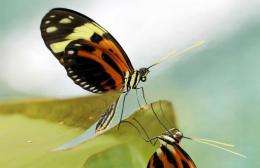
This undated handout photo released by the CNRS shows butterflies, Melinaea mneme (top) and Heliconius numata. The mystery of how a butterfly has changed its wing patterns to mimic neighbouring species and avoid being eaten by birds has been solved by a team of European scientists.

Since Charles Darwin, biologists have pondered the mystery of "mimicry butterflies", which survive by copying the wing patterns of other butterflies that taste horrible to their predators, birds.

The answer, according to a study released on Friday, lies in an astonishing cluster of about 30 genes in a single chromosome.

"We were blown away by what we found," said Mathieu Joron of France's , who led the probe into what is being called a "supergene".

"These are the 'transformers' of the insect world," said Joron.

"But instead of being able to turn from a car into a robot with the flick of a switch, a single allows these insects to morph into several different mimetic forms.

"It is amazing, and the stuff of science fiction. Now we are starting to understand how this switch can have such a pervasive effect."

The trick, known as Muellerian mimicry, was investigated by French and British scientists, who focussed on a species of Amazonian rainforest butterfly, Heliconius numata.

It is able to copy the colour patterns of several species of the Melinaea butterfly which are unpalatable to birds.

The "supergene" comprises a tightly packed region of genes on a single chromosome which control different elements of the wing pattern.
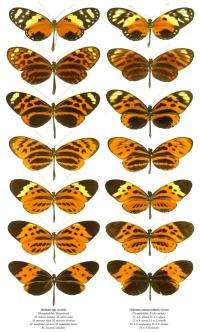
This image shows Melinaea (left) and Heliconius numata mimetic forms. Credit: Mathieu Joron

"By changing just one gene, the butterfly is able to fool its predators," explained Richard ffrench-Constant of the University of Exeter, southwestern England.

Even more astonishing is that three versions of the chromosome exist within this species, with each version controlling distinct wing-pattern forms.

Even though the butterflies look quite different from each other, they have the same DNA.

The supergene apparently transmits in a block from generation to generation, rather than go through recombination -- the mingling of genes from both parents.

The "supergene" also appears important in other species, say the authors.

One such , the peppered moth, developped black wings in 19th-century Britain as a means of gaining camouflage in the sooty industrial environment.

"It's a gene that really packs an evolutionary punch," said ffrench-Constant.

The paper is published online by the British science journal Nature.

Explore further: Biological fitness trumps other traits in mating game

add to favorites email to friend print save as pdf

Related Stories

Painting by numbers

Sep 29, 2006

Professor Richard ffrench-Constant of the University of Exeter in Cornwall has worked with an international team of experts to ‘decode’ the patterns on butterflies’ wings.

How the butterflies got their spots

Feb 05, 2010

(PhysOrg.com) -- How two butterfly species have evolved exactly the same striking wing colour and pattern has intrigued biologists since Darwin's day. Now, scientists at Cambridge have found 'hotspots' in ...

An eye gene colors butterfly wings red

Jul 21, 2011

Red may mean STOP or I LOVE YOU! A red splash on a toxic butterfly's wing screams DON'T EAT ME! In nature, one toxic butterfly species may mimic the wing pattern of another toxic species in the area. By ...

Butterfly study sheds light on convergent evolution

Jul 21, 2011

For 150 years scientists have been trying to explain convergent evolution. One of the best-known examples of this is how poisonous butterflies from different species evolve to mimic each other's color patterns – in effect ...

Recommended for you

Biological fitness trumps other traits in mating game

11 hours ago

When a new species emerges following adaptive changes to its local environment, the process of choosing a mate can help protect the new species' genetic identity and increase the likelihood of its survival. ...

Snail genetic tracks reveal ancient human migration

11 hours ago

Some snails in Ireland and the Pyrenees are genetically almost identical, perhaps because they were carried across the Atlantic during an 8000-year-old human migration. The snail genetics tie in with studies ...

User comments : 0

More news stories

S.Korean airlines ban shark fin as cargo

South Korea's two largest airlines, Korean Air and Asiana, said Thursday they had both decided to ban shark fin from their cargo flights as part of a growing global campaign against the Asian delicacy.

Panic over MERS virus fades in Saudi

People in Saudi Arabia's Eastern Province have again started greeting friends with the traditional kiss on the cheek, and face masks in public are becoming rarer, as panic subsides over the outbreak of a deadly respiratory ...

AP buys stake in live video service Bambuser

The Associated Press said Thursday that it has bought a minority stake in the live video service Bambuser, boosting its ability to acquire and distribute video collected by people who have witnessed news events.

UNESCO warns Syrian heritage sites endangered

UNESCO on Thursday added six ancient sites in Syria including a fortress of Saladin and a Crusader castle to the endangered World Heritage list, warning that more than two years of civil war had inflicted ...

Philippines financial capital bans plastic bags

The Philippines financial capital banned disposable plastic shopping bags and styrofoam food containers on Thursday, as part of escalating efforts across the nation's capital to curb rubbish that exacerbates ...