Flowing structures in soft crystals
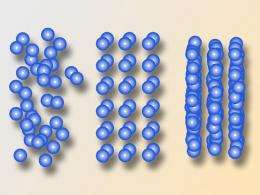
Colloids - unordered, in a crystalline structure and as strings under mechanical strain
What is common to blood, ink and gruel? They are all liquids in which tiny particles are suspended so called colloids. In some of these liquids, the particles form groups (clusters), which form regular structures, much like atoms in a crystal. A team of researchers from TU Vienna and Vienna University has now managed to study the remarkable properties of these crystal-like substances in computer simulations. Under mechanical strain, the crystalline pattern can change into a different structure, or it can vanish completely.
The researchers anticipate a broad range of practical applications for these effects. The results of their calculations have now been published in the scientific journal Physical Review Letters.
Regular Structures in Liquids
If small particles accumulate, they can form clusters. Within a cluster, the particles may overlap and mingle, similar to a densely packed shoal of eels, gliding past each other. Remarkably, these clusters are not situated at random positions, but they spontaneously form a regular structure a cluster crystal. The distance between two neighboring clusters is constant. Increasing the density of particles adds more and more particles to each cluster but the distance between them stays the same, says Arash Nikoubashman, PhD-student at TU Vienna. He made the calculations together with Professor Gerhard Kahl (Institute for Theoretical Physics, TU Vienna) and Professor Christos Likos (University of Vienna).
Crystal Structure Turning into Strings
Previous results had already led us to believe that these particles could exhibit strange behavior under certain external conditions, the physicists explain. And their hopes were not unfounded: in computer simulations they managed to calculate how the crystal-like structure behaves under mechanical strain that causes shears stress which means that surfaces within the liquid are shifted relative to each other. At first, the crystal structure starts to melt, the connections between the clusters are broken. From these molten particle clusters, a new regular order starts to emerge spontaneously. Long, straight strings of particle are formed, neatly aligned in parallel.
Thin and Thick
While these strings are created, the liquid gets thinner, its viscosity decreases. This is due to the strings being able to slide relative to one another. If the material is subject to even more strain, the strings break up too, a molten unstructured ensemble of particle clusters remains, and the viscosity of the liquid increases again. More and more particles are washed away from their original positions and inhibit the flow. This behavior is the same for all kinds of cluster crystals. With a simple theoretical model, the critical strain, at which the ordered structure vanishes completely, can be predicted very accurately.
Under shear strain, crystals made of soft, penetrable particles can exhibit new kinds of self-organization. Geometric structures emerge, governed by the kind of forces acting between the particles. This research in the field of soft matter in the micro- and nanometer regime is not only interesting from a theoretical point of view. These materials play an important role in our everyday life such as blood or large biopolymers like DNA. They are important in biotechnology, and also in petrochemistry and pharmacology wherever tailor-made nano materials are being used. A liquid which can change its viscosity under mechanical stress promises a broad spectrum of possible applications ranging from vibration dampers to protective clothing.
More information: Arash Nikoubashman, et al., Cluster Crystals under Shear, Phys. Rev. Lett. 107, 068302 (2011). DOI: 10.1103/PhysRevLett.107.068302
Provided by Vienna University of Technology
-
From lemons to lemonade: Reaction uses carbon dioxide to make carbon-based semiconductor,
32 comments
-
Thioridazine kills cancer stem cells in human while avoiding toxic side-effects of conventional cancer treatments,
3 comments
-
SpaceX private rocket blasts off for space station (Update),
42 comments
-
Climate scientists say they have solved riddle of rising sea,
31 comments
-
SpaceX capsule has 'new car' smell, astronauts say (Update),
2 comments
-
Water flow question
2 hours ago
-
[Drift velocity] Factors affecting velocity
5 hours ago
-
does cold gasoline have less energy
5 hours ago
-
distribution of molecules throughout the atmosphere
7 hours ago
-
The Global Positioning System !
8 hours ago
-
A Question relating Power
9 hours ago
- More from Physics Forums - General Physics
More news stories
Is a classical electrodynamics law incompatible with special relativity?
(Phys.org) -- The laws of classical electromagnetism that were developed in the 19th century are the same laws that scientists use today. They include Maxwell’s four equations along with the Lorentz la ...
Landmark calculation clears the way to answering how matter is formed
(Phys.org) -- An international collaboration of scientists, including Thomas Blum, associate professor of physics, is reporting in landmark detail the decay process of a subatomic particle called a kaon ...
May 25, 2012 |
4.3 / 5 (22) |
50
|
Lying in wait for WIMPs: Researchers seek to dramatically increase sensitivity of Large Underground Xenon detector
Although it's invisible, dark matter accounts for at least 80 percent of the matter in the universe. No one knows what it is, but most scientists would bet on weakly interacting massive particles, or WIMPs.
May 23, 2012 |
4 / 5 (7) |
15
|
Hawaii lab turns laser-powered bubbles into microrobots
(Phys.org) -- A team of scientists from the University of Hawaii are working on microrobots created from bubbles of air in a saline solution. The bubbles take on their title of robots as a laser ...
Sound increases the efficiency of boiling
Scientists at the Georgia Institute of Technology achieved a 17-percent increase in boiling efficiency by using an acoustic field to enhance heat transfer. The acoustic field does this by efficiently removing vapor bubbles ...
May 24, 2012 |
5 / 5 (2) |
2
Change in developmental timing was crucial in the evolutionary shift from dinosaurs to birds: study
At first glance, it's hard to see how a common house sparrow and a Tyrannosaurus Rex might have anything in common. After all, one is a bird that weighs less than an ounce, and the other is a dinosaur that ...
Computer model used to pinpoint prime materials for efficient carbon capture
When power plants begin capturing their carbon emissions to reduce greenhouse gases and to most in the electric power industry, it's a question of when, not if it will be an expensive undertaking.
'Unzipped' carbon nanotubes could help energize fuel cells, batteries
Multi-walled carbon nanotubes riddled with defects and impurities on the outside could replace some of the expensive platinum catalysts used in fuel cells and metal-air batteries, according to scientists at ...
T cells 'hunt' parasites like animal predators seek prey, study shows
By pairing an intimate knowledge of immune-system function with a deep understanding of statistical physics, a cross-disciplinary team at the University of Pennsylvania has arrived at a surprising finding: T cells use a movement ...
Manufacturing genes to attack flu virus
An international research team has manufactured a new protein that can combat deadly flu epidemics.
Yale study concludes public apathy over climate change unrelated to science literacy
Are members of the public divided about climate change because they don't understand the science behind it? If Americans knew more basic science and were more proficient in technical reasoning, would public consensus match ...