Site seeks feedback from people with disabilities who are interested in science
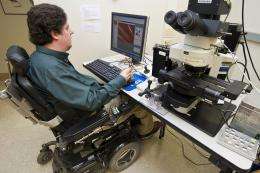
A new website started at Purdue University is available to people with disabilities and others who study or work in science fields so they can share experiences and suggestions on how to overcome obstacles related to physical impairments.
The site, iashub.org/ , is part of a $2 million Pathfinder award received last fall to create the Institute for Accessible Science at Purdue to help students with disabilities overcome challenges due to physical impairments.
"This Institute for Accessible Science hub provides a virtual community to increase awareness regarding the inclusion of persons with physical impairments in laboratory-based research and to discuss solutions on how best to improve access in labs. Doing so will encourage more people to pursue studies and careers in science," said Bradley S. Duerstock, an associate professor of engineering practice in the schools of Biomedical Engineering and Industrial Engineering and principal investigator on the project. "This site is for students and scientists with disabilities, as well as educators and researchers in the field. I also encourage parents of students with disabilities to visit the site, because they are often some of the strongest advocates for change."
Users can share information about physical obstacles as well as the assistive technologies and resources they use or recommend. Duerstock, who also is a member of the Center for Paralysis Research at the School of Veterinary Medicine, said they also want to learn about creative and innovative ways people work around these challenges such as accessible work spaces or equipment not being usable.
Duerstock, who is a neuroscientist and a wheelchair user, often uses and creates adaptive-assistive technologies so he can work in the lab. Some of those technologies, including a remote-controllable light microscope and speech recognition-based automatic transcription of voice recordings for assisted note taking, will be available through the site in the future.
"It's a two-way street - people can use the site to access information or to share what they know," said Susan M. Mendrysa, (pronounced Men-driss-a), assistant professor of basic medical sciences in the School of Veterinary Medicine and project team member. "We'll be obtaining information from users to identify and prioritize key initiatives that we can explore."
Another feature is a role model series where students and scientists with disabilities can upload their own video segments that discuss their experiences and challenges in school or at the lab.
"Visitors also will be able to join existing interest groups on the hub or create one tailored to an interest of their own, thus elevating the type of interaction and support they experience," said Lisa Hilliard, project manager for the Institutes for Accessible Science. "In addition, we are currently developing a smart phone app, which will be available this fall and will include the site's most popular features. We also will be actively monitoring the site and responding to questions or suggestions for resources."
The web-based interactive forum is powered by HUBzero software that was developed at Purdue.
In addition to the website, the grant funds an accessible wet laboratory where new design and theories can be tested. The Accessible Biomedical Immersion Laboratory in the Discovery Learning Research Center will be renovated this summer to adopt some accessibility improvements related to safety features, adjustable lab equipment, and additional space to navigate wheelchairs. The laboratory's focus is biomedical research, but Duerstock said what they learn in this space can be utilized by other research areas.
Only 2 percent of employed scientists and engineers age 35 or younger have a disability, but that demographic represents 10.4 percent of the overall U.S. workforce. In 2007 only 1.1 percent of U.S. science or engineering doctorates had a disability. The $2 million grant is administered by the National Institute of General Medical Sciences and funded by the American Recovery and Reinvestment Act.
Provided by Purdue University


