August 11, 2011 report
Sequencing of cod genome reveals unique immune system characteristic
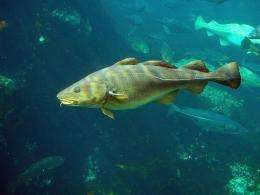
(PhysOrg.com) -- Researchers working out of Norway's University of Oslo have discovered through sequencing the genome of the Atlantic cod that the fish doesn't have a gene critical to the immune system in most other vertebrae. The missing gene is one that codes for proteins called MHC II, CD4, and invariant chain. These proteins that reside on the outside of cells are responsible for noticing when bacteria or viruses land and then for calling CD4+ T cells to alert B cells which then start to crank out antibodies. The team has published its results in Nature.
The Atlantic Cod Gadus morhua, is one of the more popular fish caught for consumption in the waters of the Atlantic, from North America to Europe, though it’s viability as a food source has come into question due to the collapse of several stocks in the 1990’s and their inability to recover. Subsequently, attempts have been made to create cod farms, but have met with mixed results due to the fish’s susceptibility to such infections as the bacterium Francisella noatunensis. It was this problem that led the Oslo team to sequence the cod’s genome in hopes of uncovering a means for creating a vaccine that would allow for more successful operations. Unfortunately, it appears that due to the cod’s missing genes, the traditional approach to creating a vaccine won’t work.
To sequence the cod genome, the team used the Roche 454 platform and then aligned the result with that of the stickleback, a fish closely related to the cod that has already been sequenced. In so doing they found, in addition to the missing MHC II, new hemoglobin genes that are believed to help the cod survive in the very cold water in which it lives.
The team says that the cod makes up for the MCH II deficiency by having more genes than other vertebrates, and also theorizes that the cod may also do more with MCH I (which normally specialize in finding intruders within cells) than other vertebrates.
The discovery of the cod’s unique immune system has caused excitement in the immunology field because it opens the door to new ideas and ways of looking at how the immune system works and how such knowledge might be applied in developing better vaccines in cod farming; something that could become more important as natural fish populations decline.
More information: The genome sequence of Atlantic cod reveals a unique immune system, Nature (2011) doi:10.1038/nature10342
Abstract
Atlantic cod (Gadus morhua) is a large, cold-adapted teleost that sustains long-standing commercial fisheries and incipient aquaculture. Here we present the genome sequence of Atlantic cod, showing evidence for complex thermal adaptations in its haemoglobin gene cluster and an unusual immune architecture compared to other sequenced vertebrates. The genome assembly was obtained exclusively by 454 sequencing of shotgun and paired-end libraries, and automated annotation identified 22,154 genes. The major histocompatibility complex (MHC) II is a conserved feature of the adaptive immune system of jawed vertebrates, but we show that Atlantic cod has lost the genes for MHC II, CD4 and invariant chain (Ii) that are essential for the function of this pathway. Nevertheless, Atlantic cod is not exceptionally susceptible to disease under natural conditions5. We find a highly expanded number of MHC I genes and a unique composition of its Toll-like receptor (TLR) families. This indicates how the Atlantic cod immune system has evolved compensatory mechanisms in both adaptive and innate immunity in the absence of MHC II. These observations affect fundamental assumptions about the evolution of the adaptive immune system and its components in vertebrates.
© 2011 PhysOrg.com


