Russia delays next manned space flight
August 29, 2011 by Dmitry Zaks
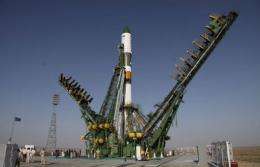
A Russian Soyuz rocket stands on the launch pad at the Baikonour cosmodrome on August 24. Russia delayed the next manned mission to the International Space Station (ISS) by at least a month after an unmanned cargo vessel crashed into Siberia instead of reaching orbit.
Russia on Monday delayed its next manned mission to the International Space Station (ISS) by at least a month after an unmanned cargo vessel crashed into Siberia instead of reaching orbit.
The head of Russia's manned spaceflight programme also warned that a significantly longer delay would force the six people on board the station to abandon the orbiter due to problems of fatigue and supplies.
"We expect that the next manned launch will take place in late October or early November -- not earlier. That is our plan," the RIA Novosti news agency quoted Russia's manned spaceflight programme director Alexei Krasnov as saying.
The launch had initially been scheduled for September 22.
Krasnov said the return to Earth of the first three of six crew members on board the ISS has also been pushed back from September 8 until September 16 on one of two Soyuz spacecraft docked at the space station.
"If for some reason we fail to send up the next crew by the end of November, we will have to study all the available options, including one of leaving the station unmanned," Russian news agencies quoted Krasnov as saying.
"But we will do everything possible to make sure that it is not left unattended," Krasnov added.
A US space agency official, meanwhile, said the ISS crew would be evacuated if the Soyuz mission is not launched by mid-November, leaving the orbiting space station to be operated from the ground.
"Assuming no significant anomaly... we can operate the ISS indefinitely without a crew on board," said NASA's ISS manager Michael Suffredini.
The NASA official said the space agencies "prefer not to operate the ISS without a crew on board for an extended period of time."
NASA has preferred to keep to ISS manned at all times so that crew members could continue carrying out their experiments.
Officials from both sides said the international crew on board the ISS has enough basic supplies and oxygen to last at least through November.
"I want to emphasize that the crew on board of the ISS is safe," Suffredini said.
"We have plans to operate the ISS either with three crew (members) or no crew. The impact of course is the amount of research we get done."
Russian officials are concerned about manned missions because the Soyuz-FG has the same third-stage motor as the one in the Soyuz-U rocket that failed to put the Progress craft in orbit on August 24.
It marked the first time the Progress cargo carrier had been lost on a mission since it was first fitted on a Soyuz for its maiden flight in 1978.
Russian space agency Roscosmos is now conducting a check of all its rockets after the disaster, which followed three other failed launches of satellites since December in an unprecedented catalogue of accidents.
Krasnov said Roscosmos would like to send at least one Soyuz rocket to space before the next manned flight to make sure that the experts had narrowed down the root of last week's problem.
Both Russian and US officials now think the problem involved a faulty fuel pump that prevented full ignition of the third stage propulsion system.
An unnamed Russian space official separately told Interfax that Roscosmos would prefer to carry out two unmanned Soyuz flights by December -- a schedule that appears to conflict with one set by NASA.
"At the moment, we are studying the option of sending the first spacecraft in November and the second in December," the Russian official said.
The crew of Russians Andrei Borisenko and Alexander Samokutyaev and NASA astronaut Ron Garan went up to the ISS in March on board a historic flight honouring the 50th anniversary of the first voyage of space pioneer Yuri Gagarin.
This month's failed launch was a spectacular blow for Russia after it had proudly become the sole nation capable of taking humans to the ISS after the July withdrawal of the US space shuttle.
(c) 2011 AFP
-
From lemons to lemonade: Reaction uses carbon dioxide to make carbon-based semiconductor,
32 comments
-
Thioridazine kills cancer stem cells in human while avoiding toxic side-effects of conventional cancer treatments,
3 comments
-
SpaceX private rocket blasts off for space station (Update),
42 comments
-
Climate scientists say they have solved riddle of rising sea,
31 comments
-
SpaceX capsule has 'new car' smell, astronauts say (Update),
2 comments
-
revamping general concept and cosmological principle
May 25, 2012
-
Transiting Exoplanet Light Curve
May 25, 2012
-
Math behind Theoretical Physics
May 24, 2012
-
Do we know whats at the center of galaxies yet?
May 23, 2012
-
Structure of the Milky Way?
May 20, 2012
-
What would it take to terraform Pluto and Charon?
May 19, 2012
- More from Physics Forums - General Astronomy
More news stories
Yale study concludes public apathy over climate change unrelated to science literacy
Are members of the public divided about climate change because they don't understand the science behind it? If Americans knew more basic science and were more proficient in technical reasoning, would public consensus match ...
2 minutes ago |
not rated yet |
0
|
10 million years needed to recover from mass extinction
It took some 10 million years for Earth to recover from the greatest mass extinction of all time, latest research has revealed.
Space & Earth / Earth Sciences
3 minutes ago |
not rated yet |
0
|
Sophisticated simulations predict future warming
The chances of our planet being hit by a global warming of 3 degrees Celsius by 2050 is as likely as it being hit by an increase of 1.4 degrees, new research shows. Presented in the journal Nature Geoscience, the British study ...
Space & Earth / Earth Sciences
May 22, 2012 |
4.4 / 5 (9) |
51
Aliens don't want to eat us, says former SETI director
Alien life probably isnt interested in having us for dinner, enslaving us or laying eggs in our bellies, according to a recent statement by former SETI director Jill Tarter.
Space & Earth / Space Exploration
May 25, 2012 |
4.4 / 5 (13) |
39
Kyoto Protocol architect 'frustrated' by climate dialogue
UN climate talks are going nowhere, as politicians dither or bicker while the pace of warming dangerously speeds up, one of the architects of the Kyoto Protocol told AFP.
May 23, 2012 |
3.7 / 5 (7) |
39
Change in developmental timing was crucial in the evolutionary shift from dinosaurs to birds: study
At first glance, it's hard to see how a common house sparrow and a Tyrannosaurus Rex might have anything in common. After all, one is a bird that weighs less than an ounce, and the other is a dinosaur that ...
Computer model used to pinpoint prime materials for efficient carbon capture
When power plants begin capturing their carbon emissions to reduce greenhouse gases and to most in the electric power industry, it's a question of when, not if it will be an expensive undertaking.
'Unzipped' carbon nanotubes could help energize fuel cells, batteries
Multi-walled carbon nanotubes riddled with defects and impurities on the outside could replace some of the expensive platinum catalysts used in fuel cells and metal-air batteries, according to scientists at ...
T cells 'hunt' parasites like animal predators seek prey, study shows
By pairing an intimate knowledge of immune-system function with a deep understanding of statistical physics, a cross-disciplinary team at the University of Pennsylvania has arrived at a surprising finding: T cells use a movement ...
Manufacturing genes to attack flu virus
An international research team has manufactured a new protein that can combat deadly flu epidemics.
Same gene that stunts infants' growth also makes them grow too big: research
UCLA geneticists have identified the mutation responsible for IMAGe* syndrome, a rare disorder that stunts infants' growth. The twist? The mutation occurs on the same gene that causes Beckwith-Wiedemann syndrome, which makes ...
Aug 30, 2011
Rank: not rated yet
Aug 31, 2011
Rank: 2 / 5 (1)
How did we get to this state?
Who was in charge?
With deep regret,
Oliver K. Manuel
Former NASA Principal
Investigator for Apollo