Roman civilization travelled further than history books tell us
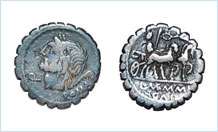
Roman coins. Credit: Portable Antiquities Scheme and the University of Exeter
A University of Exeter archaeologists research has uncovered the largest Roman settlement ever found in Devon. The discovery could force us to rewrite the history of the Romans in Britain.
The discovery of a large Roman Settlement in Devon was the result of a chance metal detecting coin find. Danielle Wootton, the Finds Liaison Officer for the Portable Antiquities Scheme (PAS) and archaeologist at the University of Exeter was called on to investigate further.
Two metal detectorists discovered nearly a hundred Roman coins in a series of fields a several miles west of Exeter. This would not be unusual in other parts of Britain but it has always been thought that Roman influence never made it this far into Devon as there is little evidence of Romans in the South West Peninsula of Britain.
After the results of a geophysical survey Wootton was astonished to find evidence of a huge settlement including roundhouses, quarry pits and track ways. The site covers at least thirteen fields and is the first of its kind for the county.
Wootton received funding from the British Museum, the Roman Research Trust and Devon County Council Archaeology Service to carry out a trial excavation on the site in June. This has uncovered evidence of trade with Europe, a road possibly linking to the major settlement at Exeter, and some intriguing structures, as well as many more coins.
University of Exeter archaeologist Danielle Wootton said: This is a really exciting discovery, but we are just at the beginning: there's so much to do and so much that we still don't know about this site. I'm hoping that we can turn this into a community excavation for everyone to be involved in, including the metal detectorists. I am very grateful to Earthwatch for funding next years excavations , but we still need more funding to run the excavation.
Most exciting of all, we have stumbled across two burials that seem to be located along the side of the settlement's main road. It is early days, but this could be the first signs of a Roman cemetery and the first glimpse of the people that lived in this community.
Sam Moorhead, National Finds Adviser for Iron Age and Roman coins for the PAS at the British Museum, believes that this is one of the most significant Roman discoveries in the country for many decades. He said: It is the beginning of a process that promises to transform our understanding of the Roman invasion and occupation of Devon. I believe we may even find more settlements in this area in the next few years.
Future excavations at the site are being funded by Earthwatch, Devon County Council and the University of Exeter, and will be directed by Danielle Wootton in conjunction with the Universitys Roman archaeology specialist, Dr. Ioana Oltean. The project will provide the wider community and University students with an exciting opportunity for fieldwork experience and training.
Provided by
University of Exeter
-
From lemons to lemonade: Reaction uses carbon dioxide to make carbon-based semiconductor,
32 comments
-
Thioridazine kills cancer stem cells in human while avoiding toxic side-effects of conventional cancer treatments,
3 comments
-
SpaceX private rocket blasts off for space station (Update),
42 comments
-
Climate scientists say they have solved riddle of rising sea,
31 comments
-
SpaceX capsule has 'new car' smell, astronauts say (Update),
2 comments
-
What would stain as translucent on light-coloured fabric?
19 hours ago
-
How do I identify different bacteria on culture plates?
May 26, 2012
-
Why Do Dogs do Strange things...
May 25, 2012
-
What does exophillic and endophillic mean in terms of mosquito and their control?
May 24, 2012
-
Semen stains glows under black lights (uv light)?
May 23, 2012
-
Question on Human Chromosome 2
May 23, 2012
- More from Physics Forums - Biology
More news stories
Change in developmental timing was crucial in the evolutionary shift from dinosaurs to birds: study
At first glance, it's hard to see how a common house sparrow and a Tyrannosaurus Rex might have anything in common. After all, one is a bird that weighs less than an ounce, and the other is a dinosaur that ...
Other Sciences / Archaeology & Fossils
5 minutes ago |
not rated yet |
0
|
Social welfare cuts ultimately come with heavy price, researchers say
(Phys.org) -- Slashing government funding for Medicaid, food stamps and other programs that serve the poor while politically popular with some lawmakers and many conservatives may do more harm ...
Other Sciences / Social Sciences
May 24, 2012 |
4.3 / 5 (16) |
147
Ancient Bethlehem seal unearthed in Jerusalem
Israeli archaeologists have discovered a 2,700-year-old seal that bears the inscription "Bethlehem," the Israel Antiquities Authority announced Wednesday, in what experts believe to be the oldest artifact ...
Other Sciences / Archaeology & Fossils
May 23, 2012 |
3.5 / 5 (14) |
23
Oldest Jewish archaeological evidence on the Iberian Peninsula
German archaeologists of the Friedrich Schiller University Jena found one of the oldest archaeological evidence so far of Jewish Culture on the Iberian Peninsula at an excavation site in the south of Portugal, ...
Other Sciences / Archaeology & Fossils
May 25, 2012 |
4.3 / 5 (4) |
12
Dollars and sense: Why are some people morally against tax?
As the U.S. presidential election campaigns heat up, the economic debate is dominated by bailouts, austerity and, inevitably, taxation. Now a new study published in Symbolic Interaction asks why tax is such an important issue ...
Other Sciences / Social Sciences
May 23, 2012 |
3 / 5 (2) |
12
Computer model used to pinpoint prime materials for efficient carbon capture
When power plants begin capturing their carbon emissions to reduce greenhouse gases and to most in the electric power industry, it's a question of when, not if it will be an expensive undertaking.
'Unzipped' carbon nanotubes could help energize fuel cells, batteries
Multi-walled carbon nanotubes riddled with defects and impurities on the outside could replace some of the expensive platinum catalysts used in fuel cells and metal-air batteries, according to scientists at ...
T cells 'hunt' parasites like animal predators seek prey, study shows
By pairing an intimate knowledge of immune-system function with a deep understanding of statistical physics, a cross-disciplinary team at the University of Pennsylvania has arrived at a surprising finding: T cells use a movement ...
Manufacturing genes to attack flu virus
An international research team has manufactured a new protein that can combat deadly flu epidemics.
Yale study concludes public apathy over climate change unrelated to science literacy
Are members of the public divided about climate change because they don't understand the science behind it? If Americans knew more basic science and were more proficient in technical reasoning, would public consensus match ...
Same gene that stunts infants' growth also makes them grow too big: research
UCLA geneticists have identified the mutation responsible for IMAGe* syndrome, a rare disorder that stunts infants' growth. The twist? The mutation occurs on the same gene that causes Beckwith-Wiedemann syndrome, which makes ...
Aug 05, 2011
Rank: 5 / 5 (1)
I've seen coins from Minoa of their fascination with mazes, coins of Hittite rulers of like 1200s, coins of Alexander the Great(with rams horns no less; to much to talk about them here!), every roman emperor from Alexander the Great to the Roman emperors of like four hundred A.D. had coins! The Ptolemies had coins. Paul had coins. There were coins of all kinds of major Jewish temples and so on. I've seen coins of Pontius Pilot who supposedly freed Jesus Christ(the real Pontius Pilot would not have done such a thing!)
Guess what? There's no coins of Jesus Christ! Around a thousand A.D. in Byzantine they did some Jesus Christ coinage; note, this is around the time people thought maybe they should make up some idea of what Jesus Christ looked like; the first pictures of Jesus Christ hanging on a cross were in Byzantium almost a thousand years later!
Aug 05, 2011
Rank: 3.5 / 5 (2)
The real Pontius Pilate might or might not have freed a rabble-rousing prophet; how do you know that he wouldn't?
(Also, only persons of acknowledged great political power, such as kings and emperors, had coins struck with their images. A poor, unknown, un-politically-powerful commoner in Judea would not have been the subject of government-issued coinage.)
Aug 05, 2011
Rank: not rated yet
I should also note that James the Just(who's james the less in the Gospel of Mark) doesn't have a coin; if you read Eisenman's "James Brother of Jesus" you'll see that much of the gospel descriptions and activities are James the Just; James the Just in conclusion seems to be written out of history . . . by somebody.
Aug 05, 2011
Rank: not rated yet
If he's such a god, he should have converted everybody to chistianity with an eyeblink - or not even that!
Aug 05, 2011
Rank: not rated yet
Aug 05, 2011
Rank: 1 / 5 (2)
Why?
Do you force your children to conform to your will? If so, how and why?
Or did your parent force you to conform to their will? Were they successful? How would that have helped you grow as an intelligent being?
Aug 06, 2011
Rank: not rated yet
Aug 06, 2011
Rank: not rated yet
Aug 06, 2011
Rank: 1 / 5 (1)
Aug 06, 2011
Rank: 5 / 5 (1)
The irony is astounding. You just described every single devout household's relationship with their children. Only a small minority of exceptional kids can overcome that bias and free their minds. (I've actually never met one)
Aug 06, 2011
Rank: not rated yet
The children of ministers, rabbis, and law enforcement officers often rebel against the confines of their upbringing, because it's a natural function of youth to rebel. Some overcompensate and wind up getting into trouble with the law or an unhealthy lifestyle, but you can easily trace the roots of that back to the nuclear family. If a young person doesn't rebel against the dogma they're raised with, it's worrisome. A healthy society depends on the rebellion of its youth to repair and renew its stodgy and sacrosanct belief system.
Aug 06, 2011
Rank: not rated yet
Not often enough it seems, as you can plainly see that religion self perpetuates through hundreds of generations. It might only be possible to rebel in a secular free country at all. Trying that in Iran would get you stoned to death. This might be one reason that religious conviction is declining throughout the world as it continues to modernize.
Aug 07, 2011
Rank: not rated yet
Aug 08, 2011
Rank: not rated yet
That is a reasonable assumption that is backed up by the fact that they discovered roundhouses on the site. Roundhouses were an Anglo-Saxon construction rather than Roman and, as they followed the demise of the Roman influence in England, there is every possibility that the artifacts were left over from the Roman era and moved to the area with the Anglo Saxon settlers.
There wasn't a clear line between Roman and Anglo Saxon periods, there would have been a change-over period that would have combined the idiosyncracies of the two populations and their cultures.