New polymeric material brings companies one step closer to cheaper plastic solar cells and electronics
Aug 17, 2011
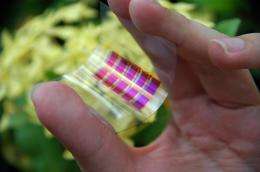
Flexible, organic solar cells - IMRE’s polymer can help save costs and resources in making devices like organic solar cells and next generation printed circuits on plastic. Credit: Agency for Science, Technology and Research (A*STAR)

A single polymer that can be used in both new age plastic electronics as well as plastic solar cells could spell greater cost-savings and open up new design options for electronic and solar cell companies. A*STAR’s IMRE has developed a new polymer that not only produces a high charge mobility of 0.2 cm2/V.s, which is the same value achieved by commercially available semiconducting materials but also has a high solar power conversion efficiency of 6.3%. This makes IMRE’s polymer one of the few that has both these properties. In addition to this, polymers of the same class as IMRE’s, which are those that use thiophene and benzothiadiazole as the building blocks, could only achieve 2.2% power conversion.

“Current polymers are usually good in one aspect or another, either as a good conductor for use in electronics or endowed with high efficiency - but not both”, said IMRE Senior Scientist, Dr. Chen Zhi Kuan, the principal researcher working on the polymers. “IMRE’s functions not only as a good material to make electronic components, the same material can be used to convert sunlight to electricity efficiently”. The polymer can also be easily applied in roll-to-roll printing techniques which is similar to how newspapers are currently printed making it possible to manufacture large area-scale printed electronics and organic quickly and cheaply.

With IMRE’s polymer, manufacturers could save cost using just a single bulk resource for making both printed electronics and organic solar cells. The material could also possibly be used in designing new devices where both power harnessing and electronics are needed in a single component. An example of this would be chemical sensors based on organic thin-film transistors and powered by organic solar cells.

“This breakthrough will help speed up the development of and organic solar cells, and make them more readily available in the marketplace,” said Prof Andy Hor, Executive Director of IMRE.
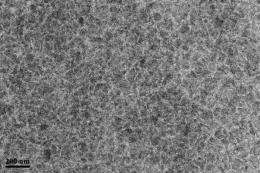
IMRE’s polymer has both high charge mobility and high power conversion efficiency in a single material as opposed to most polymers that have either one or the other, not both - A transmission electron microscopy image of the IMRE polymer, PC71BM film, showing phase separation between the polymer fibres (light) and PC71BM (dark). Credit: Agency for Science, Technology and Research (A*STAR)

Printed electronics often rely on organic materials like polymers that can be easily processed and manufactured as opposed to traditional electronics (or metal electronics) which rely on inorganics such as copper or silicon. The polymers can be made into thinner, lighter and cost-effective electronic components and organic solar cells.

The IMRE team is developing other organic materials-based polymers that can be scaled up to production and integrated easily into organic electronics. These materials can be used to make energy harvesting and low-power consumption devices like low-cost organic solar cells, new flexible display devices, next generation smart labels and RFID tags.

The research and results were recently published in Advanced Materials.

Explore further: RNA capable of catalyzing electron transfer on early earth with iron's help, study says

Provided by Agency for Science, Technology and Research (A*STAR)

4 /5 (2 votes)
add to favorites email to friend print save as pdf

Related Stories

SSRL Aids Development of Plastic Electronics

May 04, 2006

For close to a decade, researchers have been trying to improve the performance of plastic semiconductors to the level of amorphous silicon—the semiconductor used in low-cost electronics such as photovoltaic ...

Recommended for you

Attacking MRSA with metals from antibacterial clays

May 17, 2013

In the race to protect society from infectious microbes, the bugs are outrunning us. The need for new therapeutic agents is acute, given the emergence of novel pathogens as well as old foes bearing heightened antibiotic resistance.

Beautiful 'flowers' self-assemble in a beaker

May 16, 2013

By simply manipulating chemical gradients in a beaker of fluid, materials scientists at Harvard have found that they can control the growth behavior of crystals to create precisely tailored structures—such ...

Reading the unreadable

May 16, 2013

Pioneering X-ray technology is making it possible to read fragile rolled-up historical documents for the first time in centuries.

User comments : 0

More news stories

Attacking MRSA with metals from antibacterial clays

In the race to protect society from infectious microbes, the bugs are outrunning us. The need for new therapeutic agents is acute, given the emergence of novel pathogens as well as old foes bearing heightened antibiotic resistance.

Beautiful 'flowers' self-assemble in a beaker

By simply manipulating chemical gradients in a beaker of fluid, materials scientists at Harvard have found that they can control the growth behavior of crystals to create precisely tailored structures—such ...

Making gold green: New non-toxic method for mining gold

Northwestern University scientists have struck gold in the laboratory. They have discovered an inexpensive and environmentally benign method that uses simple cornstarch—instead of cyanide—to isolate gold from raw materials ...

Heat-related deaths in Manhattan projected to rise

Residents of Manhattan will not just sweat harder from rising temperatures in the future, says a new study; many may die. Researchers say deaths linked to warming climate may rise some 20 percent by the 2020s, ...

Kinks and curves at the nanoscale

One of the basic principles of nanotechnology is that when you make things extremely small—one nanometer is about five atoms wide, 100,000 times smaller than the diameter of a human hair—they are going ...

Honeybees trained in Croatia to find land mines

(AP)—Mirjana Filipovic is still haunted by the land mine blast that killed her boyfriend and blew off her left leg while on a fishing trip nearly a decade ago. It happened in a field that was supposedly ...