Microbial life on Mars: Could saltwater make it possible?

August 17, 2011

Microbial life on Mars: Could saltwater make it possible?

Enlarge

A mounting body of evidence suggests the presence of liquid water on the Red Planet. Credit: NASA

(PhysOrg.com) -- How common are droplets of saltwater on Mars? Could microbial life survive and reproduce in them? A new million-dollar NASA project led by the University of Michigan aims to answer those questions.

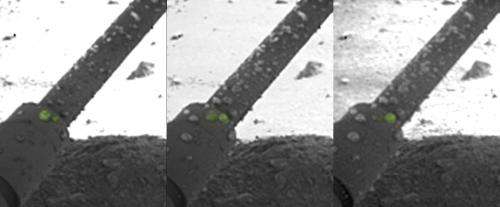
This project begins three years after beads of liquid brine were first photographed on one of the Phoenix lander's legs.

"On Earth, everywhere there's liquid water, there is microbial life," said Nilton Renno, a professor in the Department of Atmospheric, Oceanic and Space Sciences who is the principal investigator. Researchers from NASA, the University of Texas at Dallas, the University of Georgia and the Centro de Astrobiologia in Madrid are also involved.

This video is not supported by your browser at this time.

Nilton Renno describes this project

Scientists in the United States will create Mars conditions in lab chambers and study how and when brines form. These shoe-box-sized modules will have wispy carbon dioxide and atmospheres with 99 percent lower than the average pressure on Earth at sea level. Temperatures will range from -100 to -80 Fahrenheit and will be adjusted to mimic daily and . Instruments will alert the researchers to the formation of brine pockets, which could potentially be habitable by certain forms of .

Their colleagues overseas will seed similar chambers with salt-loving "extremophile" microorganisms from deep in Antarctic lakes and the Gulf of Mexico. The will observe whether these organisms survive, grow and reproduce in brines just below the surface of the soil. All known forms of life need liquid water to live. But microbes don't need much. A droplet or a thin film could suffice, researchers say.

"If we find microbes that can survive and replicate in brines at Mars conditions, we would have demonstrated that could exist on Mars today," Renno said.
Microbial life on Mars: Could saltwater make it possible?
Enlarge

Globules of liquid saltwater were pictured on the leg of the Phoenix Mars Lander. NASA/JPL-Caltech/University of Arizona/Max Planck Institute

With his colleagues on the Mars Phoenix mission in 2008, Renno theorized that globules that moved and coalesced on the spacecraft's leg were liquid saltwater. Independent physical and thermodynamic evidence as well as follow-up experiments have confirmed that the drops were liquid and not frost or ice. The Phoenix photos are believed to be the first pictures of outside the Earth.

The median temperature at the Phoenix landing site was -70 degrees Fahrenheit during the mission—too cold for liquid fresh water. But "perchlorate" salts found in the site's soils could lower water's freezing point dramatically, so that it could exist as liquid brine. The salts are also capable of absorbing water from the atmosphere in a process called deliquescence.

Provided by University of Michigan search and more info website

4.9 /5 (9 votes)  

Filter


Move the slider to adjust rank threshold, so that you can hide some of the comments.


Display comments: newest first

natetuvkok
Aug 17, 2011

Rank: not rated yet
nice,means we only know so little
natetuvkok
Aug 17, 2011

Rank: not rated yet
are we bringing stuff back to mars?
antialias_physorg
Aug 17, 2011

Rank: 5 / 5 (6)
How hard can it be to equip a lander/rover with an arm which has a microscope attached?

It's really nice that we have all these machines on Mars but why don't we ever include an instrument for _direct_ observation of life rather than all these indirect methods?
MPJ
Aug 17, 2011

Rank: 5 / 5 (5)
How hard can it be to equip a lander/rover with an arm which has a microscope attached?

It's really nice that we have all these machines on Mars but why don't we ever include an instrument for _direct_ observation of life rather than all these indirect methods?


The Viking landers actually had life detection experiments which yielded positive results - especially the Viking LR which was the most sensitive of all the experiments.

Since then NASA seems a little shy of follow-up the positive Viking results in 35 years now...
Squirrel
Aug 17, 2011

Rank: 4.7 / 5 (6)
Who is mentally prepared for the definite discovery of life on Mars? Since if there is life there then life is endemic everywhere in the Universe. Instead of being alone, we are merely one tiny drop of organic creativity in the vast cosmic ocean.
Shootist
Aug 17, 2011

Rank: not rated yet
are we bringing stuff back to mars?

Wha?

How do you "directly detect life", as opposed to indirectly detecting?

Few scientists believe there were unambiguous signs of life from Viking.

Why do I need to be prepared for "discover(ing) life on Mars"? From my POV, Life is ubiquitous.
antialias_physorg
Aug 17, 2011

Rank: 5 / 5 (4)
How do you "directly detect life",

Put a microscope to spot of this brine/water and see if anything wiggles.
See if it gasses out anything under light which it doesn't do in the dark.
Check for infrared hotspots.
Check for complex geometries using bifocals
-...

Who is mentally prepared for the definite discovery of life on Mars?

Who isn't? Who wouldn't be excited about such a find?
Who _cares_ whether anyone is prepared for such a find? Finding out facts isn't bad. Quite the opposite: Willfuly remaining ignorant so as to nurture some faulty world view might be deadly.

we are merely one tiny drop of organic creativity in the vast cosmic ocean.

All the better. Think of what kinds of ideas can be spawned by life based on different physiologies.

However, 'finding life' doesn't automatically mean 'finding intelligent life'. So even if we do find some microbe-analog in our own solar system that still leaves us with an exciting search for ET.
Nanobanano
Aug 17, 2011

Rank: 2.1 / 5 (7)
Our government doesn't want to find conclusive evidence one way or another. Designing experiments to leave more open-ended questions than answers gives them an excuse to funnel more money to black projects as part of the "NASA" budget. Answering any space-related questions definitively would reduce their cover options for black projects.
antialias_physorg
Aug 17, 2011

Rank: not rated yet
Our government doesn't want to find conclusive evidence one way or another.

Well, there are other governments that can (and have) put probes on Mars.
Telekinetic
Aug 17, 2011

Rank: not rated yet
If we don't find life in the brine on Mars, maybe pickles?
Sin_Amos
Aug 18, 2011

Rank: 5 / 5 (1)
"Our government doesn't want to find conclusive evidence one way or another. Designing experiments to leave more open-ended questions than answers gives them an excuse to funnel more money to black projects as part of the "NASA" budget. Answering any space-related questions definitively would reduce their cover options for black projects." ---Why would anyone on this board vote this down? How blissfully ignorant are you folks? Control manifests itself constantly, so to discount truth of hypocrisy and corruption in the vein of power is self-deceiving and foolish.
ubavontuba
Aug 21, 2011

Rank: not rated yet
This makes no sense to me at all.

Where did the perchlorate come from? I mean it's not like Phoenix landed in a salt bed. They only measured traces of perchlorate in the soil samples. Are they suggesting the leg speckles were somehow purified?

And, where did the water come from? Mars' atmosphere is quite dry (average .016%). And the ground was found to be "extremely dry." Why would water condense onto the leg, but not on/in the thirsty soil?

http://www.nasa.g...904.html

Has anyone thought to consider this may be an entirely different liquid? Perhaps a liquid hydrocarbon?

Vendicar_Decarian
Aug 21, 2011

Rank: 3 / 5 (2)
"It's really nice that we have all these machines on Mars but why don't we ever include an instrument for _direct_ observation of life rather than all these indirect methods?" - Foofie Woofie

Some consider the cameras to be a method of direct observation.

No one anticipates microbes on the surface of Mars because of the sterilizing effects of UV at it's surface.

So since, none of the landers have had drills to penetrate the surface to the depth of several meters or more, a microscope wasn't considered such a good idea.

Meanwhile the indirect methods are more sensitive.
antialias_physorg
Aug 22, 2011

Rank: not rated yet
No one anticipates microbes on the surface of Mars because of the sterilizing effects of UV at it's surface.

There are microbes that can survive UV (and if life is present then it certainly will adapt to the conditions of Mars by being UV resistant)

The rovers have a spatula which can dig down a few centimeters. It's not unheard of that microbes live in the soil instead of on top of it.

If we do anticipiate any kind of life on Mars hen it will be microbes (or similar small scale life). So if we're loking at all then we should have bring something better than a TV-camera.

The question of life on Mars should merit a lot more prominent slot than taking a few panoramic pictures (which we can do nicely from space)
Vendicar_Decarian
Aug 22, 2011

Rank: 1 / 5 (1)
"The rovers have a spatula which can dig down a few centimeters" - Antialias

No they don't.

http://upload.wik...over.jpg

You might be thinking of Mars Polar Lander.

http://en.wikiped...gram.png
antialias_physorg
Aug 22, 2011

Rank: not rated yet
You're right.

But the rover does have a small drill (RAT-rock abrasion tool) and the wheels have already been used to make a trench.

http://www.msnbc....science/

So it would have already been possible to get a look at what is under the surface if the arm had also been equppied with some good optics - or just some cheap radioshack stuff.
Rank 4.9 /5 (9 votes)
Relevant PhysicsForums posts
  • revamping general concept and cosmological principle
    createdMay 25, 2012
  • Transiting Exoplanet Light Curve
    createdMay 25, 2012
  • Math behind Theoretical Physics
    createdMay 24, 2012
  • Do we know whats at the center of galaxies yet?
    createdMay 23, 2012
  • Structure of the Milky Way?
    createdMay 20, 2012
  • What would it take to terraform Pluto and Charon?
    createdMay 19, 2012
  • More from Physics Forums - General Astronomy

More news stories

Yale study concludes public apathy over climate change unrelated to science literacy

Are members of the public divided about climate change because they don't understand the science behind it? If Americans knew more basic science and were more proficient in technical reasoning, would public consensus match ...

Space & Earth / Environment

created 32 minutes ago | popularity not rated yet | comments 2 | with audio podcast

10 million years needed to recover from mass extinction

It took some 10 million years for Earth to recover from the greatest mass extinction of all time, latest research has revealed.

Space & Earth / Earth Sciences

created 33 minutes ago | popularity not rated yet | comments 0 | with audio podcast

Sophisticated simulations predict future warming

The chances of our planet being hit by a global warming of 3 degrees Celsius by 2050 is as likely as it being hit by an increase of 1.4 degrees, new research shows. Presented in the journal Nature Geoscience, the British study ...

Space & Earth / Earth Sciences

created May 22, 2012 | popularity 4.4 / 5 (9) | comments 51

Aliens don't want to eat us, says former SETI director

Alien life probably isn’t interested in having us for dinner, enslaving us or laying eggs in our bellies, according to a recent statement by former SETI director Jill Tarter.

Space & Earth / Space Exploration

created May 25, 2012 | popularity 4.4 / 5 (13) | comments 39

Kyoto Protocol architect 'frustrated' by climate dialogue

UN climate talks are going nowhere, as politicians dither or bicker while the pace of warming dangerously speeds up, one of the architects of the Kyoto Protocol told AFP.

Space & Earth / Environment

created May 23, 2012 | popularity 3.7 / 5 (7) | comments 39


Change in developmental timing was crucial in the evolutionary shift from dinosaurs to birds: study

At first glance, it's hard to see how a common house sparrow and a Tyrannosaurus Rex might have anything in common. After all, one is a bird that weighs less than an ounce, and the other is a dinosaur that ...

Computer model used to pinpoint prime materials for efficient carbon capture

When power plants begin capturing their carbon emissions to reduce greenhouse gases – and to most in the electric power industry, it's a question of when, not if – it will be an expensive undertaking.

'Unzipped' carbon nanotubes could help energize fuel cells, batteries

Multi-walled carbon nanotubes riddled with defects and impurities on the outside could replace some of the expensive platinum catalysts used in fuel cells and metal-air batteries, according to scientists at ...

T cells 'hunt' parasites like animal predators seek prey, study shows

By pairing an intimate knowledge of immune-system function with a deep understanding of statistical physics, a cross-disciplinary team at the University of Pennsylvania has arrived at a surprising finding: T cells use a movement ...

Manufacturing genes to attack flu virus

An international research team has manufactured a new protein that can combat deadly flu epidemics.

Same gene that stunts infants' growth also makes them grow too big: research

UCLA geneticists have identified the mutation responsible for IMAGe* syndrome, a rare disorder that stunts infants' growth. The twist? The mutation occurs on the same gene that causes Beckwith-Wiedemann syndrome, which makes ...