Irene forecasts on track; not up to speed on wind
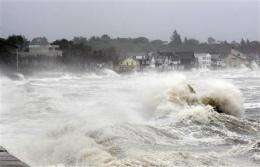
(AP) -- Hurricane Irene was no mystery to forecasters. They knew where it was going. But what it would do when it got there was another matter.
Predicting a storm's strength still baffles meteorologists. Every giant step in figuring out the path highlights how little progress they've made on another crucial question: How strong?
Irene made landfall Saturday morning at Cape Lookout, N.C. - a bull's-eye in the field of weather forecasts. It hit where forecasters said it would and followed the track they had been warning about for days.
"People see that and assume we can predict everything," National Hurricane Center senior forecaster Richard Pasch said.
But when Irene struck, the storm did not stick with the forecast's predicted major hurricane strength winds.
"It's frustrating when people take our forecasts verbatim and say, `This is where it's going to be at this time and this is how strong it's going to be,'" Pasch said. "Because even though the track is good it's not certain."
But it's getting there.
By Monday night, five days before Irene first hit the East Coast, the hurricane center figured the storm would come ashore around the North Carolina-South Carolina border. By Tuesday night, they predicted it would rake the coast. And on Friday morning - 24 hours before landfall - they had the storm's next day location to within 10 miles or so.
Twenty years ago, 24-hour forecasts were lucky if they got it right within 100 miles and the average 36-hour forecast within 146 miles. With Irene, that was about the accuracy of the five-day forecast.
"This is a gold medal forecast," retired hurricane center director Max Mayfield said. "I don't think there's any doubt: I think they saved lives."
The current director, Bill Read, tried not to sound boastful: "In the big picture of things, it looks like it panned out very well."
There are two reasons for the steady improvement in forecasts: Better computer models and better data to go into those models. With Irene, the National Oceanic and Atmospheric Administration spent extra money with jet flights and weather balloons across the country to get far more data than usual and it paid off in even better forecasts, Mayfield said.
Irene also was the type of storm that chugs off of Africa that is pretty simple to forecast accurately, said Georgia Tech meteorology professor Judith Curry, who makes private forecasts for energy interests with her firm Climate Forecast Applications Network.
Storms in the Gulf of Mexico are much more fickle, with weaker and less obvious steering currents. In 1985, Hurricane Elena caused evacuation chaos as it threatened to hit western Florida twice, but never did so.
On the negative side, the forecast after Irene hit the Bahamas had it staying as a Category 3 and possibly increasing to a Category 4. But it weakened and hit as a Category 1 storm and stayed that way up the coast until it faded into a tropical storm by the time it reached New York City. It lost strength as it moved north over land and cooler water.
Read said they will go back and figure out what happened, but noted they have made huge strides in projecting where a hurricane will hit. In past storms, they would have issued warnings for Florida, Georgia and South Carolina, but there were no evacuations there for Irene.
"We're not completely sure how the interplay of various features is causing the strength of a storm to change," Read said.
One theory is that a storm's strength is dependent on the storm's inner core. Irene never had a classic, fully formed eye wall - even going through the Bahamas as a Category 3.
"Why it did that, we don't know," Read said. "That's a gap in the science."
Georgia Tech's Curry said one of the main problems is that the giant global computer models that do so well forecasting the track require large scale data. The keys to intensity changes are usually too small for big computer models, she said.
Mayfield says what's needed is better real-time, small-scale information, like Doppler radar. NOAA used old propeller planes to take Doppler radar data inside Irene, but the information will be used to design better intensity forecasts in the future, he said.
And when it comes to damage from Irene, the problem wasn't wind strength, but storm surge and flooding, which was the message from forecasters all week long.
Given that the accuracy of forecasting intensity has not changed much at all in 20 years, Keith Seitter, executive director of the American Meteorological Society, said he thought the strength forecast was pretty good.
More information:
National Hurricane Center: http://www.nhc.noaa.gov/
Track forecasts for Irene: http://tinyurl.com/3goe2dr
Intensity forecasts for Irene: http://tinyurl.com/3vl9fvl
©2011 The Associated Press. All rights reserved. This material may not be published, broadcast, rewritten or redistributed.


