Ion Armageddon: Measuring the impact energy of highly charged ions
August 31, 2011 By Mark Esser

Measuring the impact energy of highly charged ions

Enlarge

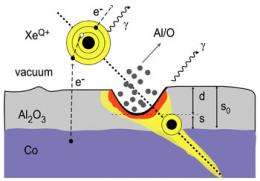
A schematic detailing the various ways that the energy of highly charged ions is dissipated during an impact. Approximately 60 percent of the ion’s energy is blown back and, according to NIST measurements, 27 percent of the remaining 40 percent goes into deforming the material—making a crater or “divot”. Credit: NIST

(PhysOrg.com) -- Much like a meteor impacting a planet, highly charged ions hit really hard and can do a lot of damage, albeit on a much smaller scale. And much like geologists determine the size and speed of the meteor by looking at the hole it left, physicists can learn a lot about a highly charged ion's energy by looking at the divots it makes in thin films.

Building upon their work for which they were recently awarded a patent,* scientists at the National Institute of Standards and Technology (NIST) and Clemson University have measured the energy of highly charged ion impacts on a thin film surface for the first time in detail.** Understanding how discharge their energy upon impact will help researchers to make better predictive models of how the particles affect surfaces.

The question isn't trivial. Ions are used in exactly that way for a variety of micro- and production processes, techniques such as ion milling and etching. Better predictive models may also help researchers curtail ionic erosion where it would be a bad thing, such as inside a .

The research team used from which they had stripped all but 10 of the atoms' original 54 electrons. Making an atom so highly ionized takes a lot of energy—about 50,000 electron volts. The atom soaks up all the energy that went into freeing the until it is capable of imparting more energy, and thus more damage, than could be done with kinetic energy—mass and speed—alone.

"When the highly charged ion is finally released and hurtles into its target, most of its energy, about 60 percent, blows back in the 'splash' and dissipates into the vacuum," says Josh Pomeroy. "According to our measurements, 27 percent of the remaining 40 percent of the ion's energy goes into changing the shape of the material—making divots."
Pomeroy says that the remaining 13 percent is most likely converted to heat.

The group first began looking into nanoscale pitting of thin films to help improve the performance of data storage hard drives, which used aluminum oxide as an insulator between magnetic plates. They used ions to pockmark the surface of these films and showed that the depth of the pitting could be determined by measuring minute changes in electrical conductance through the film.

The original motivation for the work has abated, but the group's method and materials remain useful for measuring the energy transfer of highly charged ions and calibrating industrial systems using high-energy ion beams.

More information: United States Patent 7,914,915, "Highly charged ion modified oxide device and method of making same." Inventors: J.M. Pomeroy, et al. Issued March 29, 2011.

R.E. Lake, et al. Charge state dependent energy deposition by ion impact. Physical Review Letters. August 5, 2011. http://prl.aps.org … /i6/e063202.

Provided by National Institute of Standards and Technology search and more info website

Filter


Move the slider to adjust rank threshold, so that you can hide some of the comments.


Display comments: newest first

El_Nose
Sep 01, 2011

Rank: not rated yet
So is this for the examination of tokamak fusion reactor walls?
Rank 5 /5 (3 votes)
Relevant PhysicsForums posts
  • Water flow question
    created55 minutes ago
  • [Drift velocity] Factors affecting velocity
    created3 hours ago
  • does cold gasoline have less energy
    created4 hours ago
  • distribution of molecules throughout the atmosphere
    created6 hours ago
  • The Global Positioning System !
    created7 hours ago
  • A Question relating Power
    created8 hours ago
  • More from Physics Forums - General Physics

More news stories

Is a classical electrodynamics law incompatible with special relativity?

(Phys.org) -- The laws of classical electromagnetism that were developed in the 19th century are the same laws that scientists use today. They include Maxwell’s four equations along with the Lorentz la ...

Physics / General Physics

created May 24, 2012 | popularity 4.7 / 5 (17) | comments 42 | with audio podcast feature

Landmark calculation clears the way to answering how matter is formed

(Phys.org) -- An international collaboration of scientists, including Thomas Blum, associate professor of physics, is reporting in landmark detail the decay process of a subatomic particle called a kaon – ...

Physics / General Physics

created May 25, 2012 | popularity 4.2 / 5 (21) | comments 48 | with audio podcast

Lying in wait for WIMPs: Researchers seek to dramatically increase sensitivity of Large Underground Xenon detector

Although it's invisible, dark matter accounts for at least 80 percent of the matter in the universe. No one knows what it is, but most scientists would bet on weakly interacting massive particles, or WIMPs.

Physics / General Physics

created May 23, 2012 | popularity 4 / 5 (7) | comments 15 | with audio podcast

Hawaii lab turns laser-powered bubbles into microrobots

(Phys.org) -- A team of scientists from the University of Hawaii are working on microrobots created from bubbles of air in a saline solution. The bubbles take on their title of “robots” as a laser ...

Physics / General Physics

created May 23, 2012 | popularity 5 / 5 (4) | comments 2 | with audio podcast weblog

Sound increases the efficiency of boiling

Scientists at the Georgia Institute of Technology achieved a 17-percent increase in boiling efficiency by using an acoustic field to enhance heat transfer. The acoustic field does this by efficiently removing vapor bubbles ...

Physics / Soft Matter

created May 24, 2012 | popularity 5 / 5 (2) | comments 2


Nvidia trumpets Tegra 3 phone design wins for 2012

(Phys.org) -- Nvidia’s competitive war paint has a name, Tegra 3. On the heels of Nvidia announcements about lowering costs of its Tegra 3 processors and Nvidia-enabled tablets running Android Ice Cream ...

Browser wars flare in mobile space

The browser wars are heating up again, but this time the fight is for dominance of the mobile Internet.

Scientist: Evolution debate will soon be history

(AP) -- Richard Leakey predicts skepticism over evolution will soon be history. Not that the avowed atheist has any doubts himself.

Dell tablet leak: 10.1-inch display, two-battery choice

(Phys.org) -- Headline after headline talks about vendors’ tablets in the wings as likely number-one contenders for the iPad. Such claims have justifiably been taken with a grain of salt, considering ...

Keep food safety in mind this memorial day weekend

(HealthDay) -- Picnics, parades and cookouts are as much a part of Memorial Day weekend as tributes to the United States' war veterans.

Social welfare cuts ultimately come with heavy price, researchers say

(Phys.org) -- Slashing government funding for Medicaid, food stamps and other programs that serve the poor – while politically popular with some lawmakers and many conservatives – may do more harm ...